
//CCDC 32 and the New Design-Build Suite: Three Clauses Owners Should Not Sign As-Is
CCDC 32 and the New Design-Build Suite: Three Clauses Owners Should Not Sign As-Is
In spring 2026 the Canadian Construction Documents Committee released four documents at once: revised versions of CCDC 14 and CCDC 15, and two entirely new forms — CCDC 32 for progressive design-build, and CCDC 33 for the consultant agreement that sits underneath it.
It is the first change to the design-build suite since 2013. Thirteen years is long enough that most owners are negotiating from memory rather than from the current text, and the gap between the two is where the commercial risk now sits.
This article covers what changed, and the three provisions an owner should address in supplementary conditions before signing.
What the CCDC released in 2026
Four documents, one release:
- CCDC 14 (2026) — Design-Build Stipulated Price Contract, revised
- CCDC 15 (2026) — Design Services Contract between Design-Builder and Consultant, revised
- CCDC 32 (2026) — Progressive Design-Build Contract, new
- CCDC 33 (2026) — Progressive Design-Build Service Contract between Design-Builder and Consultant, new
The headline is CCDC 32, because it is the first standardised Canadian form for progressive design-build. But CCDC 14 was revised in the same release, with new limitation of liability provisions covering both insurable and uninsurable risk. An owner running conventional design-build is also working from a contract that changed this spring.
How progressive design-build works under CCDC 32
Progressive design-build separates the project into two phases inside a single contract.
Phase 1 — Project Development Phase. Pre-construction services: design development, cost estimating, scheduling and risk analysis, performed on an open-book, cost-plus basis. Procurement focuses on qualifications and collaborative capability rather than price.
Phase 2 — Design/Construction Phase. Proceeds only after the owner accepts the Final Project Proposal, converting the arrangement to a stipulated price.
CCDC 32 formalises the transition through defined Project Gates — interim decision points where the design-builder submits progressively refined proposals on scope, cost and schedule. Pricing accuracy is tied to design maturity through standardised CCDC Class D to Class A estimates. The form also standardises an Early Work Authorization mechanism, allowing discrete construction packages to proceed before full price agreement.
The structural difference from common market practice is that everything sits in one contract from day one. Many bespoke progressive design-build arrangements use a separate development-phase agreement, then negotiate a distinct construction contract later. CCDC 32 prioritises continuity; the trade-off is that the commercial terms for Phase 2 are agreed before anyone knows what Phase 2 costs.
The $250,000 default in CCDC 33
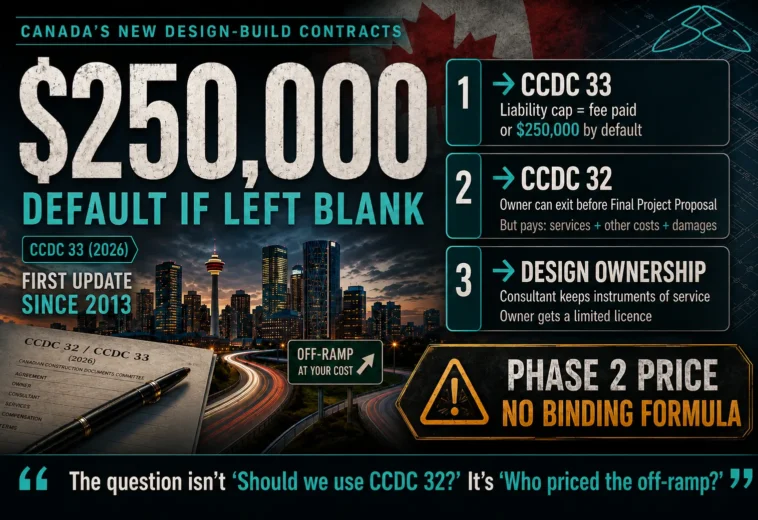
CCDC 33 caps the consultant’s liability at the amount paid for professional services. If that amount is not set in the contract, the cap defaults to $250,000.
The blank field is the default. On a project where design services are procured early and the fee is still being scoped, the number can easily be left open and never revisited.
This matters because the exposure it limits is asymmetric. The cost of correcting a design error during construction is a function of the project, not of the design fee. A cap tied to the fee — or worse, to a fixed $250,000 — sets the recovery ceiling at a level that has no relationship to the loss.
CCDC 32 separately limits liability for design services to claims arising from the errors, omissions or negligence of the consultant or other consultants where covered by insurance, to those insurance limits. What happens when a claim falls outside coverage is not addressed.
What to do: set the cap explicitly, and address uninsured and uninsurable claims as a separate question from insured ones.
The off-ramp is real, and it is not free
CCDC 32 gives the owner a clear exit: the right to terminate before acceptance of the Final Project Proposal, with no obligation to proceed to Phase 2. Unlike some other progressive design-build forms, it grants the design-builder an equivalent right.
What it does not do is state what the design-builder is owed when the owner exercises that right. The entitlement is to payment for services performed, together with “such other costs and damages sustained.” That is an open formula.
For the design-builder, the total compensation for significant early-stage effort is uncertain. For the owner, the size of a termination-for-convenience claim is equally opaque. Purpose-drafted progressive design-build agreements typically fix this with an express, pre-negotiated compensation entitlement.
What to do: price the off-ramp in the contract. A defined amount, or a defined method, agreed before Phase 1 starts.
Who owns the design
CCDC 32 follows CCDC 14 on intellectual property: the consultant retains ownership of the instruments of service, and the owner receives a limited licence.
Read alongside the off-ramp, this changes what the exit is worth. An owner who funds the entire development phase and then declines to proceed may not have the right to transfer the design to another contractor. The absence of detailed step-in or assignment provisions tied to a Phase 1 exit compounds the problem: without a mechanism to assign the consultant agreement and continue using the deliverables, the owner faces loss of continuity and duplicated effort.
The practical effect is commercial pressure to accept the Final Project Proposal rather than lose the work already paid for.
What to do: negotiate expanded intellectual property rights and an assignment mechanism at the outset, not at the point of exit.
There is no binding formula for the Phase 2 price
This is the provision that ties the others together.
CCDC 32 permits the design-builder to terminate for convenience at any point before the Final Project Proposal is accepted. At the same time, the form does not meaningfully define how the design-builder sets that price. There is no binding formula, no objective pricing mechanism, no enforceable methodology, and no obligation on either party to reach agreement.
A conventional progressive design-build agreement would not allow the design-builder to exit before submitting a proposal, and would guide the cost and time in that proposal through a pre-negotiated formula. Without those guard rails, the owner can spend the entire development phase and arrive at a price with no contractual basis to test it against — and limited ability to walk away, given the intellectual property position.
Open-book pricing is intended to solve this through transparency. In practice it often shifts the burden: owners engage their own consultants to shadow-estimate the design-builder’s numbers, which erodes the efficiency the collaborative model was supposed to deliver.
What to do: agree the pricing methodology for Phase 2 in supplementary conditions, and restrict the design-builder’s right to exit before submitting a proposal.
What this means for owners in Alberta
Progressive design-build has been used in Canada since around 2020, mainly on complex transportation and healthcare work. The known public users are Infrastructure BC, Infrastructure Ontario and Metrolinx, along with the cities of Moose Jaw and Regina on the Buffalo Pound Water Treatment Plant renewal.
None of them are in Alberta. There is no published statistic on progressive design-build adoption in the province.
For an Alberta owner, that means two things. The model is available and now has a standard form behind it, which lowers the barrier to using it. And there is no local precedent to copy supplementary conditions from — the first owners here will be drafting rather than adapting.
CCDC 32 is a reasonable starting point. It is not a finishing point. The provisions above are the ones that determine what an owner is actually buying, and none of them resolve themselves in the standard text.
This article summarises published legal commentary on the 2026 CCDC documents and is not legal advice. Before relying on any provision described here, review the contract text itself and take advice specific to your project.
Frequently asked questions
What is CCDC 32?
CCDC 32 (2026) is the Canadian Construction Documents Committee’s standard form contract for progressive design-build. It is the first standardised Canadian form for this delivery model, released in spring 2026 alongside CCDC 33, and revised versions of CCDC 14 and CCDC 15.
How is progressive design-build different from design-build?
In conventional design-build the price is fixed upfront with limited owner involvement. Progressive design-build splits the work into a Phase 1 development period on an open-book basis, and a Phase 2 construction period at a fixed price agreed only after the design has advanced.
What is the liability cap in CCDC 33?
CCDC 33 caps the consultant’s liability at the amount paid for professional services. If no amount is set in the contract, the cap defaults to $250,000.
Can an owner exit a CCDC 32 contract before construction?
Yes. CCDC 32 allows the owner to terminate before accepting the Final Project Proposal. The design-builder has an equivalent right. The form does not, however, specify the compensation owed on exit, which is why the amount or method should be agreed in supplementary conditions.
Who owns the design under CCDC 32?
The consultant retains ownership of the instruments of service; the owner receives a limited licence. An owner who wants the right to transfer the design to another contractor should negotiate expanded intellectual property rights before signing.
Sources
- BLG — New CCDC Progressive Design-Build Contract (the CCDC 32)
- Fasken — Redefining Design-Build: Key Updates in CCDC 14 (2026) and the Launch of CCDC 32 (2026)
- Osler — CCDC releases 2026 documents for design-build and progressive design-build contracting
- Clark Wilson — Key Updates to CCDC Design-Build Suite
- 155 views
- 1 Comment

Eros Belotti 01.

Eros belotti
Construction project manager with over 20 years of experience in Europe and the Canary Islands. Specialized in modular housing, container construction, real estate development and international project management. Founder of Reforma Vivienda Tenerife and Donkey Lab.




August 25, 2026 /
Sources, if you want to read the analysis yourself:
→ BLG on CCDC 32, gates and the off-ramp: https://www.blg.com/en/insights/2026/06/new-ccdc-progressive-design-build-contract-the-ccdc32
→ Fasken on the CCDC 14 changes and the CCDC 32 launch: https://www.fasken.com/en/knowledge/2026/06/redefining-design-build-key-updates-in-ccdc
→ Osler on the full 2026 release: https://www.osler.com/en/insights/blogs/construction/ccdc-releases-2026-documents-for-design-build-and-progressive-design-build-contracting/
→ Clark Wilson on all four documents side by side: https://www.cwilson.com/key-updates-to-ccdc-design-build-suite-ccdc-14-2026-ccdc-15-2026-and-the-new-ccdc-32-2026-and-ccdc-33-2026/
One thing I left out of the post, because it widens the problem.
CCDC 32 is the new contract everyone is talking about. But CCDC 14 was revised in the same release — new limitation of liability provisions covering both insurable and uninsurable risk.
So you don’t have to be doing progressive design-build for this to reach you. If you run conventional design-build, your contract also changed this spring, for the first time since 2013.
The other gap: the known users of the progressive model in Canada are Infrastructure BC, Infrastructure Ontario, Metrolinx, and Moose Jaw and Regina on Buffalo Pound. None of them in Alberta.
Which means the first owners here to use CCDC 32 will be writing their supplementary conditions without a provincial precedent to copy from.
If you’re one of them, I’d be interested in what you added.