
Alberta Construction Costs 2026: The Costly Escalation Mistake
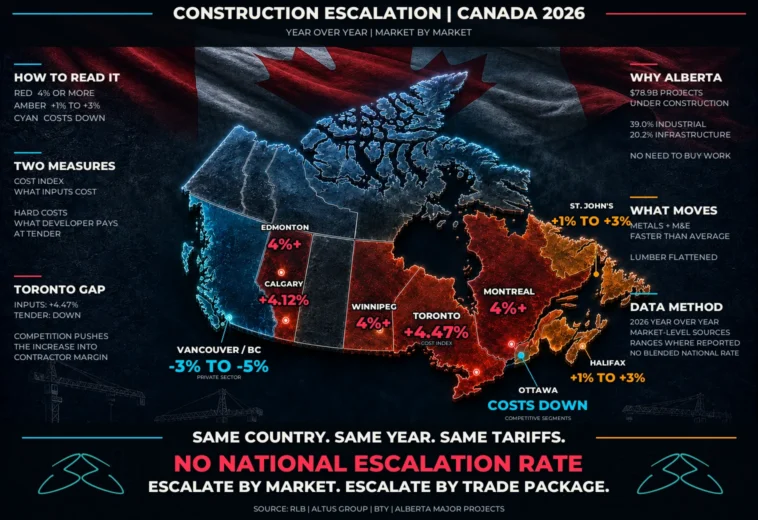
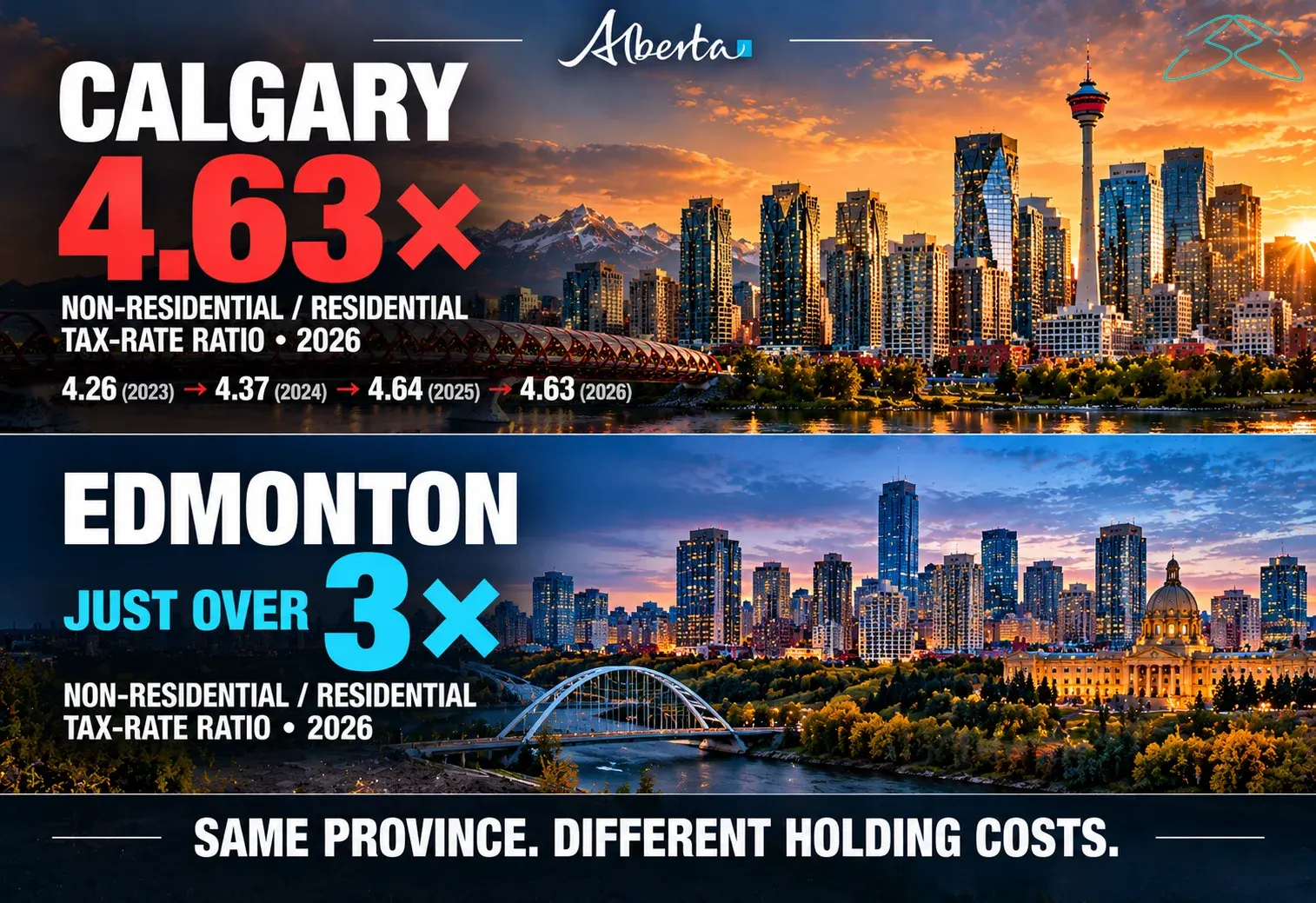
Alberta construction costs rose 4.12% in Calgary this year. In British Columbia, private sector costs fell 3 to 5%. Same country, same year, same tariffs.
Canadian construction costs split in two directions in 2026, and the split runs almost exactly along the line separating markets with work from markets without it. Altus Group put it bluntly in this year’s Cost Guide: national averages will tell you less than ever in 2026.
If you are underwriting a project here and carrying a single national escalation rate, that number is describing someone else’s market. Here is what Alberta construction costs are actually doing, and what to use instead.
Alberta construction costs versus the rest of Canada in 2026
| Market | Change | Direction | Driver |
|---|---|---|---|
| Calgary | +4.12% YoY | Up | Healthcare and institutional work, specialised trades, evolving green code standards |
| Edmonton | 4% or more | Up | Same drivers as Calgary; low-rise residential and renovation also rising |
| Montreal | 4% or more | Up | Quebec labour agreement locked in 8%, 5%, 5% and 4% over four years |
| Winnipeg | 4% or more | Up | Metals and mechanical/electrical components; institutional design standards rising |
| Halifax / St. John’s | 1-3% | Up | Thin labour supply; trades drawn toward central Canada |
| Toronto | +4.47% index / falling at tender | Both | Few new residential starts, highly competitive bidding, M&E pricing flat |
| Ottawa | Declining in competitive segments | Down | More competition on schools and apartments; local lumber, rebar and aluminum eased |
| BC private sector | -3% to -5% | Down | Condo slowdown; fewer towers, fewer parkade levels, trades competing for scarce work |
Toronto went up and down at the same time
The most useful number in this table is the one that contradicts itself.
RLB reports Toronto at +4.47% year over year. Altus Group reports Toronto hard costs coming down. Neither is wrong. They are measuring different things.
- RLB publishes a construction cost index, the basket of inputs, materials and labour. That basket is rising almost everywhere, because metals are rising almost everywhere.
- Altus and BTY report what a developer actually pays at tender. In Toronto and Vancouver, that number is falling.
The gap between those two figures is largely contractor margin. In markets where too many builders chase too few projects, trades absorb the input increase to keep crews working. BTY reports BC private sector costs falling 3 to 5% this year, not because building became cheaper, but because bidding became competitive.
Those markets are not cheaper to build in. They are cheaper to buy in right now. That distinction matters, because one of those conditions transfers to your project and the other does not.
Why Alberta construction costs do not get that discount
The mechanism pushing Toronto and Vancouver prices down requires a shortage of work. Alberta does not have one.
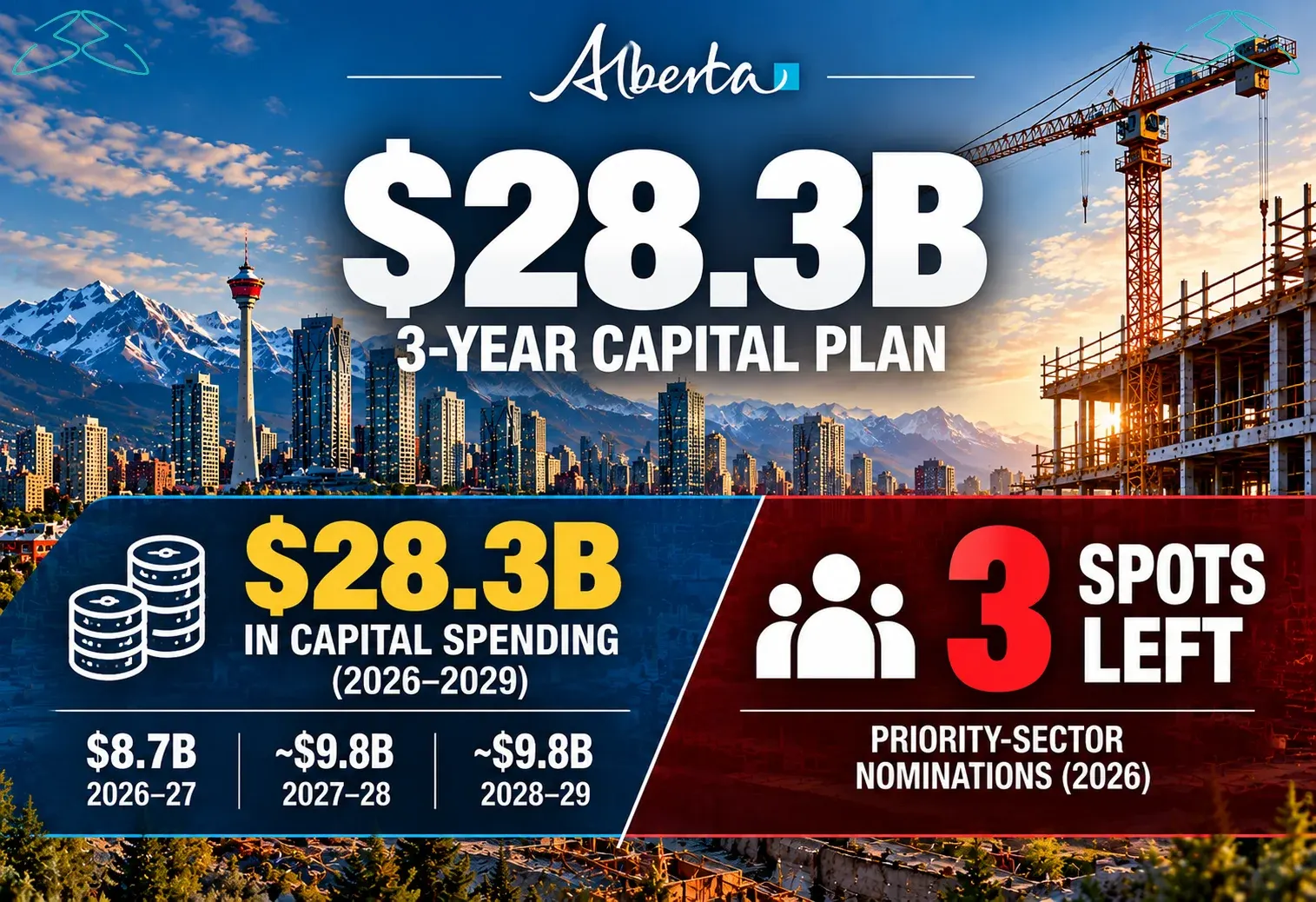
Capital projects under construction in the province total $78.9 billion, up from $73.3 billion a year earlier, with industrial accounting for 39.0% of projects and infrastructure 20.2%. Nobody in this market needs to buy work by cutting margin.
So the input increase, the same metals and the same tariffs everyone else faces, reaches an Alberta pro forma at full strength. There is no competitive discount sitting underneath it. This is the single most misunderstood thing about Alberta construction costs right now: the province is not expensive, it is simply the market where nobody is discounting.
Altus also flags skilled labour shortages as the biggest risk to price volatility in Alberta for 2026, and not only through wages. Reduced bid competition and schedule risk push cost up indirectly, in ways a rate-based escalation assumption never captures.
Inside the average: metals versus lumber
Even the provincial number is a blend, and the blend hides the packages that actually break budgets.
Headline Canadian construction inflation is running at 3 to 4% for 2026. Underneath it, quarter-over-quarter movements in early 2026 looked like this:
- Copper: +14%
- Aluminum: +11%
- Diesel: +11%
- Flat steel: +18%, forecast rather than actual
Meanwhile lumber and wood products have softened as post-pandemic oversupply normalised. Metals are the dominant pressure on Alberta construction costs nationwide, and that includes the large share of mechanical and electrical materials built around them.
A contingency applied evenly across a project therefore over-covers finishes and under-covers the mechanical and electrical packages, which are also the packages most likely to sit on the critical path.
What Alberta construction costs mean for your feasibility model
Escalate by market, not nationally. A benchmark taken from a 2025 Toronto project is wrong twice over here: wrong on level, and wrong on direction. A national average blends a distressed market with a busy one and describes neither.
Escalate by trade package, not by project. Split the assumption at minimum between metals-heavy scopes, mechanical and electrical, and everything else. A single project-wide rate is not conservative, it is arithmetically wrong in both directions at once.
Treat labour as a schedule risk, not only a rate. Where skilled trades are scarce, the cost appears as re-sequencing, standby and prolongation long before it appears as a higher hourly rate, and those land in general conditions rather than in the trade package your contingency was built against.
A note on the numbers
RLB, Altus Group and BTY use different methodologies and different scopes. They appear here as three separate measurements of the same market, not as a single series. The divergence between them is the point of this article, not a flaw in it.
Altus does not publish a point percentage for Edmonton, Montreal or Winnipeg; the published threshold is “4% or more” and should not be converted into a decimal. The reading that the gap between index and tender pricing is contractor margin is my interpretation of the mechanism, not a statement by either firm.
Sources
- RLB, Construction Cost Report Canada Q2 2026
- RLB, Construction Cost Report Canada Q1 2026
- Altus Group, 2026 Canadian Cost Guide insights
- Business in Vancouver, BC residential construction costs fall (BTY Group)
- Storeys, Construction costs stabilized in 2025 (BTY Group)
- Linesight, Construction Market Insights Americas, June 2026
I work in pre-construction and feasibility on Alberta projects, covering surveys, CAD, cost planning and development analysis. If you are building an escalation assumption for 2027 and want a second read on it, my inbox is open.
- 134 views
- 0 Comment

Eros Belotti 01.

Eros belotti
Construction project manager with over 20 years of experience in Europe and the Canary Islands. Specialized in modular housing, container construction, real estate development and international project management. Founder of Reforma Vivienda Tenerife and Donkey Lab.