

//Alberta Capital Plan: $28.3B Scheduled, 3 Nomination Spots Left for Construction Talent
Alberta Capital Plan: $28.3B Scheduled, 3 Nomination Spots Left for Construction Talent

Tags : AAIPAlbertaAlberta Capital PlanApprenticeshipBudget 2026construction labourConstruction ManagementInfrastructureskilled tradesworkforce planning
The Alberta capital plan sets $28.3 billion in spending over three years. The main provincial channel for bringing in construction talent has 3 spots left.
That is the gap contractors, developers and project managers need to plan around in 2027.
Alberta’s Budget 2026 capital plan commits $28.3 billion over three years: $8.7 billion in 2026–27, and about $9.8 billion a year in each of the following two years (my arithmetic from the published total). In Calgary, the City has raised its infrastructure spending to $3.8 billion for 2026, according to LiveWire Calgary, while its long-term infrastructure funding gap is measured in tens of billions.
These are spending forecasts, not awarded contracts. But they set the pace of the next bid cycle. The question is whether the workforce will be there to deliver them.
Table of Contents
- The Alberta Capital Plan: What Is Scheduled
- The Provincial Nomination Channel Is Nearly Full
- Construction Draws Are Small and Processing Is Slow
- Federal Supply Is Tightening
- The Domestic Pipeline Is Not the Limit
- Three Moves for Contractors
1. The Alberta Capital Plan: What Is Scheduled
The Alberta capital plan for 2026–2029 includes, according to the province:
- $7.1 billion for municipal infrastructure
- $4.9 billion to expand health care capacity
- $4.2 billion for maintenance and renewal of existing infrastructure
- $3.3 billion for new and ongoing school projects
- $2.7 billion for provincial highways, bridges and roads
This is institutional, civil and public-sector work: hospitals, schools, roads and municipal systems. It requires the same trades that the private market already competes for, from electricians and pipefitters to equipment operators and site supervisors.
I looked at how Alberta’s capital is weighted toward construction in Alberta Capital Investment 2026: Construction Up, Machinery Down vs BC. The public capital plan adds to that demand.
2. The Provincial Nomination Channel Is Nearly Full
Now the labour side.
According to the Alberta Advantage Immigration Program (AAIP) processing information:
- AAIP has 6,603 nominations for 2026.
- By October 7, 5,541 had been issued, or 84%.
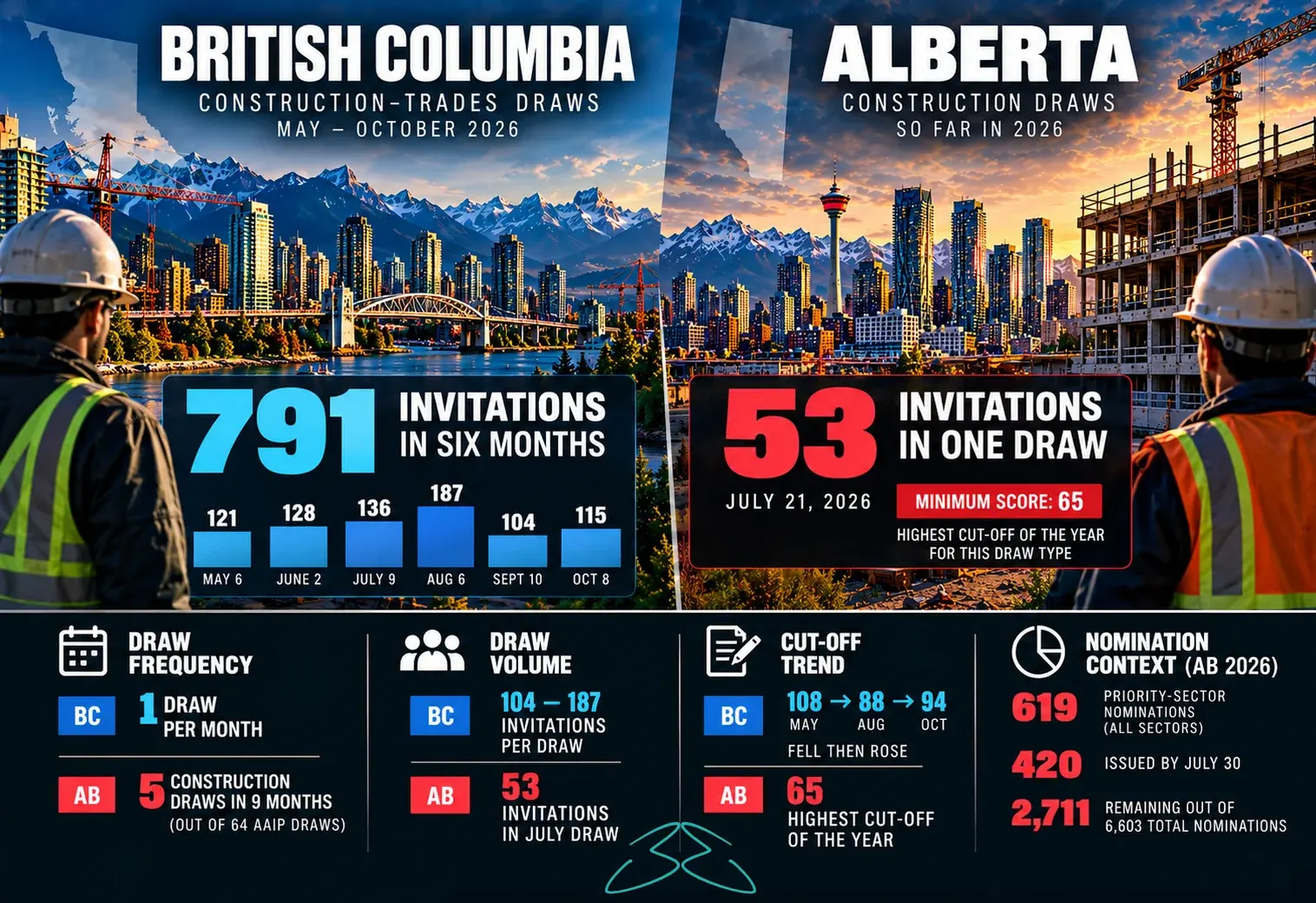
- The priority-sector stream, where construction draws are run, has 619 spots: 616 issued, 3 left.
There is no dedicated construction stream. Construction competes with other priority sectors for the same, almost exhausted allocation.
3. Construction Draws Are Small and Processing Is Slow
Small draws
Alberta ran four construction draws between February and May, with 50, 109, 50 and 50 invitations (minimum scores 59–61), plus 53 in July. That is about 312 invitations in total.
By comparison, British Columbia ran six construction draws from May to October for 791 invitations. The scoring systems differ, so compare volumes, not scores. I covered the comparison in detail in Construction Immigration Draws 2026: BC vs Alberta.
Slow processing
On October 7, AAIP was still assessing priority-sector applications received by July 6. That is a 93-day lag before work permits, relocation and onboarding even begin.
A crew you plan today for a 2027 start is already late.
4. Federal Supply Is Tightening
The federal 2026–2028 Immigration Levels Plan continues to reduce temporary resident arrivals:
- Temporary resident arrivals: from 385,000 in 2026 to 370,000 in 2027 and 2028.
- Provincial nominees across Canada: 91,500 in 2026, so Alberta’s 6,603 is about 7% of the national total.
- Transition measure: a one-time pathway for up to 33,000 work permit holders is planned for 2026–27, with no published split for the trades.
Fewer temporary workers arriving, and a fixed provincial allocation already almost used, mean immigration cannot absorb a sudden increase in construction demand.
5. The Domestic Pipeline Is Not the Limit
The domestic side tells a different story.
Alberta reached a record 72,748 registered apprentices in 2024–25, according to the Apprenticeship and Industry Training Registrar’s Report. Yet none of the 13 training providers fills all its seats.
The capacity exists. It is not being fully used.
Immigrants were about 23% of construction workers in 2024, so both channels matter. But only one of them is currently constrained by a quota.
What I cannot tell you is the total labour gap. No clean public number exists for the number of construction workers the capital plan will require versus those available. What the data does show:
- The money is scheduled.
- The fastest immigration channel is almost closed.
- Training seats are going unfilled.
This follows the pattern I described in the September 2026 Alberta labour market update: aggregate employment can grow while specific skills remain hard to secure.
6. Three Moves for Contractors
For a contractor bidding into the Alberta capital plan, three practical moves:
- Plan crews before the bid, not after the award. Include workforce availability in the go/no-go decision and in the schedule assumptions of every tender.
- Treat apprentice intake as a pipeline decision. Apprentices registered this year are the journeypersons of 2029 and beyond. Intake should follow the bid pipeline, not current workload.
- Ask for a dedicated construction line in provincial nominations. Through industry associations, make the case that a $28.3 billion capital program needs a predictable immigration channel of its own.
Money Is Scheduled. Crews Are Not.
The Alberta capital plan provides a clear signal of public construction demand through 2029. The labour channels to deliver it are uneven: the provincial nomination stream is almost full and slow, federal supply is tightening, and domestic training capacity is not fully used.
For contractors and project managers, workforce planning is no longer an HR task after the contract is signed. It is part of pre-construction.
How are you planning crews for work you haven’t won yet?
Sources: Government of Alberta, Budget 2026 Capital Plan; AAIP processing information (October 7, 2026); IRCC 2026–2028 Immigration Levels Plan; Alberta Apprenticeship and Industry Training Registrar’s Report 2024–2025.
- 4 views
- 1 Comment

Eros Belotti 01.

Eros belotti
Construction project manager with over 20 years of experience in Europe and the Canary Islands. Specialized in modular housing, container construction, real estate development and international project management. Founder of Reforma Vivienda Tenerife and Donkey Lab.

October 23, 2026 /
Sources, for anyone who wants to check the numbers:
• City of Calgary, Green Line revised Phase 1 (30 July 2024): $6.248B vs $5.543B approved in 2020. The move from Design-Build-Finance to multi-contracting is estimated to save about $600M.
https://newsroom.calgary.ca/green-line-lrt-moves-forward-with-a-revised-phase-1-project-and-capital-request-to-address-rising-costs/
• City of Calgary, “Year One” update (26 June 2026): 8 contracts awarded, $200M+ invested locally. Station construction contracts are expected later in 2026.
https://www.calgary.ca/green-line/green-line-news/article-engine/year-one-365-days-of-progress.html
Note: the cost figure dates from 2024. I could not find an updated 2026 total on the City’s pages.
Question for contractors and consultants in Calgary: when contracts are split into smaller packages, what do you need to see in a tender to decide it’s worth bidding?