
Office Vacancy in Calgary vs Edmonton: Same Province, Two Markets in Q3 2026
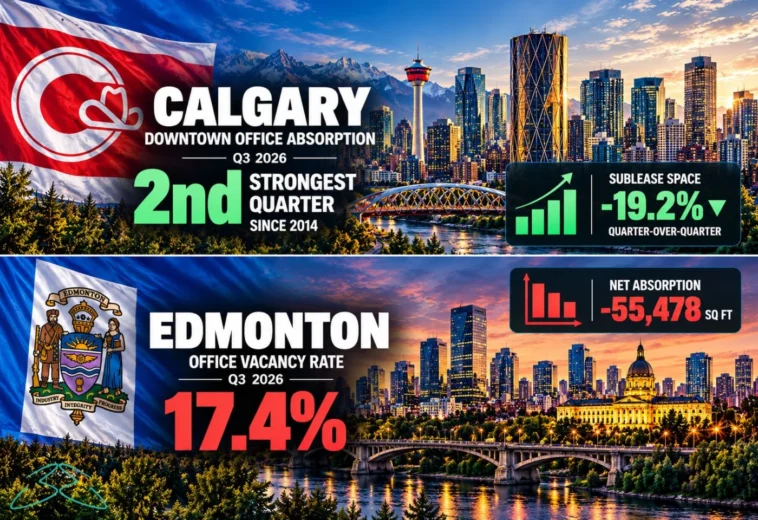
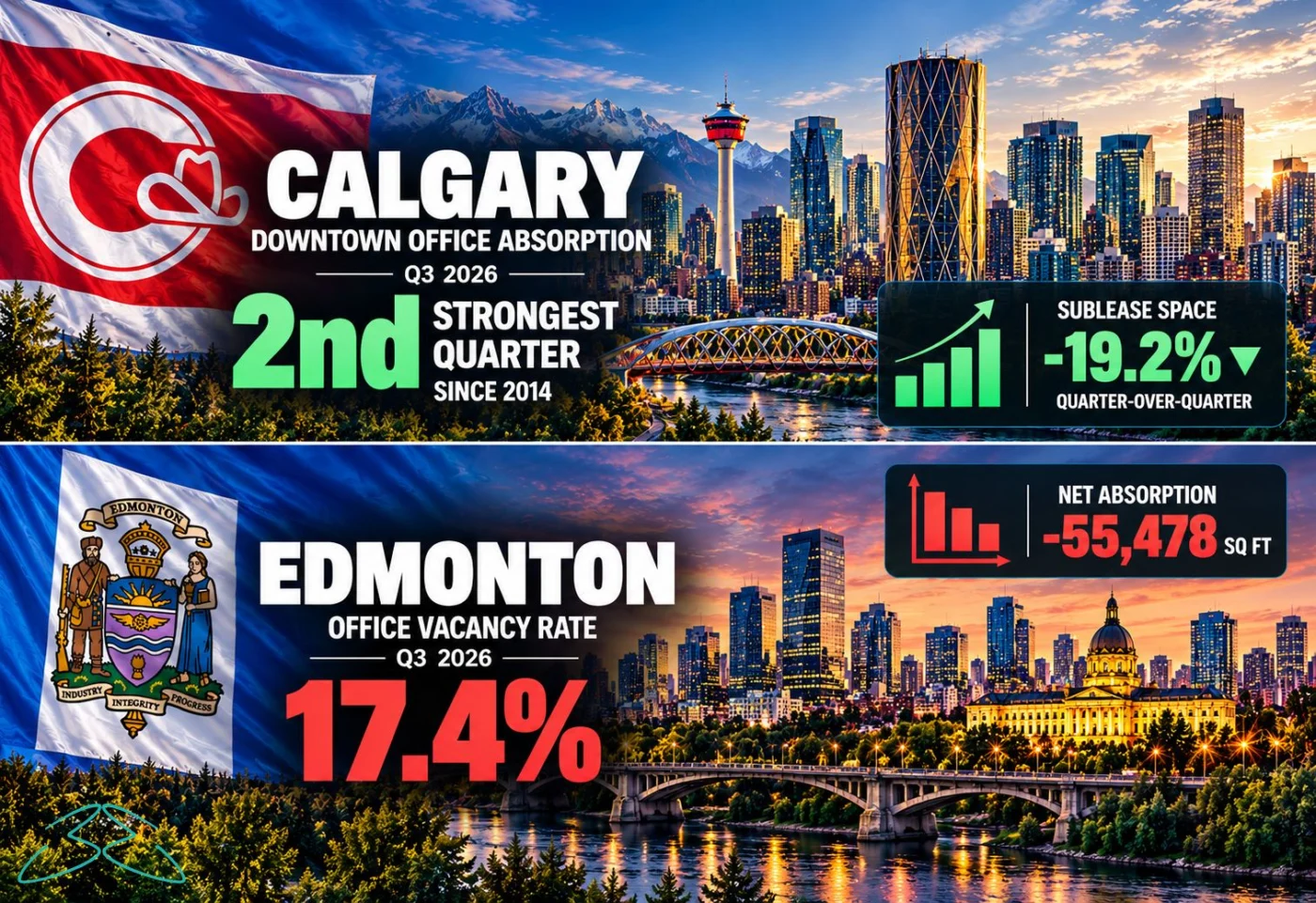
Office vacancy in Calgary and Edmonton is telling two very different stories in Q3 2026. Calgary just posted its second-strongest downtown office absorption quarter since 2014. Edmonton’s office vacancy is still 17.4%.
Same province. Same quarter. Two very different markets.
But the headline numbers only tell part of the story. Behind Edmonton’s high vacancy is a shortage of the space tenants actually want, and that changes how developers, owners and tenants should read the data.
Table of Contents
- Calgary: Downtown Office Demand Is Improving
- Edmonton: High Vacancy, Negative Absorption
- Why Office Vacancy Can Be Misleading
- The Right Question: How Much of the Right Space Is Available?
- Implications for Feasibility and Repositioning
1. Calgary: Downtown Office Demand Is Improving
In Calgary, downtown office demand is clearly recovering. According to CBRE’s Calgary Downtown Office Figures for Q3 2026:
- Net absorption: the second-strongest downtown quarter since 2014
- Sublease space: down 19.2% quarter-over-quarter
The drop in sublease space is particularly significant. Sublease listings are often the first space to return to the market when companies downsize, and the first to be absorbed when demand improves. A fall of nearly a fifth in one quarter suggests tenants are taking space rather than shedding it.
Calgary still carries a structurally high downtown vacancy rate after a decade of energy-sector restructuring, and the city’s office-to-residential conversion program continues to remove obsolete space from the inventory. But the direction has changed.
2. Edmonton: High Vacancy, Negative Absorption
Edmonton tells a different story. According to Colliers’ Edmonton Office Market Report for Q3 2026:
- Overall office vacancy: 17.4%
- Net absorption: negative, at about -55,478 sq ft for the quarter
On the surface, that looks like an oversupplied market with weak demand. But there’s an important detail behind the number.
3. Why Office Vacancy Can Be Misleading
In Edmonton, the problem isn’t simply “too much office space.” Good space is still hard to find.
Top-tier buildings have limited availability, and some larger tenants are being pushed toward lower-grade alternatives because the space they actually want isn’t available.
That changes how office vacancy should be interpreted. A 17.4% vacancy rate sounds like a market with plenty of choice. But if the vacant space doesn’t match what tenants need in terms of:
- Location: near transit, amenities and the talent pool,
- Size: contiguous floors for larger tenants,
- Quality: modern building systems, natural light and amenities,
- Specification: energy performance, accessibility and fit-out condition,
then the headline number becomes much less useful. A market can be oversupplied and undersupplied at the same time, depending on which segment you look at.
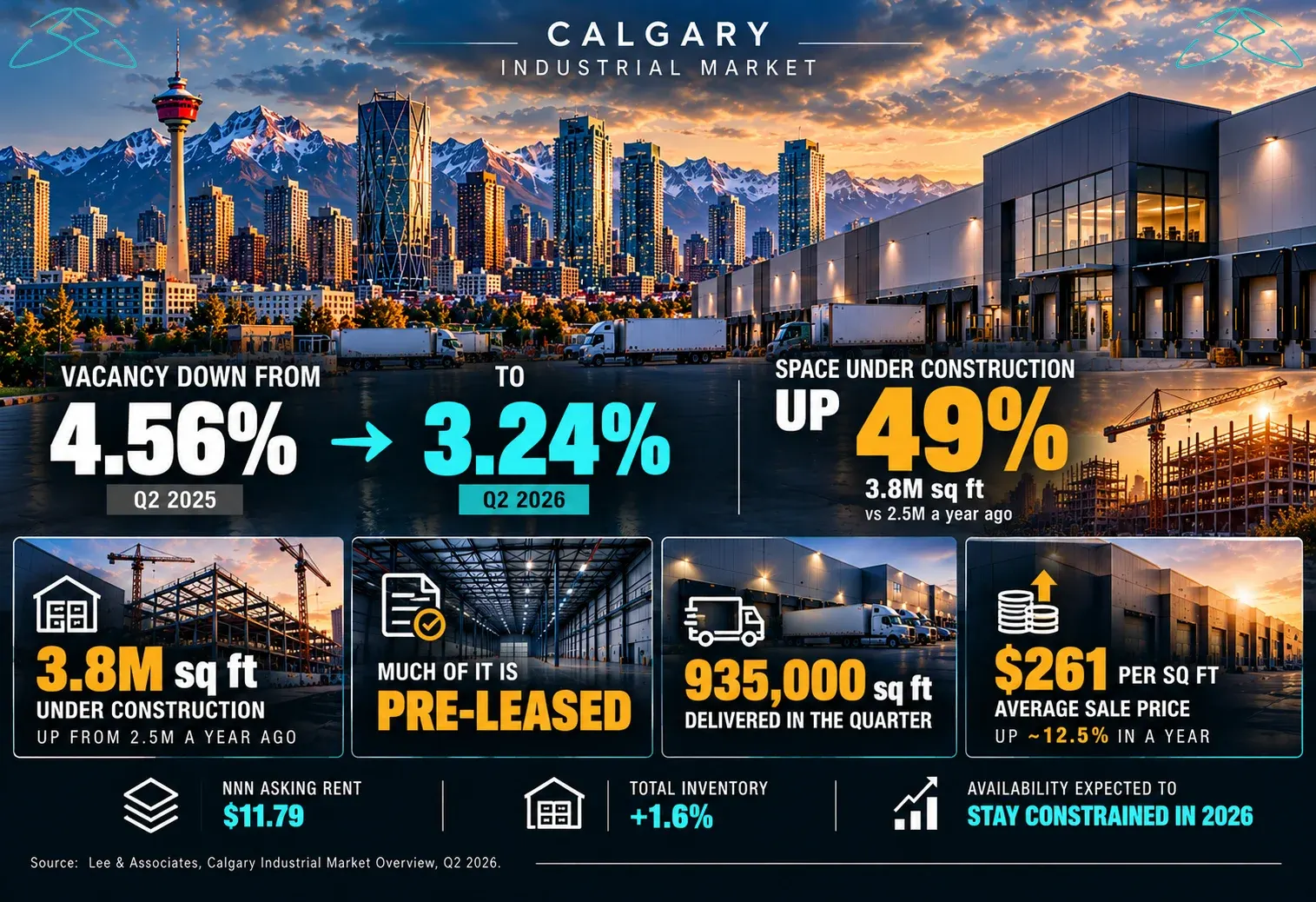
This is the same pattern we see across Alberta real estate: aggregate figures hide divergent sub-markets. I discussed a similar split in Calgary’s industrial market, where low vacancy coexists with a large pre-leased pipeline.
4. The Right Question: How Much of the Right Space Is Available?
Calgary and Edmonton are a good reminder that office vacancy is an average, not a description of the market a specific tenant faces.
One market is tightening. The other still has significant vacancy. But in both cases, the headline number only tells part of the story.
For developers, owners and tenants, the better question isn’t:
“How much office space is vacant?”
It’s:
“How much of the right office space is actually available?”
Answering that requires segmenting the market by building class, location, floor-plate size and tenant profile, rather than relying on a single citywide rate.
5. Implications for Feasibility and Repositioning
The distinction matters when assessing feasibility, repositioning an asset or deciding where to invest:
- New development: in Edmonton, a high overall vacancy rate does not necessarily rule out new high-quality space if top-tier availability is genuinely limited. The feasibility study should test demand by building class.
- Repositioning older buildings: lower-grade buildings in both cities face a choice between upgrading to compete for tenants, converting to another use, or accepting long-term vacancy. Upgrade costs must be compared with the rent premium achievable.
- Conversion: office-to-residential conversion can remove obsolete space and add housing, but only where the floor plate, structure and location support it.
- Tenant strategy: tenants in Edmonton should not assume a high vacancy rate gives them leverage on high-quality space. In Calgary, falling sublease availability means fewer discounted options.
- Investment: investors should underwrite at the building level, with specific attention to quality, location and capital expenditure requirements.
Construction costs also play a role in whether upgrades and new supply make sense. For the latest Alberta data, see Calgary vs Edmonton Construction Costs: 2026 Data.
Read Office Vacancy by Segment, Not by Headline
Calgary’s downtown office market is tightening, with strong absorption and falling sublease space. Edmonton still shows high overall vacancy and negative absorption, but with a shortage of the top-quality space tenants want.
In both cities, office vacancy is only useful when broken down by building quality, location and tenant need.
How do you look at office vacancy today: as a market-wide number, or by building quality and tenant profile?
Sources: CBRE, Calgary Downtown Office Figures, Q3 2026; Colliers, Edmonton Office Market Report, Q3 2026.
- 5 views
- 0 Comment

Eros Belotti 01.

Eros belotti
Construction project manager with over 20 years of experience in Europe and the Canary Islands. Specialized in modular housing, container construction, real estate development and international project management. Founder of Reforma Vivienda Tenerife and Donkey Lab.