
Calgary Industrial Market Q2 2026: 3.24% Vacancy and a Pre-Leased Pipeline
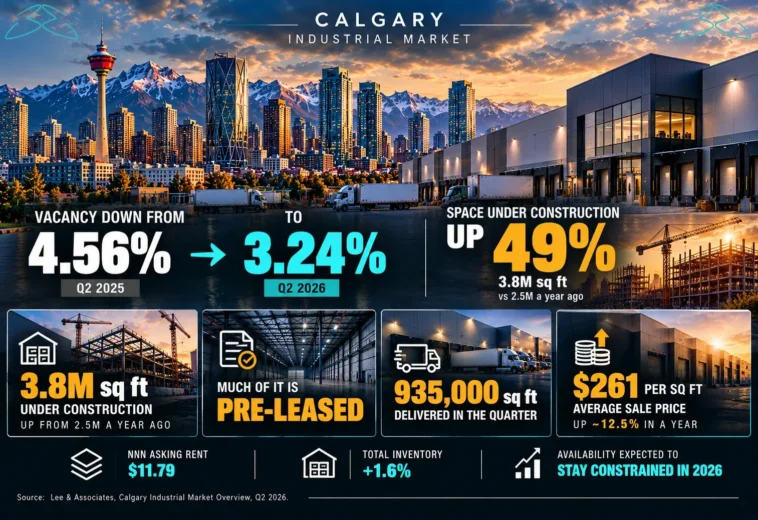
The Calgary industrial market is tightening while construction accelerates. Vacancy fell from 4.56% to 3.24%. Space under construction is up 49%. And much of what is being built already has a tenant.
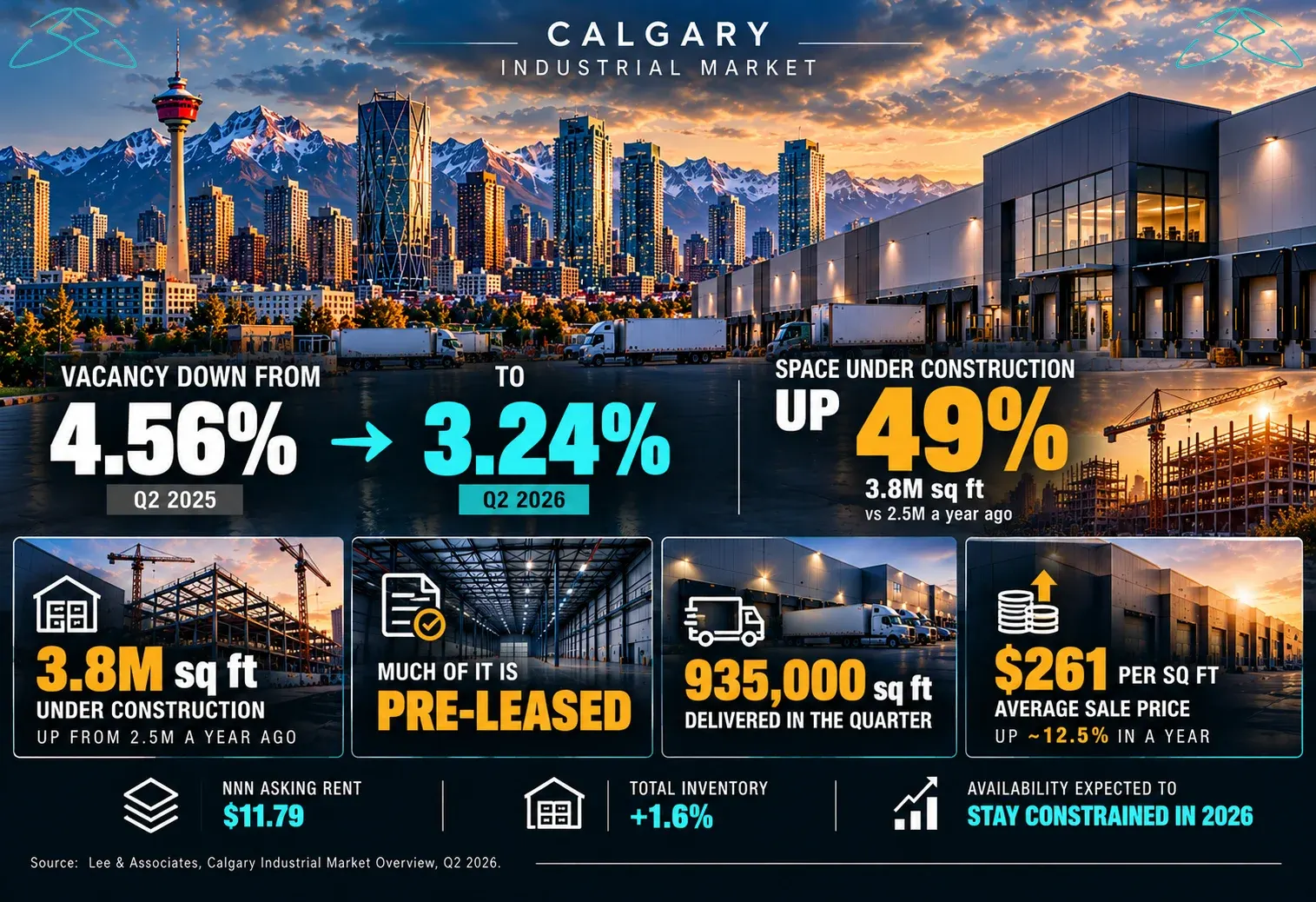
According to the Lee & Associates Calgary Industrial Market Overview for Q2 2026, industrial vacancy reached 3.24%, the lowest of the last five quarters, down from 4.56% in Q2 2025.
But the most interesting part is not the vacancy rate. It is what is being built, and for whom.
Table of Contents
- Calgary Industrial Market Q2 2026: The Key Numbers
- New Supply Is Following Signed Demand
- Prices and Rents Confirm the Tightness
- From “Will It Lease?” to “Can You Deliver?”
- What Developers and Builders Should Plan For
1. Calgary Industrial Market Q2 2026: The Key Numbers
The Calgary industrial market posted the following results in Q2 2026:
- Vacancy: 3.24%, down from 4.56% a year earlier
- Under construction: about 3.8 million sq ft, up from 2.5 million a year ago (+49%)
- Delivered in the quarter: about 935,000 sq ft
- Net absorption: roughly 912,500 sq ft
- Average sale price: $261 per sq ft, up about 12.5% in a year
- NNN asking rent: $11.79 per sq ft
- Total inventory growth: +1.6%
Other brokerages measure the market differently. CBRE’s Q2 2026 Calgary industrial figures, for example, report a higher vacancy rate because of different inventory definitions. The direction, however, is consistent: demand is absorbing new supply.
2. New Supply Is Following Signed Demand
Almost the entire quarter’s deliveries were absorbed: about 935,000 sq ft delivered and about 912,500 sq ft absorbed.
More important is the pipeline. The report notes that much of the 3.8 million sq ft under construction is already pre-leased, and that speculative building remains limited.
That changes how we should read a 49% increase in construction. In many markets, a jump like that would signal oversupply risk. In Calgary, supply is growing mostly where demand is already contracted.
Supply is growing, but only where demand is already signed.
With limited speculative product and a heavily pre-leased pipeline, the report expects availability to stay constrained through 2026. Tenants looking for space without a build-to-suit commitment will find fewer options.
3. Prices and Rents Confirm the Tightness
The signal is in the price.
The average industrial sale price reached $261 per sq ft, up about 12.5% in one year, while total inventory grew only 1.6%. When prices rise much faster than the stock of buildings, buyers are competing for a limited supply of existing assets.
NNN asking rent stands at $11.79 per sq ft. For context, I compared Calgary’s industrial occupancy costs with Metro Vancouver in Alberta Industrial Real Estate vs BC: The 2026 Numbers. Calgary remains considerably cheaper, but the gap is not guaranteed to last if rents keep rising.
4. From “Will It Lease?” to “Can You Deliver?”
This is a very different feasibility problem from the one most developers are used to.
In a speculative project, the main risk is market risk: will the building lease, at what rent and how quickly?
When the tenant is signed before the foundation is poured, the main risk shifts to delivery:
- Schedule: the tenant has an occupancy date, often linked to its own operations.
- Budget: the lease rate is fixed, so cost overruns come straight out of the developer’s return.
- Specification: clear heights, loading, power and floor loads must match the tenant’s requirements.
- Penalties: late delivery can trigger rent abatements, damages or termination rights.
In this market, execution capacity is worth more than land price.
The question for developers and builders isn’t “is there demand for industrial in Calgary?” It’s “can we deliver a pre-leased building on the tenant’s timeline?”
5. What Developers and Builders Should Plan For
For anyone building or financing industrial in the Calgary industrial market, five practical points:
- Lock procurement early. Steel, roofing, electrical gear and dock equipment can drive the critical path. Recent cost trends are covered in Calgary vs Edmonton Construction Costs: 2026 Data.
- Secure trade capacity. With 3.8 million sq ft underway, contractors and subtrades are in demand at the same time.
- Align the lease and the construction contract. Delivery dates, delay remedies and change mechanisms should be consistent in both documents.
- Build schedule contingency. Allow for permitting, utility connections and weather, especially for winter construction in Alberta.
- Model delivery risk in the feasibility study. Test the impact of a three- or six-month delay on cash flow, financing and tenant obligations.
A Market That Rewards Execution
The Calgary industrial market combines low vacancy, rising prices and a large, mostly pre-leased construction pipeline. Demand is not the problem. Delivery is.
For developers, builders and lenders, the competitive advantage is shifting from finding tenants to delivering for them: on schedule, on budget and to specification.
For those building or financing industrial in Alberta: how has pre-leasing changed your feasibility assumptions this year?
Source: Lee & Associates, Calgary Industrial Market Overview, Q2 2026.
- 7 views
- 0 Comment

Eros Belotti 01.

Eros belotti
Construction project manager with over 20 years of experience in Europe and the Canary Islands. Specialized in modular housing, container construction, real estate development and international project management. Founder of Reforma Vivienda Tenerife and Donkey Lab.