

//Large-Scale Project Management in Alberta: Systems Built for Multi-Phase Delivery
Large-Scale Project Management in Alberta: Systems Built for Multi-Phase Delivery
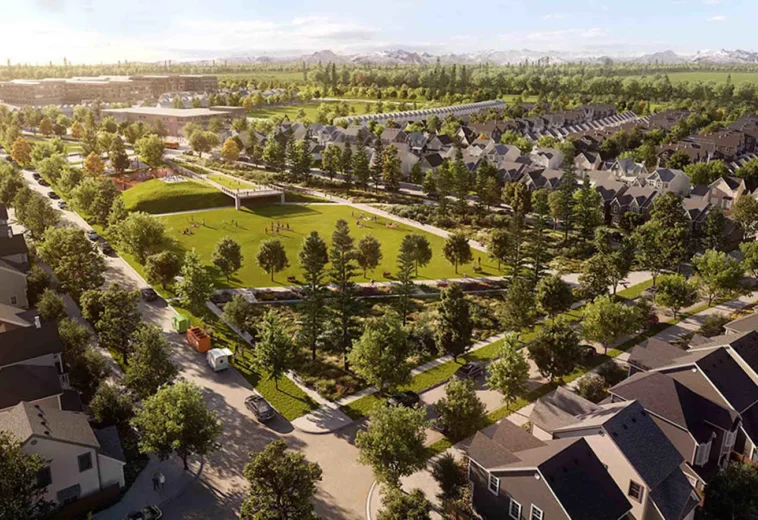
Tags : Alberta ConstructionAlberta Real EstateConstruction ManagementHousing AlbertaProject ManagementReal Estate Development
Alberta is no longer just building houses one lot at a time. Multi-phase master-planned communities, large purpose-built rental portfolios, institutional projects and data centres are reshaping the province’s construction pipeline. In December 2024 the provincial government set a target of attracting $100 billion in data centre investment within five years, and large technology projects have already been announced. ICBA’s Winter 2026 Construction Monitor puts Alberta’s major projects inventory at about $166 billion.
Projects at this scale create opportunities for project professionals, but they also expose weaknesses in how projects are planned and controlled. A single-family build forgives loose documentation. A multi-phase community or a hyperscale facility does not. This article explains what changes at scale and how to build a project management system that holds.
Why scale changes everything
On a small project, an error in a feasibility assumption or a missing decision record costs a few days or a few thousand dollars. On a large, multi-phase project, the same error compounds. One misaligned assumption in phase one can repeat across ten sub-phases, several contractors and years of execution. Interfaces multiply: civil works, utilities, multiple building types, amenities, public infrastructure and phased occupancy all depend on each other.
From managing projects to managing decisions
On large programs, the most useful mindset shift is from managing tasks to managing decisions. Every request for information, change order and schedule shift should be traceable to a documented decision: who made it, when, why and with what cost and schedule impact. This traceability is what allows a program to stay coherent across years and teams, survive staff turnover and resolve disputes quickly.
Four questions before committing to a large-scale project
1. Does the feasibility model reflect current costs and codes?
Altus Group’s 2026 Canadian Cost Guide reports overall construction cost increases of 4% or more in Calgary and Edmonton, led by healthcare and institutional work, with low-rise residential and renovation costs also rising. Metals affected by tariffs and labour shortages are the main pressures. Energy and building code requirements add further cost. A model that uses last year’s unit rates across a multi-year program will understate the budget significantly.
2. Is the documentation system built for multi-phase delivery?
A filing structure designed for one handover will collapse under ten. Large programs need a document control system that separates phases, tracks revisions across packages and links as-built information to each completed phase.
3. Does change management connect cost and schedule from the start?
Changes on large programs affect more than one budget line and one date. A change protocol must show the impact on cost, schedule and other phases before approval.
4. Who owns traceability?
Define, before ground breaks, who maintains the decision log, the risk register and the document control system. If everyone owns them, nobody does.
The building blocks of a large-program system
Program-level master schedule
A master schedule that links phases, infrastructure, approvals and procurement, with detailed schedules for each phase that roll up into it.
Phase gates
Formal reviews before each phase starts: is the design frozen, is financing in place, are approvals secured, is the market still there?
Integrated cost control
Budgets by phase and package, with committed costs, forecasts and contingency tracked monthly.
Risk management at two levels
A program risk register for strategic risks such as market, financing and regulation, and phase registers for delivery risks.
Stakeholder and interface management
Municipalities, utilities, future residents or tenants and multiple contractors all need coordinated communication. An interface register prevents gaps between packages.
Continuous documentation
As-built drawings, warranties and commissioning records collected phase by phase, so that each handover is complete and the next phase builds on accurate information.
Data centres and specialised facilities
Data centres bring additional requirements: power availability, cooling, redundancy, security and very fast construction schedules. Alberta’s strategy emphasises off-grid and natural-gas-based power solutions, which add energy infrastructure to the building scope. These projects reward teams that combine strong planning with disciplined procurement of long-lead electrical and mechanical equipment.
Purpose-built rental at scale
Purpose-built rental made up a large part of Alberta’s construction boom. BILD Alberta reported that purpose-built rentals represented 34% of the province’s starts in Q1 2026, with 23,553 units under construction. Large rental portfolios are delivered in phases and operated for decades, so life-cycle costs, maintainability and accurate handover information matter as much as speed.
Two weeks that save months
On large projects, spending two extra weeks tightening the pre-construction process (decision log, document control, change protocol, risk registers and phase gates) avoids the delays that destroy margins later. It is one of the highest-return investments a project team can make.
Skills that make the difference
Large programs need project professionals who can work across disciplines: reading a pro forma and a structural drawing, chairing a municipal meeting and a trade coordination meeting, and translating between owners, consultants and contractors. Technical background matters, but so does the ability to structure information so that dozens of people can use it. Professionals who combine construction experience, CAD and documentation skills and commercial understanding are particularly valuable at the front end of these programs, when the systems that will govern years of work are set up.
The bottom line
Alberta offers project professionals a window that many other Canadian markets do not: large, complex projects across housing, institutional and technology sectors. To capture it, teams need systems built for scale, where every decision is traceable and every phase builds on reliable information.
If you are preparing a large-scale project in Alberta and want to review your planning and control systems, see my construction project management services, read about project governance, or contact me. What is the biggest planning gap you see on large-scale builds?
Frequently asked questions
How much data centre investment is Alberta targeting?
In December 2024 the province announced a goal of $100 billion in data centre infrastructure completed or under construction within five years.
How much are construction costs rising in Calgary and Edmonton?
Altus Group’s 2026 Canadian Cost Guide reports overall increases of 4% or more, led by healthcare and institutional projects.
What is decision traceability in project management?
A documented record linking every change, RFI and schedule shift to the decision behind it, including who made it, when and why.
Sources
- Altus Group: 2026 Canadian Cost Guide insights
- Benefits and Pensions Monitor: Alberta targets $100bn in data centre investments
- ICBA: Alberta Construction Monitor, Winter 2026
- BILD Alberta: Quarterly Report Q1 2026
- 193 views
- 1 Comment

Eros Belotti 01.

Eros belotti
Construction project manager with over 20 years of experience in Europe and the Canary Islands. Specialized in modular housing, container construction, real estate development and international project management. Founder of Reforma Vivienda Tenerife and Donkey Lab.

June 10, 2026 /
A little context on why I wrote this.
I’ve worked on projects across 8 countries — from single-unit renovations to large residential and commercial developments.
The pattern I keep seeing in Alberta right now?
Professionals with solid PM skills, but systems designed for a different scale.
A 253-acre master-planned community isn’t just a bigger house.
It’s a different category of decision-making entirely.
If you’re operating in Alberta and want to stress-test your pre-construction process — feel free to DM me.
I read every message. 📩