

//Calgary Population Forecast vs Water Servicing: Demand Shrinks, the Pipe Doesn’t
Calgary Population Forecast vs Water Servicing: Demand Shrinks, the Pipe Doesn’t
Tags : AlbertaBearspaw Feeder MainCalgaryCalgary Population Forecastfeasibility studyNet MigrationPopulation ProjectionsServicing RiskStatistics CanadaWater Infrastructure
The Calgary population forecast has been cut sharply in two years. Net migration: 80,200, then 40,500, then a forecast 15,500. Your servicing schedule didn’t shrink with it.
For developers and builders in Calgary, this is the core tension in a 2027 pro forma: demand assumptions can be revised in a quarter, while the water infrastructure a site depends on takes years to build.
Table of Contents
- Canada’s Population Outlook: A 31.8 Million Range
- 2025: How Fast the Setting Can Move
- The Calgary Population Forecast to 2031
- The Other Side of the Pro Forma: Water Servicing
- What This Means for Feasibility Work
1. Canada’s Population Outlook: A 31.8 Million Range
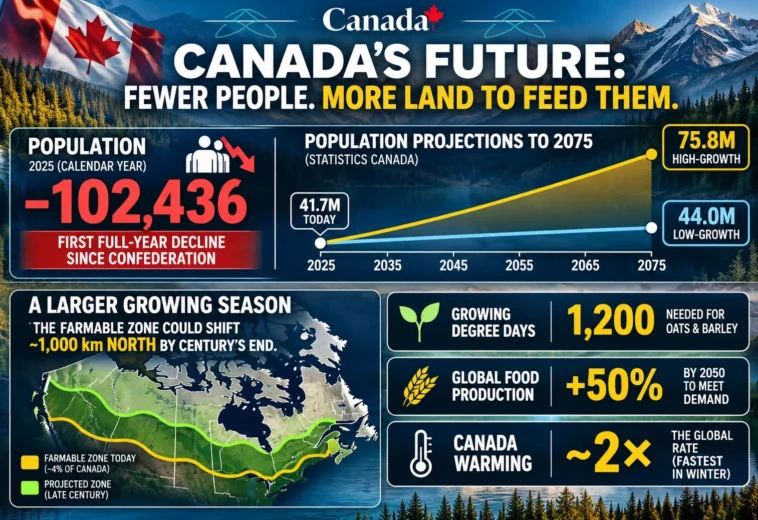
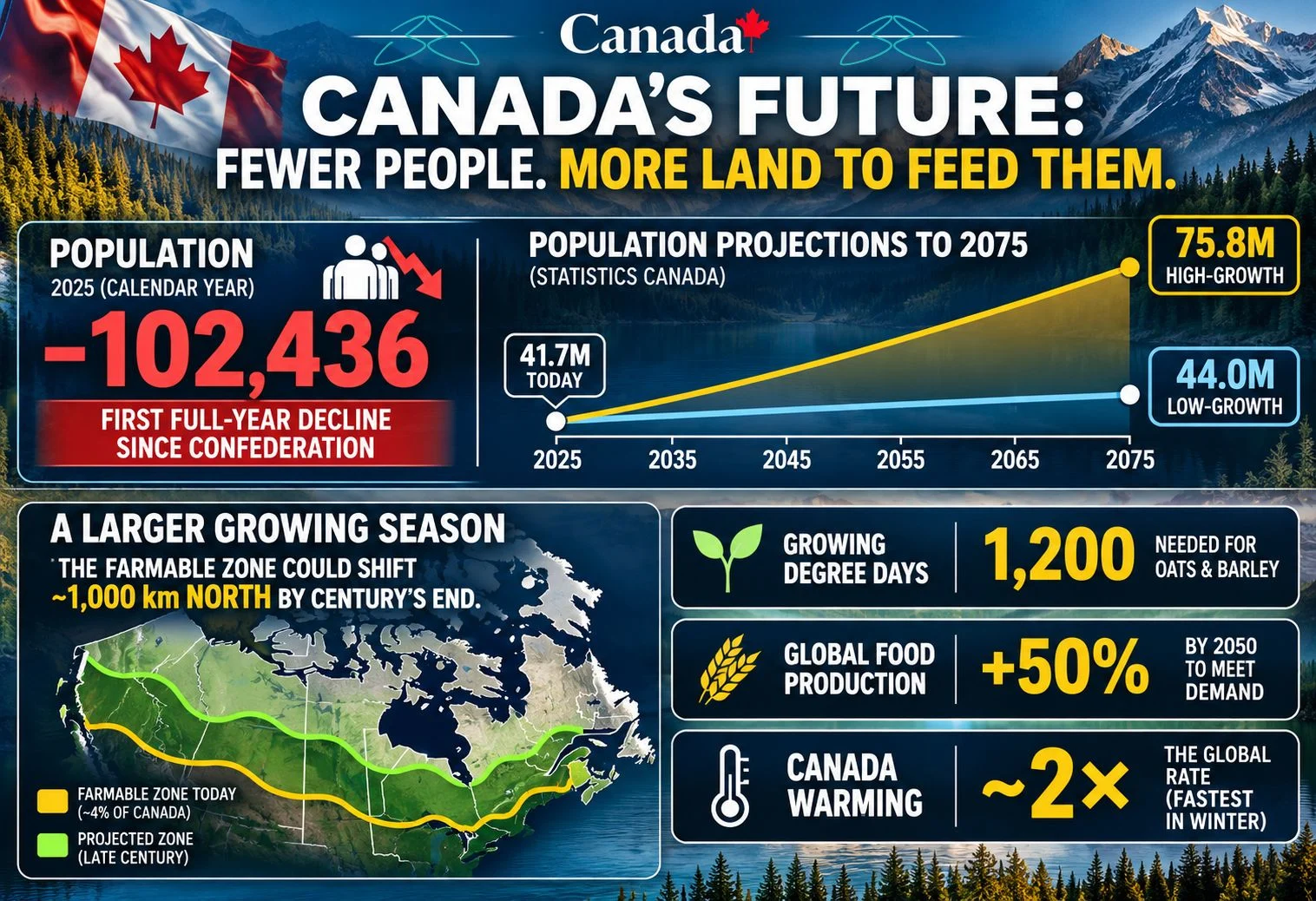
Start with the demand side. Statistics Canada’s latest population projections start from 41.7 million people (July 1, 2025) and end in three very different places in 2075:
- Low growth: 44.0 million
- Medium growth: 57.4 million
- High growth: 75.8 million
That is a spread of 31.8 million people. Every scenario is also lower than in the previous round of projections.
The gap is not demography. It is policy. Statistics Canada stresses that these are scenarios, not forecasts, and that the main variable is immigration: how many permanent residents are admitted and how many temporary residents stay.
2. 2025: How Fast the Setting Can Move
2025 showed how quickly that variable can change:
- Canada’s population fell by 102,436 in the calendar year, the first annual decline Statistics Canada has recorded (preliminary estimates, to be interpreted with caution).
- Non-permanent residents recorded a net outflow of 461,688.
- Permanent immigration added 328,046; natural increase only 31,206.
Alberta went the other way, growing by 59,970 (+1.2%), while Ontario and British Columbia each fell by 0.7%. Statistics Canada projects Alberta passing British Columbia in population in almost all scenarios.
3. The Calgary Population Forecast to 2031
The City of Calgary’s own population outlook, in the Spring 2026 Calgary and Region Economic Outlook (forecast completed in January 2026):
- Population: 1,558,700 (2025), 1,583,200 (2026), 1,717,600 (2031)
- Annual growth: from 3.2% to about 1.6% a year
- Net migration: 80,200, then 40,500, then a forecast 15,500
That is still about 134,000 more residents by 2031 (our calculation from the City’s figures). Calgary keeps growing, but at roughly half the pace of the recent surge, and net migration in a single year halved.
For context on how that growth has been absorbed across the region, see Calgary’s Housing Supply Gap and the latest Calgary housing market data for October 2026.
4. The Other Side of the Pro Forma: Water Servicing
The Bearspaw South Feeder Main carries about 60% of the area’s treated water. It failed in summer 2024 and again in December 2025. April 2026 brought the third round of water limits in under two years.
Stage 4 outdoor water restrictions returned on November 4 while crews connect the new main, according to CTV News.
In March 2026, Calgary City Council approved $609 million in additional 2026 capital budget for the water system:
- $367.4 million for the Bearspaw South Feeder Main
- $222 million for north Calgary water servicing, including a new feeder main north from the Bearspaw Water Treatment Plant
Water and wastewater capacity is often the hidden constraint behind housing supply, a point I made in Alberta Housing Infrastructure: Why $510M in Pipes Matters More Than Permit Reform.
5. What This Means for Feasibility Work
- Demand is a setting. Net migration fell from 80,200 to 40,500 in one year. A pro forma built on a single population scenario is a bet, not a base case. Model low, medium and high absorption.
- Infrastructure is a clock. The replacement main was first targeted for 2028. Servicing does not flex the way absorption does: if the pipe is late, the project is late.
- Location matters. Sites that depend on north Calgary servicing carry schedule risk that the market price does not yet show.
- Restrictions are now a recurring event. I did not find published rules for construction-site water use in the City’s notices. Check your municipality’s current requirements for dust control, concrete curing, testing and landscaping before scheduling.
- Financing compounds the delay. A servicing delay extends carrying costs, which have risen after the October 2026 Bank of Canada rate hike.
Demand Moves in Quarters. Pipes Move in Years.
The Calgary population forecast still shows growth, but at half the recent pace, and national scenarios span tens of millions of people depending on policy. Meanwhile, the water infrastructure that new development depends on is under strain and on a multi-year schedule.
Demand can be re-forecast in a quarter. A pipe takes years.
How are you treating servicing risk in your 2027 pro formas: a contingency line, or a schedule driver?
Sources: Statistics Canada, Population Projections for Canada (2025 to 2075) and quarterly demographic estimates; City of Calgary, Spring 2026 Calgary and Region Economic Outlook; City of Calgary water system updates and Council decision of March 17, 2026.
- 63 views
- 1 Comment

Eros Belotti 01.

Eros belotti
Construction project manager with over 20 years of experience in Europe and the Canary Islands. Specialized in modular housing, container construction, real estate development and international project management. Founder of Reforma Vivienda Tenerife and Donkey Lab.

November 6, 2026 /
Sources and notes for the numbers above:
→ Population scenarios (44.0M / 57.4M / 75.8M, base 41.7M): Statistics Canada, The Daily, Jan 27, 2026
https://www150.statcan.gc.ca/n1/daily-quotidien/260127/dq260127a-eng.htm
→ 2025 population change (−102,436; non-permanent residents −461,688; Alberta +59,970): StatCan estimates as summarized by Rennie, Mar 2026
https://rennie.com/intelligence/demographics/three-takeaways-from-canadas-2025-population-estimates
→ Calgary population and net migration (1,558.7k → 1,717.6k; 80.2k → 40.5k → 15.5k): City of Calgary, Economic and Population Outlook (forecast completed Jan 2026; 2025 is an estimate, no civic census)
https://www.calgary.ca/cfod/finance/corporate-economics/economic-outlook-population-outlook.html
→ $609M capital budget increase ($367.4M Bearspaw, $222M north Calgary water servicing): Water Canada, Mar 18, 2026
https://www.watercanada.net/calgary-city-council-approves-additional-609-million-for-water-infrastructure/
→ Bearspaw main failures and the 60% share: Global News (Jan 2026) and Canadian Press (Apr 2, 2026)
https://globalnews.ca/news/11601339/ruptured-calgary-feeder-main-wont-run-full-capacity/amp/
→ Stage 4 restrictions from Nov 4: CTV Calgary
https://www.ctvnews.ca/calgary/article/calgary-water-restrictions-start-wednesday-continue-through-grey-cup/
Two clarifications: the “134,000 more residents by 2031” is my own calculation from the City’s table, and StatCan’s provincial projections only run to 2050.