
Bank of Canada Rate Hike: What +25 bps Costs a Construction Loan
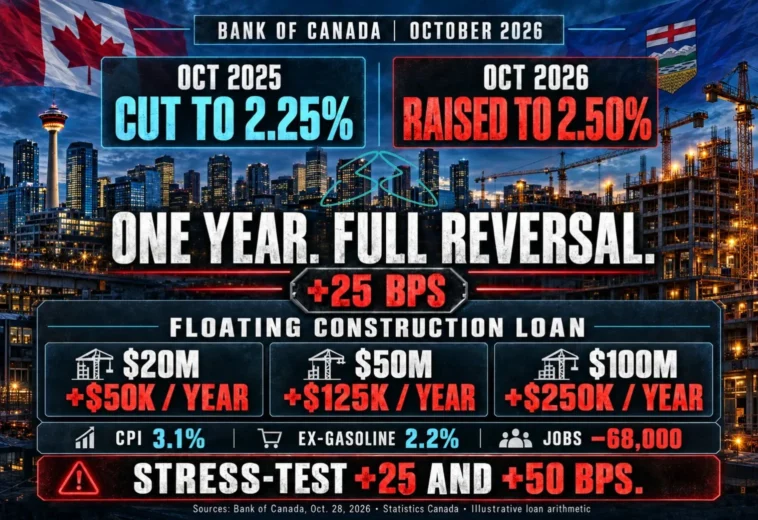
The Bank of Canada rate hike of October 28, 2026, completed a full reversal in one year. October 2025: the policy rate was cut to 2.25%. October 2026: it was raised back to 2.50%.
The Bank of Canada raised its policy rate by 25 basis points after seven consecutive meetings on hold. The stated goal is to stop high energy prices from spreading to other prices.
For developers, builders and lenders, the most important question is not what the Bank did. It is what 25 or 50 basis points do to a construction loan that is already drawn.
Table of Contents
- The Numbers Behind the Bank of Canada Rate Hike
- A Risk-Management Move, Not a Response to Broad Inflation
- What 25 Basis Points Cost on a Construction Loan
- Why Alberta Developers Should Care
- Five Checks Before the Next Feasibility Sign-Off
1. The Numbers Behind the Bank of Canada Rate Hike
The data the Bank was looking at:
- Headline CPI, September: 3.1%, up from 3.0% in August (Statistics Canada data).
- CPI excluding gasoline: 2.2%, down from 2.4%.
- Bank forecast for inflation: about 3.5% by year-end, 3% on average in 2027, back to the 2% target by mid-2028.
- GDP growth: 1% in 2026, 2% in 2027 and 2028.
- Jobs: about 68,000 lost in September.
- Market expectations: two days before the decision, markets priced just over 83% odds of a hike.
The next rate decision is scheduled for December 9, 2026.
2. A Risk-Management Move, Not a Response to Broad Inflation
Read the numbers twice. Inflation outside gasoline is falling, employment is weakening, and growth is modest. Yet the Bank raised anyway.
This is a risk-management decision. Gasoline prices rose sharply on higher crude oil prices, and the Bank’s concern is that energy costs feed into transport, goods and services, and then into wage and price expectations. The Bank signalled that further increases may follow, but did not give a path.
For anyone financing real estate or construction, that matters more than the single move: the direction of rates has changed, and the uncertainty around the path is now higher.
3. What 25 Basis Points Cost on a Construction Loan
On a floating-rate construction loan, a 25-basis-point increase passes through almost directly. My own illustrative arithmetic, assuming the loan is fully drawn:
- $20M fully drawn: about $50,000 a year
- $50M fully drawn: about $125,000 a year
- $100M fully drawn: about $250,000 a year
At +50 basis points, double each figure.
Construction loans are rarely fully drawn for the whole term. If the average drawn balance over the build is 60%, a $50M facility costs about $75,000 a year more at +25 basis points.
These numbers are examples, not market quotes. Actual exposure depends on the loan structure, spread, fees, hedging and draw schedule. But they show the order of magnitude: on a large project, a single move can absorb a meaningful part of the contingency or developer margin.
4. Why Alberta Developers Should Care
Higher energy prices help commodity-producing provinces such as Alberta through incomes, investment and government revenue, as economists noted before the decision.
But the borrowing rate is national. A project in Calgary or Edmonton pays the same policy-driven cost of debt, whatever the oil price does for the local economy.
Revenue upside and financing cost are decoupled.
A stronger local economy may support absorption and rents over time. The higher interest cost arrives immediately, on every dollar already drawn. In a feasibility study, those two effects do not arrive at the same time, and they should not be netted against each other as if they did.
This adds to other pressures already in Alberta pro formas, from escalation risk in fixed-price procurement to construction cash flow stress and the labour constraints behind the $28.3B Alberta capital plan.
5. Five Checks Before the Next Feasibility Sign-Off
Before approving or refinancing a project, I would check:
- Rate sensitivity at +25 and +50 basis points, not a single rate assumption.
- Interest reserve: is it sized for a higher rate path, or for the one assumed when the loan was arranged?
- Draw schedule: the later the draws, the lower the exposure. Review whether equity, phasing or procurement timing can defer debt.
- Fixed, floating or hedged: identify which part of the capital stack moves with the Bank and which does not.
- Return hurdle: which projects still clear their required return at +50 basis points, and which only work at the old rate?
Limits of This Analysis
One hike is not a trend. The figures are national, not Alberta-specific data. The loan sizes are illustrative examples, not market quotes. The Bank did not give a path for further increases.
What the decision does show is that a feasibility model built on last year’s falling-rate assumption needs updating.
For developers and lenders in Alberta: what rate are you using in your feasibility models today, and when did you last update it?
Sources: Bank of Canada, interest rate announcement, October 28, 2026; Statistics Canada, Consumer Price Index, September 2026. Loan figures are the author’s illustrative arithmetic.
- 9 views
- 0 Comment

Eros Belotti 01.

Eros belotti
Construction project manager with over 20 years of experience in Europe and the Canary Islands. Specialized in modular housing, container construction, real estate development and international project management. Founder of Reforma Vivienda Tenerife and Donkey Lab.