

//Alberta Fixed-Price Procurement: Who Carries Escalation Risk
Alberta Fixed-Price Procurement: Who Carries Escalation Risk
Most of the debate about construction procurement in Canada is framed as a question of efficiency. It is more useful to frame it as a question of allocation. Every delivery model assigns escalation risk to someone. Fixed price does not eliminate that risk — it hands it to the party that signed the bid.
That distinction matters more in Alberta than almost anywhere else in the country, because Alberta has not followed the shift toward progressive and collaborative delivery models that has taken hold in Ontario, Quebec and British Columbia. Understanding what that means in practice — for contractors bidding and for owners buying — requires looking at what procurement duration actually costs.
What procurement duration costs
The Canadian Construction Association published a report on project delivery methods in June 2026, prepared for Public Services and Procurement Canada with input from PCL, EllisDon, Graham, Kiewit and Ledcor. Buried in it is a figure that rarely appears in industry discussion.
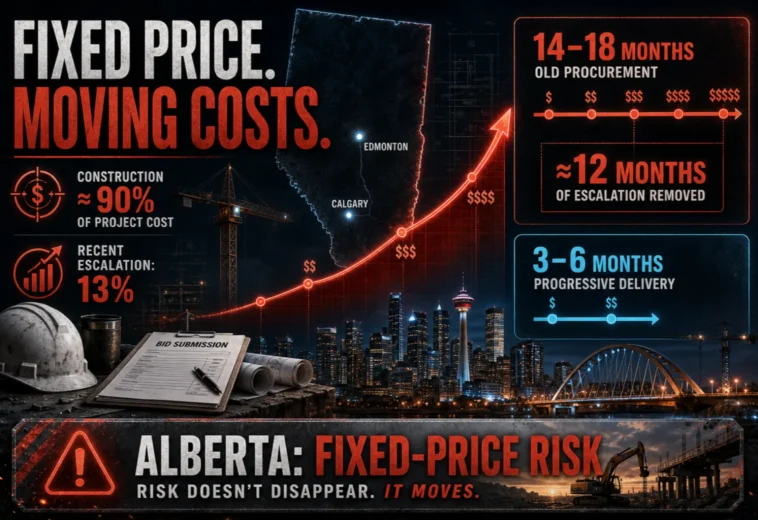
A 2021 PSPC presentation put progressive design-build procurement at 14 to 18 months from RFQ or RFP to award. Industry participants now report the same process closing in 3 to 6 months.
The saving is not administrative. Construction typically accounts for around 90% of total project cost, and the CCA report notes escalation reaching 13% in recent years. Removing roughly a year of exposure between pricing and mobilisation is, in most cases, a larger saving than any design optimisation available on the same project.
Alberta-specific data supports the underlying pressure. Statistics Canada’s Building Construction Price Index for the second quarter of 2026 shows non-residential construction costs in Calgary up 1.6% quarter over quarter and 3.9% year over year, and Edmonton up 1.4% and 4.0%. Residential costs in Calgary moved the other way, down 0.1% in the quarter and 0.5% over the year. The divisions driving the non-residential increases include conveying equipment at 2.9%, earthwork at 2.2%, structural steel framing at 2.2% and metal fabrications at 2.0%. Statistics Canada attributes the metals and steel increases to retaliatory tariffs and the related supply chain disruptions.
For a contractor holding a fixed price, those are not market observations. They are margin.
Where Alberta sits
The CCA report describes Alberta as a province that continues to prefer fixed-price contracts — design-bid-build and conventional design-build — while expanding its DBFM pipeline on bundled schools and health facilities. It notes that Alberta does not currently use the Alliance model at all.
Two further data points sit alongside that description.
The Premier’s mandate letter to the Minister of Infrastructure, dated 22 September 2025, sets out eight priorities. None of them concerns collaborative risk allocation or alternative delivery models.
In May 2025, the ambulatory building at the Red Deer Regional Hospital dropped its P3 structure and returned to conventional procurement.
The procurement mechanics reinforce the point. Alberta Transportation and Economic Corridors states publicly that it does not pre-qualify bidders and awards to the lowest compliant bid, with bid security at 10%, a 50% performance bond, a 50% labour and material payment bond, and a 5% holdback. There is no stage at which an owner evaluates whether a bidder has priced escalation credibly. The lowest number wins, and the market discovers the answer later.
The counter-argument: progressive delivery fails too
It would be easy to write this as a story about a province falling behind. That version is not accurate, and contractors who have worked under collaborative models know it.
Infrastructure BC issued a second RFP for Dawson Creek Hospital in January 2023 at roughly 60% design completion, having failed to reach agreement with the original proponent. The CCA report also lists failed validations and terminated contracts on Metrolinx On-Corridor, SmartTrack and Ontario’s IPD water treatment project.
Adoption in Canada remains thin in any case. Research from the Integrated Project Delivery Alliance with UBC and ÉTS identified roughly 60 IPD projects started in Canada, concentrated in Alberta and Ontario — a figure that dates from 2022 and has not been updated. The three case studies examined in that work, including two Edmonton schools, were delivered on time and on budget with the incentive compensation layer paid in full. That is a strong result on a small sample.
Comparable share figures are American, not Canadian. FMI and DBIA’s 2024 utilisation study put progressive design-build at roughly 33% of all design-build procurements in the United States, with design-build forecast to reach 47% of US construction spending by 2028. Those numbers describe a different market and should not be read across.
The honest position is that progressive models redistribute risk and shorten exposure, but they introduce their own failure mode: validation phases that do not converge, and a second procurement that costs more than the first.
What this means for contractors bidding fixed price
If the delivery model is not going to change, the pricing discipline has to.
A fixed-price bid in Alberta in 2026 is a commitment to absorb escalation between tender and completion, on a cost base where non-residential inputs are moving nearly 4% a year and steel-linked divisions faster than that. Under lowest-compliant-bid award with no pre-qualification, the bidder who prices that risk realistically is at a structural disadvantage against one who does not.
The practical response is not to refuse the model. It is to stop treating contingency as a single percentage applied at the end of an estimate. Escalation is a function of duration, of which divisions carry the exposure, and of where the supply chain sits. A project that is 40% structural steel and a project that is 40% sitework do not carry the same escalation profile, and a flat contingency prices them identically.
The tools that do exist are contractual rather than arithmetic: indexed price adjustment clauses, material-specific escalation provisions, shortened bid validity periods, and early procurement of long-lead divisions. None of them are standard in Alberta fixed-price work. All of them are negotiable.
What this means for owners
Owners in Alberta are not avoiding escalation risk by buying at fixed price. They are paying for it in the bid, whether or not it is visible as a line item — and where a bidder has underpriced it, they are buying a claims exposure instead.
The CCA and KPMG digital maturity survey of 265 firms, published in June 2025, offers a revealing detail. 78% of respondents said procurement is already changing to favour innovation, but only 43% identified the owner as highly influential in driving that change. Read together, those figures suggest the pressure is coming from the supply side rather than from the parties writing the contracts.
That is a slow mechanism for change. It also means that an owner who does move first — by pre-qualifying on capability rather than awarding purely on price, or by adopting an indexed adjustment clause — is likely to find a market that has already thought about it.
The CCDC framework is available for organisations that want to move without inventing documents. Progressive design-build maps to CCDC 32. Alliance and IPD arrangements map to an adapted CCDC 30. Construction management at risk maps to CCDC 5A and 5B.
Frequently asked questions
What is progressive design-build? A two-phase delivery model in which the owner selects a design-builder early, largely on qualifications, then develops the design collaboratively before agreeing a price for construction. In Canada it maps to CCDC 32.
Does Alberta use progressive design-build or IPD? Alberta has hosted IPD projects, including two Edmonton schools, but the CCA’s June 2026 report describes the province as continuing to prefer fixed-price contracts and notes that it does not currently use the Alliance model. Its alternative-delivery activity is concentrated in DBFM structures for bundled schools and health facilities.
Who carries escalation risk under a fixed-price contract? The contractor, from the date the price is fixed until completion, unless the contract includes an indexed adjustment or material-specific escalation clause. These are not standard in Alberta fixed-price work.
How long does public procurement take in Alberta? No published figure was identified. The 14-to-18-month and 3-to-6-month figures cited in this article are federal, drawn from a 2021 PSPC presentation and from current industry observation reported by the CCA. They should not be read as Alberta measurements.
Does Alberta pre-qualify bidders on public construction work? Alberta Transportation and Economic Corridors states that it does not pre-qualify bidders and awards to the lowest compliant bid.
Sources
- Canadian Construction Association, Construction Project Delivery Methods Report, June 2026 — https://www.cca-acc.com/wp-content/uploads/2026/06/Construction-Project-Delivery-Methods-Report_EN-June2026.pdf
- Alberta Transportation and Economic Corridors, Transportation tendering and contracting overview — https://www.alberta.ca/transportation-tendering-and-contracting-overview
- Statistics Canada, Building Construction Price Index, second quarter 2026 — https://www150.statcan.gc.ca/n1/daily-quotidien/260724/dq260724b-eng.htm
- Statistics Canada, Building Construction Price Index, Q2 2026, by census metropolitan area — https://www150.statcan.gc.ca/n1/daily-quotidien/260724/t001b-eng.htm
- BLG, Alberta’s infrastructure mandate: paving the way for construction growth, October 2025 — https://www.blg.com/en/insights/2025/10/albertas-infrastructure-mandate-paving-the-way-for-construction-growth-in-2025
- Integrated Project Delivery Alliance / UBC / ÉTS, research on IPD project success in Canada — https://leanipd.com/blog/new-research-testifies-ipd-project-success-in-canada/
- Canadian Construction Association and KPMG, Digital maturity in Canadian construction, June 2025 — https://www.cca-acc.com/canadas-construction-industry-gets-serious-about-investing-in-technology-as-pressure-mounts-to-do-more-with-less/
- Design-Build Institute of America / FMI, 2024 utilisation study — https://dbia.org/blog/new-fmi-report-2024/
- 154 views
- 1 Comment

Eros Belotti 01.

Eros belotti
Construction project manager with over 20 years of experience in Europe and the Canary Islands. Specialized in modular housing, container construction, real estate development and international project management. Founder of Reforma Vivienda Tenerife and Donkey Lab.


August 27, 2026 /
Sources, plus one clarification worth making before someone else does.
The 14-18 month figure is federal, not Alberta. It comes from a 2021 PSPC presentation on progressive design-build procurement, cited in the CCA report. The 3-6 month figure is what industry reports observing today. I haven’t found an equivalent published measurement for Alberta procurement — if someone has one, I’d like to see it.
CCA, Construction Project Delivery Methods Report (June 2026), prepared with PCL, EllisDon, Graham, Kiewit and Ledcor:
cca-acc.com/wp-content/uploads/2026/06/Construction-Project-Delivery-Methods-Report_EN-June2026.pdf
BLG on the Alberta infrastructure mandate letter, September 2025:
blg.com/en/insights/2025/10/albertas-infrastructure-mandate-paving-the-way-for-construction-growth-in-2025
One number I left out of the post. In the CCA/KPMG digital maturity survey of 265 firms, 78% say procurement is already changing to favour innovation — but only 43% named the owner as highly influential in that change. My read: the push is coming from the supply side, not from the people writing the contracts. Which is a slow way to change anything.