
//Alberta Construction Cash Flow: What Q2 2026 Insolvency Data Shows
Alberta Construction Cash Flow: What Q2 2026 Insolvency Data Shows
Alberta Construction Cash Flow: What the Q2 2026 Insolvency Data Actually Says
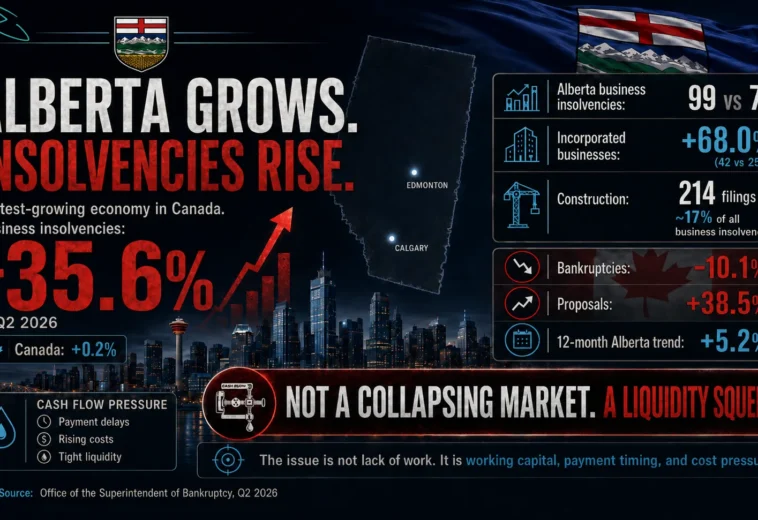
Alberta is the fastest-growing economy in Canada. It also just posted a 35.6% year-over-year jump in business insolvencies. Both statements are true, and the gap between them is where the Alberta construction cash flow story lives.
Nationally, business insolvencies were essentially flat last quarter — up 0.2% year over year. Alberta moved 35.6%. Same country, same quarter, opposite direction.
This article breaks down what the Office of the Superintendent of Bankruptcy data shows, why it is happening in a province that is not short of work, and which numbers a contractor or developer should be watching instead.
The headline numbers
Business insolvencies in Alberta reached 99 filings in Q2 2026, against 73 in Q2 2025. That is a 35.6% increase.
Incorporated businesses moved harder still: 42 filings against 25, an increase of 68.0%.
For national context, Canada recorded 1,281 business insolvencies in Q2 2026 versus 1,278 a year earlier — a 0.2% change. Quebec fell 7.7%. Saskatchewan fell 40.0%. Alberta is the outlier, and it is the outlier on the wrong side.
Why this is an Alberta construction cash flow problem, not a demand problem
Here is what makes the number strange: Alberta is not short of work.
Housing starts are coming off a record year. Major industrial and data centre projects are landing. Non-residential construction employment is forecast to keep rising through the next decade. The order book is not the issue.
Companies operating in a growing market rarely fail because revenue disappeared. They fail because of working capital — the gap between money spent and money collected.
That gap has widened for three reasons that all landed at once:
Contracts priced on old assumptions. Fixed-price work signed in 2024 is being delivered against 2026 input costs. Tariff measures have added roughly 9.2% to Canadian construction material costs, with steel and aluminium products facing rates up to 50%. A steel-intensive scope and a wood-frame scope no longer carry the same risk, but many contracts still treat them as if they do.
Payment timing. Alberta’s Prompt Payment and Construction Lien Act requires owners to pay contractors within 28 calendar days of a proper invoice, and contractors to pay subcontractors within 7 calendar days of receiving payment. The legal framework exists. Enforcement through adjudication remains rare, so in practice many firms still finance the project themselves.
Thin margins meeting rising carrying costs. When margin is compressed and the receivable cycle stretches, the business does not need a downturn to fail. It only needs one slow payer at the wrong moment.
The detail most people miss
Within the construction sector nationally, two numbers moved in opposite directions in Q2 2026.
Bankruptcies fell 10.1% year over year. Proposals — formal restructuring filings — rose 38.5%.
That combination matters. A collapsing sector produces bankruptcies. What Q2 produced was more companies attempting to restructure and survive. That is the signature of a liquidity squeeze, not a demand collapse.
Construction remained Canada’s most affected sector overall, with 214 filings in Q2 2026, following 208 in Q1 2026. In that first quarter, construction accounted for 17.0% of all business insolvencies in the country.
Two caveats the number deserves
Any figure this dramatic should come with its limits stated.
The base is small. Ninety-nine filings is not a large absolute number. On a small base, quarterly percentages swing hard, and one unusual quarter can distort the picture.
The 12-month view is calmer. Over the year to 30 June 2026, Alberta recorded 322 business insolvencies against 306 the year before — an increase of 5.2%, not 35.6%.
So the direction is real. The headline is louder than the underlying trend. Both things can be said honestly, and saying both is more useful than picking whichever one supports a stronger opinion.
What to measure instead
If you operate in Alberta, the province-level statistic is not the number that will affect your business. These are:
Days sales outstanding, tracked over time. Not this month’s figure — the trend against 2024. If the gap between completing work and banking cash has grown, that trend is your actual risk exposure, regardless of how strong the pipeline looks.
Material mix exposure in every open contract. Tariff impact varies by scope. A flat contingency percentage applied across a portfolio hides the fact that steel-heavy work and light-frame work now sit on completely different cost trajectories.
Escalation and payment terms in contracts still being signed. Cost pressure that is not addressed at contract stage becomes a margin problem at delivery stage. There is no way to recover it later.
Whether your feasibility assumptions have been refreshed. A pro forma built on 2024 unit rates is not conservative. It is simply out of date, and it will pass internal review anyway because the format looks correct.
The takeaway for Alberta construction businesses
Alberta’s growth story is real. The insolvency data does not contradict it.
What the data shows is that growth and financial stability are separate variables, and that a firm can have a full order book and still run out of cash. Managing Alberta construction cash flow through a growth cycle turns out to be harder than managing it through a slow one, because the temptation to take on more work is strongest exactly when working capital is tightest.
The firms that struggle in 2027 will not be the ones that ran out of projects. They will be the ones that never measured the distance between the work and the money.
Frequently asked questions
How much did business insolvencies rise in Alberta in Q2 2026? Alberta recorded 99 business insolvency filings in Q2 2026 compared with 73 in Q2 2025, an increase of 35.6%. Incorporated businesses alone rose 68.0%, from 25 filings to 42.
Is Alberta’s construction industry in decline? The data does not support that reading. Housing starts are coming off a record year and non-residential activity is forecast to grow. The pressure shows up in working capital and payment timing rather than in demand.
What is the difference between a bankruptcy and a proposal? A bankruptcy generally ends the business. A proposal is a formal restructuring filing that allows a company to renegotiate obligations and continue operating. In Q2 2026, construction bankruptcies fell 10.1% while proposals rose 38.5%.
What are the payment deadlines under Alberta’s prompt payment rules? Under the Prompt Payment and Construction Lien Act, owners must pay contractors within 28 calendar days of receiving a proper invoice, and contractors must pay subcontractors within 7 calendar days of receiving payment.
How much have tariffs increased construction costs in Canada? Current measures are estimated to have raised construction material costs by roughly 9.2%. Steel and aluminium products face rates of up to 50%, with structural steel, rebar and equipment-heavy scopes carrying the highest exposure.
If you run projects in Alberta, I would be interested to hear what you are seeing on payment timelines this year — whether the gap between completed work and collected cash has widened for you since 2024, and how you are handling it in new contracts. Leave a comment or send me a message.
Sources
- Office of the Superintendent of Bankruptcy — Insolvency Statistics in Canada, Second Quarter of 2026 (Tables 3, 3a, 4): https://ised-isde.canada.ca/site/office-superintendent-bankruptcy/en/statistics-and-research/insolvency-statistics-canada-second-quarter-2026
- Office of the Superintendent of Bankruptcy — Insolvency Statistics in Canada, First Quarter of 2026: https://ised-isde.canada.ca/site/office-superintendent-bankruptcy/en/statistics-and-research/insolvency-statistics-canada-first-quarter-2026
- Government of Alberta — Prompt payment rules for construction industry: https://www.alberta.ca/prompt-payment-rules-for-construction-industry
- Cushman & Wakefield — Impact of Tariffs on Canadian CRE Construction Costs: https://www.cushmanwakefield.com/en/canada/insights/impact-of-tariffs-on-canadian-cre-construction-costs
- BuildForce Canada — Construction and Maintenance Looking Forward 2026–2035: https://www.buildforce.ca/en/lmi-2026/
- BILD Alberta — Housing Data: https://bildalberta.ca/housing-data/
- 141 views
- 1 Comment

Eros Belotti 01.

Eros belotti
Construction project manager with over 20 years of experience in Europe and the Canary Islands. Specialized in modular housing, container construction, real estate development and international project management. Founder of Reforma Vivienda Tenerife and Donkey Lab.


August 20, 2026 /
Full data set, for anyone who wants to check the numbers.
ALBERTA — business insolvencies
Q2 2026: 99 | Q2 2025: 73 → +35.6%
Incorporated only — Q2 2026: 42 | Q2 2025: 25 → +68.0%
12 months to 30 Jun 2026: 322 | prior year: 306 → +5.2%
CANADA — business insolvencies
Q2 2026: 1,281 | Q2 2025: 1,278 → +0.2%
CONSTRUCTION SECTOR (Canada, all provinces)
Q2 2026: 214 filings
Q1 2026: 208 filings — 17.0% of all business insolvencies that quarter
Bankruptcies, Q2 year over year: −10.1%
Proposals, Q2 year over year: +38.5%
Two notes on method:
Alberta’s quarterly swing sits on a small base (99 filings), so the percentage moves hard. The 12-month figure (+5.2%) is the steadier read.
The bankruptcy/proposal split is construction sector, Canada-wide — not Alberta-specific.
Source: Office of the Superintendent of Bankruptcy, Insolvency Statistics in Canada, Q2 2026 (Tables 3, 3a and 4).