

//Alberta Construction Costs 2026: Where Tariffs Actually Hit
Alberta Construction Costs 2026: Where Tariffs Actually Hit
Tags : Alberta ConstructionCalgaryconstruction costsConstruction Managementcost estimatingEdmontonpreconstructionprocurementtariffs
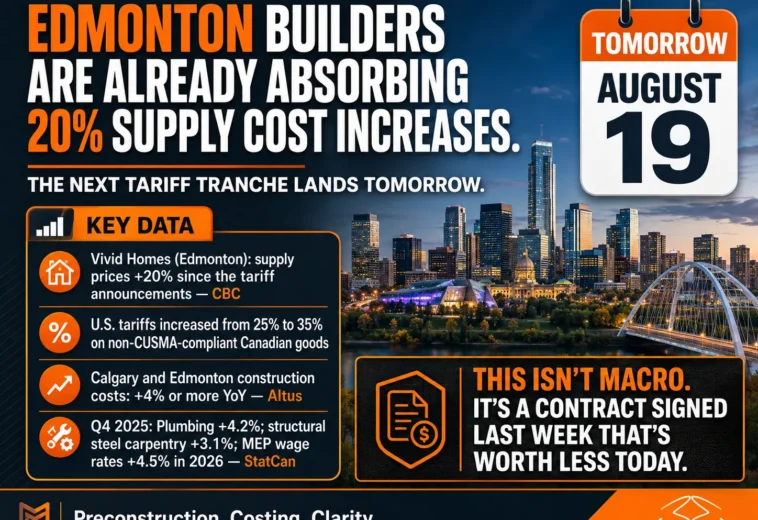
Supplies up 20%. Project costs up 4%. Same year, same market. Someone is absorbing the difference — and on most projects, it isn’t the client.
Alberta construction costs rose across the board in 2026, but the headline numbers hide the part that actually matters to anyone pricing work: the increase did not spread evenly. It concentrated. Understanding where it concentrated is the difference between a contract you can defend and one that quietly eats your margin.
The 20% versus 4% gap
Tariffs on non-CUSMA-compliant Canadian goods moved from 25% to 35% this year. At the market level, that translated into overall construction cost increases of roughly 4% or more year-over-year in Calgary and Edmonton, according to Altus Group’s 2026 cost guide. At the invoice level, the picture is different. An Edmonton homebuilder told CBC his supply prices are up around 20%. Not forecast — paid. Those two figures are not measuring the same thing. One is a market-wide index across all building types; the other is one builder’s actual purchasing on a specific scope mix. But that is precisely the point. The spread between the average and the invoice is where margin disappears, and it varies enormously depending on what you are building.Alberta construction costs are concentrating, not spreading
Statistics Canada’s building construction price data shows the increases clustering in specific trades rather than distributing evenly across a build:- Structural steel framing: +3.1% in Q4 2025 alone
- Plumbing: +4.2% in the same quarter
- MEP wages: +4.5% in 2026
- Overall Calgary and Edmonton costs: +4% or more year-over-year
Why two projects of equal value carry different risk
Take two Alberta projects at the same contract value. A distribution warehouse might be 60% structural steel and mechanical by cost. A wood-frame fourplex might be 15%. Priced with the same escalation assumption, those projects behave completely differently when metals move. The warehouse absorbs a multiple of the fourplex’s exposure. Yet in practice both are frequently quoted as a single number with a single contingency, because that is how the estimate was structured from the start. This is not a forecasting failure. Nobody was going to predict the tariff schedule correctly. It is a structural failure in how the cost was documented.A documentation problem, not a pricing problem
A project priced as one number cannot be defended when costs move. A project priced by assembly can. You can point to the specific line that moved, show the client the index behind it, and renegotiate that line — not the whole contract, and not the relationship. Most disputes on escalating projects are not really arguments about escalation. They are arguments about attribution. The contractor knows costs went up. The client knows costs went up. What nobody can produce is the evidence showing exactly where, by how much, and against what baseline. Accurate quantities are what make that conversation possible. If your takeoff separates structural steel from framing from mechanical rough-in, you have an audit trail. If it doesn’t, you have an opinion.Five things to check before your next buyout
- Break the estimate by assembly, not by phase. You need metal-intensive scopes isolated as their own line items.
- Calculate your metals ratio. What percentage of contract value sits in steel, copper, HVAC, electrical and conveying equipment? That single number is your tariff exposure.
- Tighten escalation clauses to named indices. “Material cost increases” is unenforceable. A named Statistics Canada series with a defined baseline date is not.
- Front-load buyout on exposed scopes. Lock metals early even if the schedule doesn’t require it yet.
- Scenario-plan two cases. Model the project at current pricing and at a further 10% metals increase. If the second case wipes out your margin, the contract needs restructuring before signature, not after.
The question worth asking
The useful question in this market isn’t “how much did materials go up?” Everyone knows the answer is “a lot.” The useful question is whether you can show a client exactly which line moved, prove it against a published index, and have a commercial conversation instead of a claim. The firms defending their margins through the back half of 2026 are not the ones who guessed the tariffs right. They’re the ones whose numbers were granular enough that renegotiating was a conversation.Frequently asked questions
How much have Alberta construction costs risen in 2026?
Overall construction costs in Calgary and Edmonton are running approximately 4% or more year-over-year. However, individual builders report supply cost increases as high as 20%, depending on how metal-intensive their scope of work is.Which construction trades are most affected by tariffs?
Metal-intensive scopes absorb the most exposure: structural steel, copper, HVAC, electrical and conveying equipment. Statistics Canada recorded structural steel framing up 3.1% and plumbing up 4.2% in Q4 2025 alone.How can contractors protect margins against tariff escalation?
Price by assembly rather than as a single lump figure, tie escalation clauses to named published indices with a defined baseline date, front-load buyout on metal-intensive scopes, and scenario-plan a further 10% metals increase before signing.- 178 views
- 1 Comment

Eros Belotti 01.

Eros belotti
Construction project manager with over 20 years of experience in Europe and the Canary Islands. Specialized in modular housing, container construction, real estate development and international project management. Founder of Reforma Vivienda Tenerife and Donkey Lab.


August 18, 2026 /
Quick way to size your own exposure: take your last three estimates and add up structural steel, copper, HVAC, electrical and conveying equipment as a share of contract value.
Under 20% — escalation is an annoyance.
Over 40% — it’s a margin event, and your contract should say so