
Feasibility Studies in Alberta: Why One Cost Scenario Is Not Enough
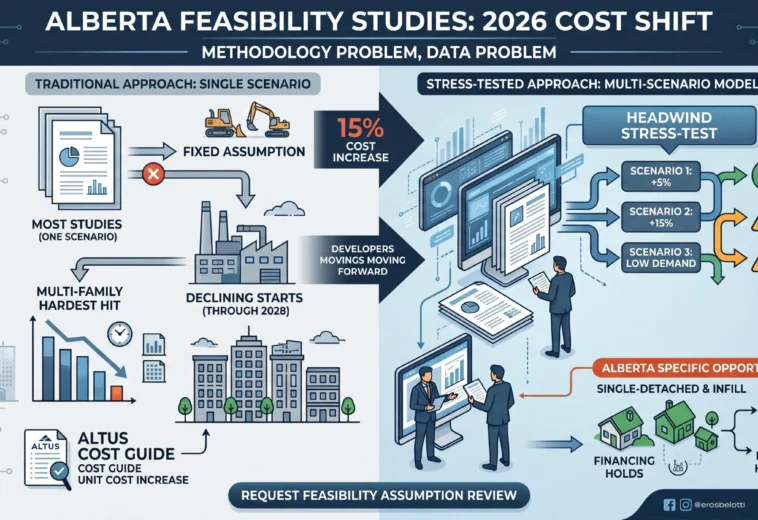
Most feasibility studies I review for Alberta projects share a hidden weakness: they are built on a single cost assumption. One construction budget, one sales price, one absorption rate, one outcome. When costs move, and in 2026 they do, that single scenario stops being a plan and becomes a liability.
This article explains why single-scenario feasibility is dangerous in today’s market, what the current cost data shows and how to build a study that still works when assumptions change.
What the cost data shows
Construction costs in Alberta are not falling. Altus Group’s 2026 Canadian Cost Guide reports overall cost increases of 4% or more in Calgary and Edmonton, led by healthcare and institutional projects, with low-rise residential and renovation costs also rising. The main pressures are metals such as steel and aluminum, affected by tariffs and trade uncertainty, and persistent labour shortages that drive wage inflation, schedule risk and fewer bids. Nationally, Statistics Canada’s Building Construction Price Index was up 4.1% year over year at the end of 2025.
Individual items can move far more than the average. Mechanical and electrical equipment containing metals, specialised trades and long-lead components are especially exposed to tariff decisions and supply disruptions.
The demand side is moving too
CMHC’s mid-2026 outlook forecasts national housing starts declining through 2028, with builders responding to unsold inventory and high costs. In Calgary, CMHC expects starts to fall to about 22,000 in 2026 and rental vacancy to rise to around 5.9%. Average prices are forecast to be broadly flat in Calgary. When costs rise and prices stay flat, margins compress from both sides.
Why single-scenario feasibility fails
A single-scenario study answers only one question: does the project work if everything goes as planned? It says nothing about how close the project is to failure. If a 5% cost increase or a three-month delay in absorption wipes out the profit, the project is fragile, even if the base case looks attractive.
A feasibility study that only works in perfect conditions is not a feasibility study. It is a best-case pitch.
How to build scenario-based feasibility
1. Define a realistic base case
Use current local unit costs, current prices or rents for your exact product and location, and realistic absorption based on recent data, not on the boom years.
2. Add a downside case
Model what happens if costs rise more than expected, prices fall, absorption slows and interest rates stay higher. A typical downside might combine construction costs up 8% to 10%, revenue down 5% and absorption six months slower.
3. Add an upside case
Know what happens if conditions improve. This helps decide whether to phase the project or hold options.
4. Run sensitivity tests on key variables
Change one variable at a time (hard costs, soft costs, sales price, rent, absorption, interest rate, construction duration) and record the effect on profit, return on cost and internal rate of return. The variables that move results most deserve the most attention.
5. Find the breaking points
Calculate how much each variable can move before the project no longer meets the minimum return. If costs can rise only 3% before the project fails, that is critical information for the investment decision.
6. Link scenarios to actions
For each downside, define a response: value engineering options, phasing, price adjustments, alternative unit mix or additional equity. A scenario without an action plan is only a warning.
Where opportunity still exists
Scenario analysis is not about finding reasons not to build. In Alberta, single-detached, infill and missing middle projects still hold opportunity in many locations, as do differentiated rental and publicly supported segments. The difference is that the projects that move forward in 2026 are those whose numbers survive realistic stress, and whose financing and margins are modelled honestly.
Protecting the budget after feasibility
Scenario analysis also guides execution decisions. If the study shows high sensitivity to construction costs, the project should prioritise early procurement of long-lead and tariff-exposed items, fixed-price subcontracts where possible and a design freeze before tender. If it shows sensitivity to absorption, phasing and pre-leasing or presale thresholds become the main tools. The feasibility study should therefore not end in a single yes or no; it should end with a short list of the controls that matter most for that specific project.
A simple example
Consider a 24-unit townhouse project with a base-case margin of 15% on cost. If hard costs rise 8%, the margin may fall to around 9%. If, at the same time, sales prices drop 5%, the margin may fall to around 4%. If absorption slows by six months, adding interest and holding costs, the project may break even or lose money. None of those scenarios is extreme in today’s market. Knowing them before buying the land allows the developer to negotiate a better land price, change the unit mix, phase the project or walk away.
The bottom line
For any developer, investor or contractor scoping projects in Alberta, the question is not only “does this pencil out?” It is “does this still pencil out when costs move?” The developers still moving forward in 2026 are not ignoring headwinds; they are stress-testing against them.
If you are working on a project and want a second read on your feasibility assumptions, see my feasibility services, read about where feasibility breaks in Alberta, or contact me.
Frequently asked questions
How much are construction costs rising in Alberta in 2026?
Altus Group’s 2026 Canadian Cost Guide reports overall increases of 4% or more in Calgary and Edmonton, driven mainly by tariff-affected metals and labour shortages.
What is scenario analysis in a feasibility study?
Testing the project under several sets of assumptions, such as base, downside and upside, to see how results change and where the project stops being viable.
What should a downside scenario include?
Higher construction costs, lower prices or rents, slower absorption, higher interest rates and a longer schedule, combined in realistic proportions.
Sources
- Altus Group: 2026 Canadian Cost Guide insights
- Canadian Construction Association: Economic Report, Spring 2026
- CMHC: Summer update, 2026 Housing Market Outlook
- 218 views
- 0 Comment

Eros Belotti 01.

Eros belotti
Construction project manager with over 20 years of experience in Europe and the Canary Islands. Specialized in modular housing, container construction, real estate development and international project management. Founder of Reforma Vivienda Tenerife and Donkey Lab.