

Alberta’s Indigenous Loan Guarantee Is 75% Unused. That Is Not a Funding Problem.
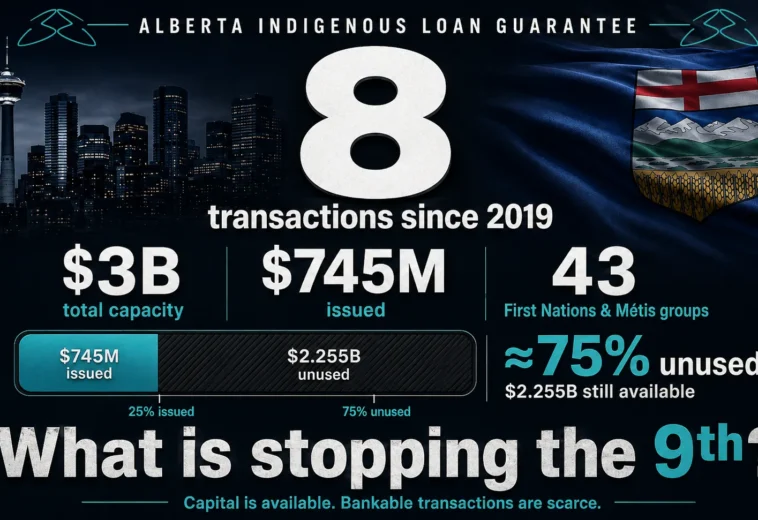
Alberta’s Indigenous loan guarantee programme has authorised up to $3 billion in capacity. Since 2019 it has issued just over $745 million across eight transactions, benefiting 43 First Nations and Métis groups.
Roughly three quarters of the capacity has never been drawn.
The obvious reading is that the programme is underused, and that someone should be marketing it harder. I think that reading is wrong, and the reason it is wrong matters to anyone who develops, finances or builds capital projects in this province.
What the Alberta Indigenous loan guarantee actually is
The Alberta Indigenous Opportunities Corporation is a provincial Crown corporation created in 2019. It does not lend money. It guarantees borrowing, which lowers the cost of capital for Indigenous Nations and groups taking equity positions in commercial projects.
The parameters are specific:
- Capacity: up to $3 billion in guarantees
- Minimum per transaction: $20 million
- Maximum per transaction: $250 million
- Eligible sectors: natural resources, agriculture, telecommunications, transportation, tourism, healthcare, technology
Note what is absent from that list. Construction and real estate are not eligible sectors in their own right. Access is indirect — as the builder, developer or technical partner of an asset that sits inside a sector that does qualify.
That distinction is where most people stop reading. It is also where the opportunity starts.
The numbers
| Metric | Value |
|---|---|
| Authorised capacity | Up to $3 billion |
| Issued to date | $745 million+ |
| Transactions closed | 8 |
| Nations and groups benefiting | 43 |
| Average per transaction | ≈ $93 million |
| Capacity remaining | ≈ 75% |
Two things stand out. The first is the obvious one — most of the facility is untouched. The second is less obvious and more useful: at roughly $93 million, the average closed transaction sits near the upper half of the permitted range.
The programme is not failing at the top end. It is producing almost nothing in the $20 to $50 million band.
Why “underused” is the wrong diagnosis
AIOC is direct about what it will consider: mid- to large-scale, commercially viable projects supported by well-defined business and financial plans, strong business models, and detailed transaction terms.
Read that as a specification, not as marketing copy. It describes a document set. A guarantee is not approved because a project is a good idea — it is approved because someone has produced a file that a lender’s credit committee can price.
If the capital is authorised and available, and the applications are not arriving in volume, then the constraint is upstream of the capital. The constraint is the number of transactions that reach that standard of preparation.
That is not a finance problem. It is a development problem, and it is one that construction and engineering firms are unusually well placed to solve — because the inputs are the same ones they already produce.
Where construction and development firms fit
Every eligible sector on that list turns into a physical asset before it becomes a revenue stream. A processing facility. A fibre route. A road. A lodge. A clinic. A data hall.
And the work that moves a transaction toward a term sheet overlaps almost completely with the work that moves a project toward a construction contract:
- A feasibility study that survives third-party review
- A cost base built from measured quantities, not allowances
- A schedule with identified critical path and named long-lead items
- A risk register that assigns each item to a party who can actually carry it
- A capital structure that shows when the asset starts producing cash
Firms that treat Indigenous partnership as a box on a procurement form are answering a compliance question. Firms that can produce the file above are answering the question that actually unlocks capital — and they are doing it as a service to the Nation that holds the equity, not as a route around them.
That order matters. The Nation is the principal. The technical work is the service.
The gap nobody has filled
Eight transactions in seven years, averaging $93 million, tells you the large-ticket pathway exists and works. Advisors know it, lenders know it, and the deals get done.
The $20 to $50 million transaction is a different animal. It carries almost the same structuring cost as a $200 million deal but supports far less advisory fee, which means the specialist finance market has limited incentive to build a repeatable process for it.
That is precisely the size at which most Alberta development and mid-market construction firms operate.
The unused capacity is not evidence that nobody wants the money. It is evidence that nobody has yet built a template for the smaller deal — a standardised, defensible package that can be produced at a cost proportionate to the transaction.
What to take from this
If your growth plan assumes that capital is the hard part of a project in Alberta, the evidence points elsewhere. There is authorised guarantee capacity sitting unused, and the thing standing between it and a project is documentation quality.
That is a solvable problem. It is also a slow one — relationships with Nations are built over years, not quarters, and any firm approaching this as a short-term business development play will deserve the outcome it gets.
But the arithmetic is hard to ignore. Eight transactions in seven years, in a province with a $28.3 billion three-year capital plan and a Crown corporation with $2.25 billion in unused guarantee capacity.
The ninth transaction is not waiting on a policy change.
Sources
- Alberta Indigenous Opportunities Corporation — About Us
- Alberta Indigenous Opportunities Corporation — Impacts
- Alberta Indigenous Opportunities Corporation — Projects
- Alberta Capital Plan
- 140 views
- 0 Comment

Eros Belotti 01.

Eros belotti
Construction project manager with over 20 years of experience in Europe and the Canary Islands. Specialized in modular housing, container construction, real estate development and international project management. Founder of Reforma Vivienda Tenerife and Donkey Lab.