

//Calgary Property Tax 2026: The City Raised 1.8%. The Province Raised 21%.
Calgary Property Tax 2026: The City Raised 1.8%. The Province Raised 21%.
Tags : AlbertaCalgarycommercial real estateFeasibilitymunicipal budgetoperating expensesproperty taxunderwriting
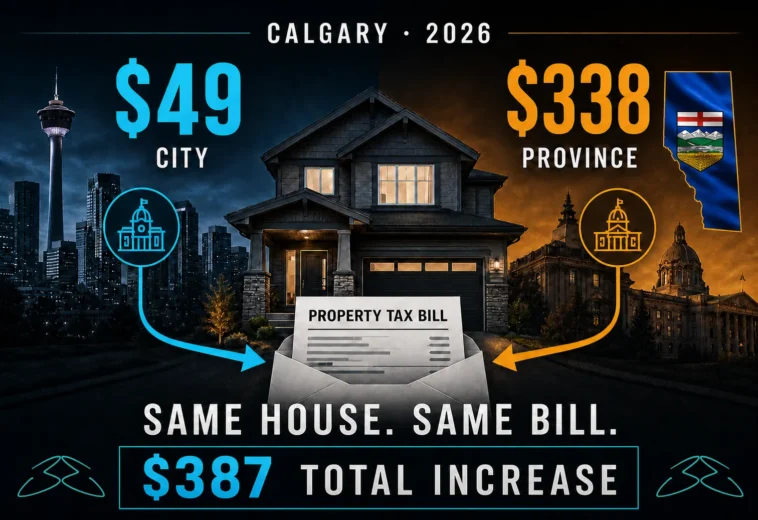
On a typical Calgary home assessed at $706,000, the municipal portion of the property tax bill went up $49 this year. The provincial portion went up $338.
Same house. Same envelope. Two very different numbers.
The Calgary property tax 2026 conversation has focused almost entirely on City Hall — on a November budget debate, on a tax shift that was cancelled, on a headline rate that came in lower than proposed. All of that happened. None of it explains the number on the bill.
What Calgary actually approved
On March 31, 2026, City Council approved the bylaws that set the Calgary property tax 2026 rates. The provincial budget had been the last missing input: until Alberta tables its own numbers, the City cannot calculate what it owes upward, and therefore cannot finalise what it charges.
Three inputs determine the rate and the bill:
- The municipal budget. In November 2025, Council adjusted its 2026 budget and reduced the proposed property tax revenue increase from 3.6 per cent to 1.6 per cent.
- Total assessed value. Property Assessment Notices were mailed January 14, 2026. The city-wide total sets the rate; the individual assessment sets the bill.
- The provincial budget. This determines the requisition — the amount of property tax the City collects on behalf of the Province and remits to it.
The first input is debated in public for weeks. The third arrives late, from a different government, and lands on the same bill.
Where the Calgary property tax 2026 increase came from
For a single-family home assessed at $706,000:
- The City of Calgary: an increase of $49 per year, or 1.8 per cent
- The Province of Alberta: an increase of $338 per year, or 21 per cent
City-wide, the provincial portion rose by $212 million in a single year — a 20.4 per cent increase. Calgary now remits over $1.2 billion in property tax to the Province, the highest amount of any Alberta municipality classified as a city on a per-capita basis.
Put the two residential figures together and the total Calgary property tax 2026 increase on that typical home is $387. The City accounts for $49 of it.
Council did not raise the tax bill. It raised $49 of a $387 increase.
The tax shift that dominated the debate
There was a second municipal decision in November 2025 that the commercial market watched closely, and it shaped most of the public Calgary property tax 2026 discussion.
Council had planned to shift 1 per cent of the tax share from non-residential to residential properties in 2026. It cancelled that shift, citing economic pressure on Calgarians, and replaced it with a slower approach: a gradual shift of 0.25 per cent per year over eight years, beginning in 2027, intended to support local businesses.
This is a real decision with real consequences for commercial owners. But it is worth being precise about what kind of decision it is. The tax share governs how the burden is divided between property classes. It does not govern the size of the amount being divided — and in 2026, the size is where the movement happened.
Why this matters for underwriting and feasibility
If you hold or are acquiring an asset in Calgary, the property tax line sits in your operating expense model, and that model has to be indexed to something.
The common approach is to index it to municipal signals: council composition, budget cycles, the annual rate announcement. Those signals are visible, well covered by local media, and easy to follow.
They are also, this year, the smaller input. The Calgary property tax 2026 increase was driven overwhelmingly by a requisition set outside the municipal process entirely.
The provincial requisition follows a separate calendar, reflects provincial fiscal priorities, and is not subject to the municipal budget debate at all. A model that treats it as a flat pass-through, or that folds it into a single blended municipal growth assumption, will understate volatility in the tax line — and property tax is rarely a small line.
Calgary property tax 2026: what to check in your model
Two practical points follow.
First, separate the two components. Municipal and provincial portions should be distinct line items with distinct growth assumptions. Blending them hides exactly the divergence that showed up this year.
Second, watch the provincial budget, not just the council vote. The provincial budget release is the input that finalises Calgary’s rates. If your review cycle only picks up the November municipal budget, you are seeing part of the picture several months before the rest of it arrives.
Third, check the date your assumption was set. Most operating models in circulation were built when the requisition was stable. A stable input that stops being stable does not announce itself in a model — it just quietly stops being right.
An important caveat on the numbers
The $49 and $338 Calgary property tax 2026 figures published by the City are for a typical residential property. Non-residential assessments follow a different rate and a different assessment methodology, and property tax changes depend on both property type and value.
The mechanism described here — a provincial requisition moving faster than the municipal levy — applies across classes. The specific dollar figures do not. Anyone modelling a commercial asset should work from that asset’s own assessment notice rather than extrapolating from the residential example.
The question worth asking
The useful question for owners and developers is not “what will Council do next year?”
It is “what is the Province going to requisition, and is that line modelled separately in my pro forma — or is it assumed flat?”
For most models built in the last few years, the honest answer is the second one. The Calgary property tax 2026 bill is the first one in a while that makes the difference visible.
Sources
- Provincial budget finalizes information needed to set Calgary’s 2026 property tax rates — The City of Calgary Newsroom, March 31, 2026
- Municipal tax share — The City of Calgary
- 2026 Budget — The City of Calgary
- Understanding your residential property tax changes 2026 — The City of Calgary
- Delivering City services and determining your property tax bill — The City of Calgary
Frequently asked questions
How much did Calgary property tax 2026 go up?
On a typical single-family home assessed at $706,000, the total increase was $387 per year. Of that, $49 came from the municipal portion — a 1.8 per cent increase — and $338 came from the provincial portion, a 21 per cent increase.
Why is my Calgary property tax 2026 bill up more than the 1.8 per cent I read about?
The 1.8 per cent figure refers only to the City of Calgary’s share. Your bill also includes a provincial requisition that the City collects and remits to the Province of Alberta. In 2026 that provincial portion rose 20.4 per cent city-wide, an increase of $212 million.
What is the provincial property tax requisition?
It is the portion of property tax that municipalities in Alberta collect on behalf of the provincial government and pass through to it. The amount is determined by the provincial budget, not by municipal council, and it appears on the same bill as municipal taxes.
Did Calgary shift property tax from businesses to homeowners in 2026?
No. Council cancelled the 1 per cent shift from non-residential to residential that had been planned for 2026. It approved a gradual shift of 0.25 per cent per year over eight years, starting in 2027.
When are Calgary 2026 property taxes due?
Tax bills are mailed in May and payment is due by June 30 for owners paying a single annual lump sum. The City also offers a Tax Instalment Payment Plan (TIPP) for monthly payments.
- 110 views
- 1 Comment

Eros Belotti 01.

Eros belotti
Construction project manager with over 20 years of experience in Europe and the Canary Islands. Specialized in modular housing, container construction, real estate development and international project management. Founder of Reforma Vivienda Tenerife and Donkey Lab.


August 26, 2026 /
A note on the timing, which is the part I find most telling.
The City can’t finalise its rates until the province tables its budget. Council debated its own numbers in November 2025. The provincial figure landed on March 31, 2026 — four months after the public conversation had closed. By the time the larger input arrives, nobody is watching.
One limitation I want to be explicit about: the $49 and $338 figures are residential, because those are the only ones the City publishes in plain language. If you hold a commercial asset in Calgary and your 2026 assessment notice shows a different split between the municipal and provincial components, I’d like to see it. I’ll update the article with verified figures and credit the source.