

Categories
//Calgary vs Edmonton Property Tax 2026: Lower Rate, Bigger Bill
Calgary vs Edmonton Property Tax 2026: Lower Rate, Bigger Bill
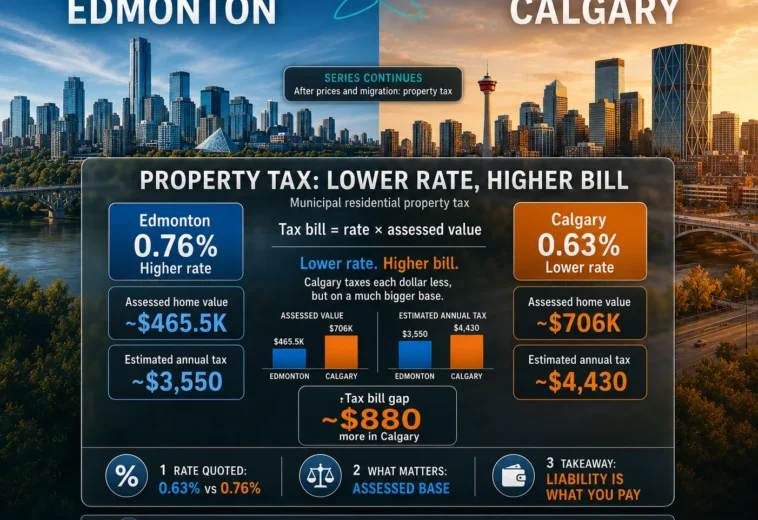
0.63% vs 0.76%. Those are the 2026 residential property tax rates in Alberta’s two biggest cities — and they hide a trap. When you compare Calgary vs Edmonton property tax, Calgary has the lower rate, yet the typical Calgary homeowner writes a bigger cheque to the city than their Edmonton counterpart. Same province. Lower rate. Higher bill. All three are true at once, and it catches almost everyone off guard — including people underwriting real estate projects for a living.
The paradox in one line
A few days ago I broke down the Calgary–Edmonton price gap: an average home runs about $669,519 in Calgary versus $483,600 in Edmonton. The obvious follow-up question is, “So Edmonton is cheaper to own, right?” On property tax, the answer flips. A lower headline rate does not mean a lower bill.
How property tax actually works
Property tax isn’t a rate. It’s a rate multiplied by an assessed value — the city’s official valuation of your home. Alberta cities express the rate as a mill rate, where one mill equals $1 of tax for every $1,000 of assessed value.
For 2026, Calgary’s municipal residential mill rate sits at roughly 6.28 (about 0.63%), while Edmonton’s is around 7.63 (about 0.76%). In other words, Edmonton taxes each dollar of home value harder. So far, that would suggest Edmonton owners pay more. But the rate is only half the equation.
Calgary vs Edmonton property tax, run on a real home
The other half is the base. Calgary homes are assessed far higher than Edmonton homes, and that gap is large enough to overturn the rate. Run the numbers on each city’s median single-family home:
- Calgary — ~$706,000 assessed × 6.28 mills ≈ $4,430 per year
- Edmonton — ~$465,500 assessed × 7.63 mills ≈ $3,550 per year
The result: the city with the lower rate collects roughly $880 more per home. The assessment base sets the bill, not the rate.
Why the assessment base beats the rate
This is the part that trips up even experienced buyers. A rate is a percentage; a bill is a dollar figure. Two cities can move their rates in opposite directions and still see their bills converge — or invert — because assessed values are doing the heavy lifting underneath. In the Calgary vs Edmonton property tax comparison, Calgary’s assessment base is high enough that a materially lower rate still produces a materially higher bill.
It’s the same reason a “low tax rate” headline in any jurisdiction tells you very little on its own. The rate is the number everyone quotes. The liability is what actually leaves your account.
The caveat worth stating plainly
Property tax is only a small slice of the total carrying cost — the full annual cost of holding a property. Financing, insurance, and (for condos) monthly fees usually move the needle far more than an $880 tax difference. So this comparison, on its own, is not a reason to choose one city over the other. Anyone deciding between the two should model the entire carrying cost, not a single line item.
What it means for underwriting an Alberta project
For developers, investors, and anyone running a feasibility study, the lesson is concrete: a headline tax rate tells you almost nothing until you multiply it by the assessment base you’re actually building into. If you underwrite carrying cost off the rate alone, you can misprice the same building by four figures a year, per unit — and that error compounds across a portfolio.
The discipline is simple. Pull the current mill rate, pull the assessment base for the property type and location you’re modelling, and multiply. Don’t let a low rate flatter your pro forma.
FAQ
Is property tax higher in Calgary or Edmonton?
On a typical median single-family home in 2026, Calgary’s annual municipal property tax bill (~$4,430) is higher than Edmonton’s (~$3,550), even though Calgary’s rate is lower — because Calgary homes are assessed at higher values.
Why does Calgary have a lower rate but a higher bill?
Because property tax equals the rate times the assessed value. Calgary’s assessed values are high enough that they outweigh its lower rate, producing a larger bill.
What is a mill rate?
A mill rate is a way of expressing the property tax rate: one mill is $1 of tax for every $1,000 of assessed value. A 6.28 mill rate equals roughly 0.63%.
The bottom line
The Calgary vs Edmonton property tax picture is a clean reminder that in real estate math, the base beats the rate. Rate is what gets quoted; liability is what gets paid. Whether you’re buying a home or underwriting a build, multiply before you conclude.
Do you model carrying cost off the rate, or off the assessed base? I’d be curious where others land.
- 125 views
- 1 Comment

Eros Belotti 01.

Eros belotti
Construction project manager with over 20 years of experience in Europe and the Canary Islands. Specialized in modular housing, container construction, real estate development and international project management. Founder of Reforma Vivienda Tenerife and Donkey Lab.




July 31, 2026 /
Sources:
→ 2026 municipal residential mill rates — Calgary 6.28 (~0.63%), Edmonton 7.63 (~0.76%), via city budgets / MillRate.ca
→ Median single-family assessments — Calgary ~$706K, Edmonton ~$465.5K (Edmonton median municipal tax reported at ~$3,550, which this math reproduces)