

//Canada Start-Up Visa 2026: What the Pause Really Costs
Canada Start-Up Visa 2026: What the Pause Really Costs
Tags : Albertabusiness immigrationCalgaryCanada Start-Up Visaentrepreneur pilotforeign direct investmentImmigrationImmigration PolicyIRCC
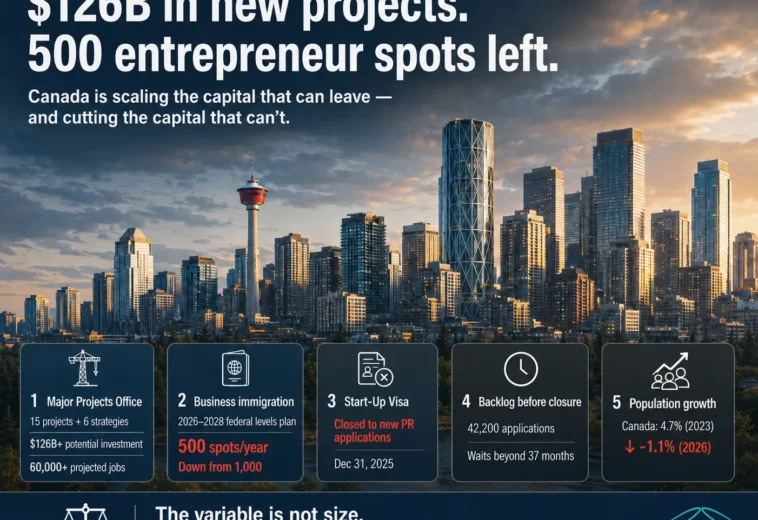
The Canada Start-Up Visa 2026 pause is the most important immigration decision almost no one is talking about. On December 31, 2025, Canada closed its flagship entrepreneur programme to new applicants. The replacement — a “targeted entrepreneur pilot” promised for 2026 — still has no criteria and no launch date. At the same time, the country is chasing more than $126 billion in megaprojects and openly targeting $1 trillion in new investment. On the surface, that looks like a nation open for business. Look closer at who owns what, and a different picture emerges.
I am writing this as someone with a stake in the outcome: an entrepreneur and construction project manager planning a move to Alberta. This is not a policy critique from the sidelines. It is the read of a person deciding where to put his company, his taxes, and his family.
What changed: a timeline of the Canada Start-Up Visa 2026 pause
The shutdown did not arrive as a single headline. It came in steps, which is part of why it drew so little attention.
- December 19, 2025: IRCC announced the measures and immediately stopped issuing new Start-Up Visa work permits.
- December 31, 2025: intake of new permanent residence applications under the Start-Up Visa closed.
- Self-Employed Persons Program: already paused, with the pause extended “until further notice.”
- June 30, 2026: final deadline for the small group of founders who already held a 2025 commitment certificate.
- 2026–2028 Levels Plan: the federal business category target set at 500 admissions per year, down from 1,000.
The official rationale is legitimate. IRCC pointed to a backlog of roughly 42,000 applications (including family members), processing times past 37 months, and files from 2022 sitting inside a ten-year queue. By any honest measure, the old programme was broken.
But “broken” is an argument for repair, not for halving the numbers and closing the intake before the replacement exists. As of mid-2026, the Canada Start-Up Visa 2026 replacement pilot remains a promise on a page marked “Paused” — no eligibility rules, no caps, no date. Meanwhile founders who were mid-process have started shifting to the UK Innovator Founder visa and the US International Entrepreneur Parole.
The megaproject arithmetic
Now the other side of the ledger. Canada is not standing still on investment — quite the opposite.
The Major Projects Office opened in Calgary in August 2025. By spring 2026 it listed 15 projects and 6 strategies representing over $126 billion in potential investment and more than 60,000 jobs. That works out to roughly $2.1 million of capital per job — and that figure already counts the temporary construction phase, which is the generous reading. Strip out construction and the ratio gets worse.
The composition matters, too. The Red Chris mine expansion is projected at about 1,500 construction workers and 800 in operation. That is a favourable ratio compared with what is coming next. A data centre — where the binding constraint is provincial electricity allocation, and every megawatt assigned is a megawatt taken from something else — employs a fraction of that once built. Big numbers on capital do not translate into proportional, durable local benefit.
The real variable: ownership, not project size
Here is the core of it. The economic benefit of an asset is determined less by how big it is than by where its owner lives.
An entrepreneur who physically relocates, pays tax locally, buys a home, hires on the block, and absorbs the social cost of his own decisions is the one category of capital that cannot leave.
A pipeline’s owner can sit in Geneva. A data centre’s shareholders can sit anywhere on earth. A resident founder cannot — his interests are pinned to the place he lives. That distinction is not sentimental; it is structural. Between 2015 and 2024, RBC estimates that more than $1 trillion in net foreign direct investment left Canada. Capital that can leave, does. Capital that has moved house, stays.
None of this means 500 entrepreneurs “replace” $126 billion in megaprojects. That framing misses the point. It is not substitution — it is portfolio balance. A healthy economy needs both the capital that scales (large projects, royalties, infrastructure) and the capital that roots (resident owners who compound locally over decades). The problem with the Canada Start-Up Visa 2026 decision is not that big projects are being pursued. It is that one side of the portfolio is being built aggressively while the other is being cut.
Why the timing makes it worse
Demographics sharpen the mistake. Canada’s population growth is falling fast — from 4.7% in 2023 to an estimated 1.1% for 2026. When a country stops growing by adding people, the levers that remain are productivity and new firm formation.
In other words, this is precisely the decade in which the entrepreneurial channel matters most — and it is the channel that just got halved and paused. Alberta is the sharpest example of the stakes: it is the country’s fastest-growing province and has led interprovincial migration for 15 consecutive quarters. It is exactly where new resident owners would compound the most, and exactly where the closed door is felt.
A view from the Canary Islands
I do not argue this from theory. I live inside the alternative model. I am resident in the Canary Islands, where the leading sector accounts for 37.7% of GDP and 42.3% of employment. And yet one resident in three is at risk of poverty — an AROPE rate of 31.2% against a 25.7% national average — while rents hit a record 15.7 €/m² in April 2026, up 7.3% in a year.
Record employment sitting next to static poverty. That is the tell. Jobs were never the variable. Tourism here is extremely labour-intensive, and it produces the same extractive structure as an asset that employs almost no one. Only the intensity changes, not the structure. When the owners of the productive base live elsewhere, headline job counts can rise while local prosperity stalls.
For the record: I run short-term rentals and luxury villas in Costa Adeje. I am not describing this from the outside. I am the resident taxpayer — exactly the category this argument defends.
This is not anti-development
Let me be precise about what I am not saying, because the easy misreading is that this is hostility to big projects. It is not.
Ports, transmission lines, and critical minerals paired with domestic processing build genuine supply chains and pay royalties for decades. In Alberta, that resource revenue is the base the provincial budget sits on. Pipelines and LNG generate returns that fund public services long after construction ends. All of that is real and worth defending. The critique is narrower and more specific: a portfolio weighted heavily toward capital that can leave, with the single channel that roots ownership halved and suspended, is not a development strategy. It is a bet.
What the Canada Start-Up Visa 2026 pause means for founders eyeing Alberta
If you are an entrepreneur weighing a move to Canada right now, here is the practical read.
- The federal entrepreneur door is closed for now. New Start-Up Visa applications are not being accepted, and the replacement pilot has no published criteria or date. Do not build a timeline around a programme that does not yet exist.
- Watch the pilot, but plan without it. Early signals point to sector quotas (AI, clean-tech, life sciences), 12-month service standards, and a requirement to already be operating in Canada. If confirmed, it will favour founders with existing Canadian operations — which changes sequencing.
- Provincial and alternative pathways matter more than ever. Provincial Nominee streams, intra-company routes, and work-permit-first strategies deserve a serious look while the federal channel is paused.
- Alberta’s fundamentals remain strong. Fastest-growing province, leading interprovincial migration, deep construction and energy demand. The opportunity did not disappear; the easiest immigration route to it did.
The honest summary: the destination still makes sense. The paved road to it was closed without a detour posted. Anyone serious about the move should treat the next official pilot announcement as the single most important thing to track.
Frequently asked questions
Is the Canada Start-Up Visa open in 2026?
No. Canada closed the Start-Up Visa to new applicants on December 31, 2025. Only founders who held a valid 2025 commitment certificate could still apply, with a final deadline of June 30, 2026.
What is replacing the Start-Up Visa?
The government has promised a “targeted entrepreneur pilot” for 2026, expected to focus on sectors such as AI, clean-tech and life sciences with faster processing. As of mid-2026 it had no published eligibility criteria, no intake caps, and no launch date.
Why did Canada pause the programme?
IRCC cited a backlog of roughly 42,000 applications and processing times exceeding 37 months. The programme was genuinely overloaded — the debate is about closing intake before a replacement was ready.
How much did business immigration get cut?
The 2026–2028 Immigration Levels Plan sets the federal business category target at 500 admissions per year, down from 1,000.
The bottom line
Canada is scaling the capital that can leave and cutting the capital that cannot. The Canada Start-Up Visa 2026 pause is not a small administrative footnote — it is the quiet removal of the one immigration channel designed to root ownership locally, at the exact moment demographics make that channel most valuable. Big projects will keep the headlines. But over a decade, it is resident owners who decide whether growth turns into prosperity or just into activity. Right now, the portfolio is out of balance. Whether that gets corrected depends entirely on what the next pilot actually delivers.
Are you building in Alberta, or watching the same imbalance play out where you live? I would like to hear how it looks from your side.
- 128 views
- 1 Comment

Eros Belotti 01.

Eros belotti
Construction project manager with over 20 years of experience in Europe and the Canary Islands. Specialized in modular housing, container construction, real estate development and international project management. Founder of Reforma Vivienda Tenerife and Donkey Lab.




July 31, 2026 /
For anyone who wants to check the numbers:
→ Start-Up Visa closed to new applicants; the replacement “targeted entrepreneur pilot” still has no criteria and no date (IRCC).
→ 2026–2028 Immigration Levels Plan: federal business immigration cut from 1,000 to 500 per year.
→ Major Projects Office (Calgary): 15 projects + 6 strategies, ~$126B, 60,000+ jobs.
→ RBC: over $1 trillion in net FDI left Canada between 2015 and 2024.
One thing I want to be clear about, before anyone reads this as anti-development: it isn’t. Pipelines, LNG and critical minerals pay royalties that carry Alberta’s budget for decades — that’s real, and I’m not arguing against it.
My point is narrower. A portfolio needs both the capital that scales and the capital that roots. Right now one side is being built and the other was cut. That’s the imbalance — not the projects themselves.