

//Fort Worth Real Estate: Reading the Texas A&M Campus Demand Wave
Fort Worth Real Estate: Reading the Texas A&M Campus Demand Wave
Tags : commercial real estateConstruction ManagementDallas-Fort WorthDFWFeasibilityFort Worthmarket analysismultifamilyNorth TexasReal Estate DevelopmentTexas A&M Fort WorthTexas real estate
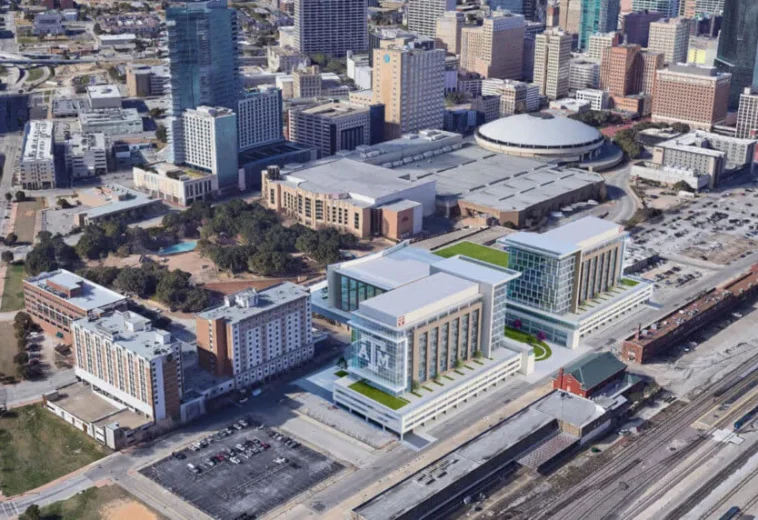
On August 5, 2026, Texas A&M University-Fort Worth opened its first academic building in downtown Fort Worth and broke ground on the next phase of the campus. When fully built, the Texas A&M-Fort Worth district is projected to support more than 25,000 direct and indirect jobs and generate more than $3 billion in annual economic activity. Headlines like these attract developers quickly. The real opportunity, however, depends on timing and on which real estate segments respond first.
This article looks at what the campus includes, how demand typically moves around large institutional anchors and how to approach feasibility for projects near the district.
What has been built and what comes next
The first building, the Law & Education Building, is eight stories and about 228,000 square feet. On the same day, the university system broke ground on the 11-story Research & Innovation Building-A, scheduled for completion in 2029. The campus brings together Texas A&M University programs in law, engineering, business, health and pharmacy, Tarleton State University programs, Texas A&M-Corpus Christi’s aviation technology center and several Texas A&M System agencies, working with the Fort Worth-Tarrant County Innovation Partnership and private-sector partners.
Demand moves with the construction schedule
Large institutional projects create demand in waves, and the waves follow construction and hiring milestones rather than ribbon-cuttings. Typically:
- During construction: demand for construction workforce housing, short-term rentals and services.
- As buildings open: students, faculty and staff create demand for rental housing, food and retail near the campus.
- As research and corporate partners arrive: office, lab, flexible industrial and logistics space, and higher-end residential for professionals.
- Over the long term: broader neighbourhood change, including ownership housing and mixed-use development.
With the first building opened in 2026 and the second scheduled for 2029, the district is at an early stage. Not all of the projected 25,000 jobs will arrive at once.
Which segments move first
Student and young-professional rental
Rental housing within walking or transit distance of the campus is usually the first segment to respond. Unit mix, price point and amenities should reflect students and early-career professionals.
Multifamily and mixed-use
As faculty, staff and research employees arrive, demand grows for well-designed multifamily with ground-floor retail and services.
Office, lab and flex space
Research partnerships and corporate relocations create demand for specialised space, but lab and research facilities require specific design and long lead times.
Logistics and retail
Supporting businesses follow population and employment, usually with some delay.
Detached single-family
Single-family demand tends to lag the wave, as households settle and look for longer-term homes in surrounding neighbourhoods.
The market context
The broader Texas market was adjusting in 2026. The Texas A&M Real Estate Research Center reported in its housing insight for June 2026 that statewide sales were up 8.6% year over year while prices were slightly below year-ago levels, extending a decline that began in mid-2025. Fort Worth-Arlington posted year-over-year price gains in recent months, suggesting relative strength. Developers near the campus should still underwrite carefully: regional supply, financing costs and construction prices all affect feasibility.
How to approach feasibility near an institutional anchor
Map the timeline
List building openings, enrolment phases and announced partner arrivals. Match project delivery to the phase that creates demand for your product.
Define the target occupant precisely
Students, faculty, researchers, corporate employees and service workers have different budgets and needs. A project designed for one group may not suit another.
Check competing supply
Anchor announcements attract many developers at once. Track proposed and under-construction projects within the same radius.
Assess site and infrastructure
Downtown and near-downtown sites involve zoning, parking requirements, utility capacity and existing buildings. Surveys and early design studies reduce risk.
Stress-test absorption and rents
Model slower ramp-up of campus population and lower rents in the first years. Institutional projects can shift schedules and scope, so build flexibility into your assumptions.
Risks to keep in mind
- Timeline changes in campus phases or partner commitments.
- Oversupply if many developers target the same segment at once.
- Construction cost escalation and tariff effects on materials.
- Financing conditions for speculative development.
Lessons from other university districts
University and innovation districts across North America show a consistent pattern. Early movers that build for the first wave of students and staff often succeed, but only when their projects match the actual size and timing of that wave. Projects launched on the assumption that the full projected employment will arrive immediately frequently face slow lease-up. The districts that mature successfully combine institutional anchors with mixed-use development, transit access and a steady flow of private partners over a decade or more. For developers, patience and phasing are as important as location.
Questions to ask before committing
Before buying land or committing to a project near a new campus, investors should ask a few direct questions. How many students, faculty and staff will be on site in each phase, and when? Will the institution provide its own housing, and how much? What transit and parking changes are planned around the campus? Which competing projects are already in the permitting pipeline nearby? Answering these questions with data from the institution, the city and local brokers turns a general growth story into a specific, testable demand forecast for the project.
The bottom line
The Texas A&M-Fort Worth campus is a long-term demand generator, not a quick win. But it is not a wait-and-see story either. The first segments to benefit, student and young-professional rental and multifamily, are already relevant, while office, logistics and single-family will follow. The question for developers, contractors and investors is which segment, which submarket and which timing.
If you are evaluating a project near the innovation district and want a second read on the numbers, see my feasibility services, read my analysis of the Texas housing market in 2026, or contact me.
Frequently asked questions
How many jobs will the Texas A&M Fort Worth campus create?
When fully built, the district is projected to support more than 25,000 direct and indirect jobs and over $3 billion in annual economic activity.
When did the first building open?
The Law & Education Building opened on August 5, 2026. The Research & Innovation Building-A is scheduled for completion in 2029.
Which real estate segments benefit first?
Typically student and young-professional rental and multifamily near the campus, followed by office, lab, retail and logistics, with single-family demand lagging.
Sources
- Texas A&M-Fort Worth: First academic building opens, next phase breaks ground (August 2026)
- Texas Housing Insight, August 2026 (Texas A&M Real Estate Research Center data)
- 128 views
- 1 Comment

Eros Belotti 01.

Eros belotti
Construction project manager with over 20 years of experience in Europe and the Canary Islands. Specialized in modular housing, container construction, real estate development and international project management. Founder of Reforma Vivienda Tenerife and Donkey Lab.

June 30, 2026 /
Numbers are from the economic impact analysis cited by the project leadership (Fort Worth Inc. / Cowtown Business & Capital Summit, Feb 2026).
Curious where others land: if you were allocating capital near the district today, would you lead with multifamily or wait for the single-family wave?