
Calgary Suburbs Growth: Where the Region Is Really Expanding
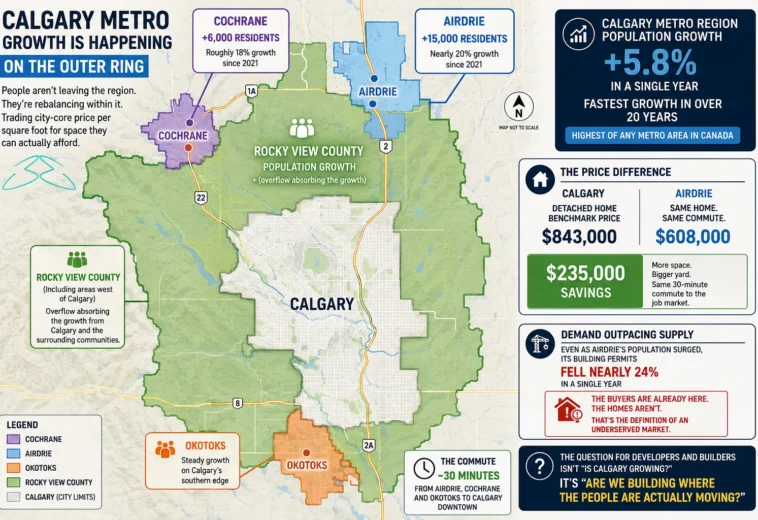
Calgary just posted the fastest population growth of any major metro area in Canada — but the most important part of that story isn’t happening inside the city. Calgary suburbs growth is quietly redrawing the map of the region, pulling tens of thousands of new residents into the collar towns of Airdrie, Cochrane, Okotoks and Rocky View County. For anyone in real estate, construction or development, understanding where that demand is landing — and why — matters more than the headline growth rate itself.
Here’s what the data shows, where the popular narrative gets it wrong, and what it means for the people who actually build and finance homes in this region.
The Numbers Behind Calgary Suburbs Growth
The Calgary Census Metropolitan Area — which includes Airdrie, Cochrane, Chestermere and Rocky View County — grew 5.8% between July 2023 and July 2024, the highest growth of any CMA in Canada and the fastest pace in more than two decades. Growth cooled to roughly 2.9% the following year, but Calgary still ranked among the three fastest-growing metros in the country.
Zoom in, and the pattern is clear: a disproportionate share of that growth is happening outside the city core.
| Community | 2021 | 2025 | Change |
|---|---|---|---|
| Airdrie | 77,079 | ~92,500 | +15,000 (~20%) |
| Cochrane | 33,295 | 39,397 | +6,000 (~18%) |
| Okotoks | ~31,000 | ~33,500 | +2,000 (~7%) |
| Rocky View County | — | ~46,000 | Steady inflow |
Airdrie alone added roughly 15,000 residents in four years — close to 20% growth. Cochrane grew about 18%. Okotoks, further south with tighter land and servicing constraints, grew more slowly. This isn’t people leaving the region. It’s people rebalancing within it.
Why People Are Moving to the Collar Towns
The main driver is affordability, and it shows up on every buyer’s spreadsheet. Using CREB benchmark data, a detached home in Calgary sits around $843,000, while the Airdrie benchmark is closer to $608,000.
A quick caveat that seasoned buyers rightly point out: the benchmark is not a like-for-like comparison. Calgary’s figure is pulled up by inner-city stock that has no direct equivalent in Airdrie, so the true gap on a comparable home — same size, age and finish — is narrower than the headline spread. But directionally the signal holds: buyers get more house and more yard for their dollar the further out they go.
Two other forces are amplifying Calgary suburbs growth:
- Interprovincial migration. A large share of the metro’s record growth came from other provinces — especially British Columbia, where buyers trade Lower Mainland prices for Alberta affordability and often land in the collar towns first.
- Lifestyle and space. Young families want a yard, a garage and a community feel, without giving up access to a big-city job market.
The commute trade-off is real, though. The “30-minute” figure holds off-peak, but heading into downtown Calgary at rush hour it can stretch to 40–60 minutes. The nuance that matters: as employment spreads into the north and the industrial ring, fewer suburban buyers commute to a downtown tower every day. Commute-to-a-job is increasingly different from commute-to-downtown.
The Supply Gap Developers Can’t Ignore
Here’s the part that should interest anyone in development and construction: demand is running ahead of supply.
Even as Airdrie’s population surged, its building permits fell nearly 24% in a single year (1,355 permits in 2024, down from 1,781 in 2023). The buyers are already there. The homes are not being permitted fast enough to match them. That is the textbook definition of an underserved market — and it is not in the tower core, it’s in the collar around it.
But population demand and buildable supply don’t always point the same direction. Expansion west is attractive to residents but challenging and costly for developers because of terrain, servicing and approvals. Growth is easier to deliver to the north, south and east, where land and infrastructure are more forgiving. Industry veterans note that the vast majority of new residential volume clusters within about 10 minutes of the Highway 2 (QE2) corridor — access and servicing, not distance on a map, decide where shovels actually go.
That mismatch — between where people want to live and where it’s feasible to build — is exactly where rigorous feasibility work earns its keep.
What Calgary Suburbs Growth Means for 2026 and Beyond
For developers and builders, the strategic question is no longer “Is Calgary growing?” It’s “Are we building where the people are actually moving?” The collar towns represent a durable, migration-fed demand base with a visible supply lag.
For investors, the trend rewards a sharper lens: benchmark spreads overstate the deal, but tight supply, land constraints and steady in-migration support modest appreciation in the strongest sub-markets like Cochrane and pockets of Airdrie.
For the region as a whole, the challenge is balancing this outward pull with servicing costs and intensification — which is why downtown office conversions and infill matter alongside the growth in the ring.
The map of the Calgary region is being redrawn in real time. The winners will be the teams that read the demand signal correctly — and match it to where building is genuinely feasible.
Frequently Asked Questions
How fast are Calgary’s suburbs growing? The Calgary metro area grew 5.8% in a single year (July 2023–July 2024), the fastest of any Canadian CMA in over 20 years. Airdrie added about 15,000 residents (~20%) from 2021 to 2025, and Cochrane grew roughly 18%.
Why are people leaving Calgary for the suburbs? Mainly affordability, space and lifestyle, amplified by strong interprovincial migration (notably from BC). Buyers get more house and yard for their money in towns like Airdrie and Cochrane while staying connected to the Calgary job market.
Is a suburban home really $235,000 cheaper than in Calgary? Not on a like-for-like basis. That figure reflects the gap between CREB benchmark detached prices, and Calgary’s benchmark is inflated by inner-city stock. Comparable homes show a much smaller gap — but suburbs still offer more space per dollar.
Where is it easiest to build around Calgary? Development is generally easier to the north, south and east, where land and servicing costs are lower, and it clusters near the Highway 2 corridor. Western expansion is popular with residents but more costly and complex for developers.
Have a project or site in the Calgary region? Get in touch for a feasibility review — see our pre-construction services or read more market analysis on the blog.
- 100 views
- 0 Comment

Eros Belotti 01.

Eros belotti
Construction project manager with over 20 years of experience in Europe and the Canary Islands. Specialized in modular housing, container construction, real estate development and international project management. Founder of Reforma Vivienda Tenerife and Donkey Lab.