

//Alberta Rural Entrepreneur Stream 2026: Who Qualifies and Where Capital Can Land
Alberta Rural Entrepreneur Stream 2026: Who Qualifies and Where Capital Can Land
Tags : AAIPAlbertaCalgaryFeasibilityImmigrationOkotoksReal Estate DevelopmentRural Entrepreneur Stream
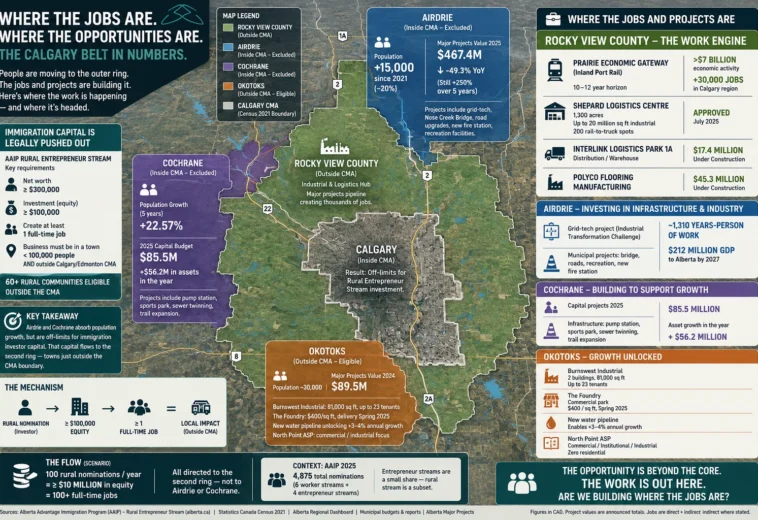
The Alberta Rural Entrepreneur Stream is one of the smallest immigration programs in the province, but it has an outsized effect on where new businesses and private capital can land. It offers a path to permanent residence to foreign business owners who invest in and run a business in rural Alberta. Because of how eligibility is defined, it also excludes the fast-growing suburbs around Calgary and Edmonton. For developers, brokers and anyone running feasibility on commercial projects outside the big cities, that detail matters.
This article explains how the Alberta Rural Entrepreneur Stream works in 2026, which communities are eligible, how competitive it is, and what it means for investment in rural Alberta.
What the Alberta Rural Entrepreneur Stream requires
The stream is part of the Alberta Advantage Immigration Program (AAIP). According to the Government of Alberta, candidates must meet requirements including:
- Net worth: at least $300,000, personally owned by the candidate or their spouse or partner
- Investment: at least $100,000 of the candidate’s own equity in the business
- Ownership: at least 51% of a new business, or 100% when taking over an existing business through succession
- Job creation: a new business must create at least one full-time job for a Canadian citizen or permanent resident who is not a relative
- Location: a community with a population under 100,000 that is outside the Calgary and Edmonton Census Metropolitan Areas (CMAs)
- Language: at least CLB/NCLC 4 in English or French
- Education: high school completion, confirmed by an Educational Credential Assessment
- Experience: at least 3 years as an active business owner-manager or 4 years as a senior manager in the past 10 years
- Exploratory visit to the community, in person or by video conference
- Community Support Letter from a participating rural community
Approved candidates usually sign a Business Performance Agreement covering the sector, location, investment and job creation, receive a work permit support letter, and are nominated for permanent residence after they meet their commitments.
Two filters: the CMA line and the participating list
Eligibility depends on two separate conditions, and both must be met.
The first is geographic. The community must be outside the Calgary and Edmonton CMAs. That rules out the towns that absorb most of the population growth around Calgary, such as Airdrie, Cochrane, Chestermere and Rocky View County, and around Edmonton, such as St. Albert, Spruce Grove, Leduc and Fort Saskatchewan.
The second is participation. The community must be one of the participating rural communities that has enrolled with the program and can issue a Community Support Letter. As of October 2026, the province lists about 60 participating communities. They include cities such as Brooks, Camrose, Cold Lake, Grande Prairie, Lacombe and Wetaskiwin; towns such as Olds, Didsbury, Sylvan Lake, Blackfalds, Innisfail, Ponoka, Claresholm, Fort Macleod and Whitecourt; and rural municipalities such as Foothills County, Red Deer County, Lacombe County and Fort McMurray Wood Buffalo.
Being outside the CMA is not enough on its own. Several towns that qualify on geography, such as Okotoks, High River and Strathmore, do not appear on the current participating list, although Foothills County, which surrounds Okotoks and High River, does. Communities can apply to join through a Community Enrolment Form, so the list changes over time and should always be checked before making plans.
How competitive is the stream?
The program is small. According to AAIP processing information updated on October 7, 2026, Alberta’s 2026 allocation for all entrepreneur streams combined is 60 nominations, out of a total AAIP allocation of 6,603. By that date, 36 entrepreneur nominations had been issued and 214 applications were in process at various stages. Allocations can be redistributed during the year, so these numbers change.
In practice, that means demand far exceeds the available spaces, and processing can take a long time. Candidates should treat the stream as a multi-year project and build that timeline into their business plans.
Why it matters for investment and real estate
Each successful candidate brings at least $100,000 of equity, a running business and at least one local job, and all of that capital must land outside the two big metro areas. In absolute terms, the numbers are small. But in a town of a few thousand people, a new restaurant, workshop, clinic or logistics business makes a visible difference to demand for commercial space, housing and services.
The effect is a policy-driven nudge toward the second ring of communities around Calgary and Edmonton, and toward regional centres such as Red Deer County, Lacombe, Camrose and Grande Prairie. Population growth follows affordability into the commuter towns, but this channel of vetted business capital follows the census map and the participating list.
How to use it in a feasibility study
For a developer or investor looking at commercial or light-industrial space in rural Alberta, the stream is one demand factor among many, not a reason to build on its own. A sound feasibility study should consider:
- Local economic drivers: agriculture, energy, tourism, logistics and public services usually matter more than immigration programs.
- Community participation: whether the community is on the participating list and actively attracting entrepreneurs.
- Existing vacancy and rents: small markets can be thin, and a few vacancies can change the picture.
- Business succession opportunities: many rural businesses have owners approaching retirement, and the stream supports succession purchases.
- Infrastructure and access: highway connections, utilities and broadband determine which businesses can operate there.
Advice for prospective entrepreneurs
For business owners considering the stream, a few practical points help:
- Confirm the community is currently participating before investing time in a business plan.
- Visit the community and speak with its economic development office early.
- Consider buying an existing business through succession, which removes the job creation requirement.
- Prepare realistic financial projections, as the business plan is assessed closely.
- Take advice from a licensed immigration lawyer or regulated consultant, since requirements and allocations change.
The bottom line
The Alberta Rural Entrepreneur Stream is small, with 60 entrepreneur nominations in 2026 against more than 200 applications in process. But it channels committed business capital into communities outside the Calgary and Edmonton CMAs that are on the participating list. For developers and investors working in rural Alberta, it is a useful signal of where new small businesses may appear, as long as it is weighed alongside the local economic fundamentals.
Planning a feasibility study or site assessment in rural Alberta? Get in touch to discuss how these factors fit your project.
Frequently asked questions
How much money do I need for the Alberta Rural Entrepreneur Stream?
Candidates need a personal net worth of at least $300,000 and must invest at least $100,000 of their own equity in the business.
Can I open a business in Airdrie or Cochrane under the stream?
No. Both are inside the Calgary Census Metropolitan Area, which is excluded.
Are Okotoks and High River eligible?
They are outside the Calgary CMA, but as of October 2026 they are not on the participating community list. Foothills County, which surrounds them, is. Always check the current list.
How many nominations are available in 2026?
The 2026 allocation for all entrepreneur streams combined is 60, according to AAIP processing information updated October 7, 2026.
Sources: Government of Alberta, Rural Entrepreneur Stream – Eligibility and Participating Communities; AAIP Processing Information (updated October 7, 2026); Bridgepoint Law, Alberta Entrepreneur Streams 2026; Statistics Canada, Census Metropolitan Area definitions. This article is for general information and is not immigration or legal advice.
- 109 views
- 1 Comment

Eros Belotti 01.

Eros belotti
Construction project manager with over 20 years of experience in Europe and the Canary Islands. Specialized in modular housing, container construction, real estate development and international project management. Founder of Reforma Vivienda Tenerife and Donkey Lab.


August 1, 2026 /
Numbers are straight from the source, in case anyone wants to check the math:
• 90 entrepreneur nominations vs 242 applications for 2026 — Alberta.ca AAIP processing page (Table 8), updated July 15.
• $300K net worth / $100K investment / 1+ full-time job — AAIP Rural Entrepreneur Stream eligibility.
• The CMA split (who’s in vs out) — Statistics Canada 2021 Census, Calgary CMA.
One caveat worth naming: being outside the CMA makes a town eligible, but it also has to be a designated participating community. Olds and Didsbury already are. Okotoks and High River qualify on geography — worth confirming before you build a thesis on them.
Curious which second-ring town the people actually working these deals would bet on.