

//European Construction Is Growing Again. That’s Bad News for Alberta.
European Construction Is Growing Again. That’s Bad News for Alberta.
Tags : AlbertaAlbertaBusinessBuildAlbertaCivilEngineeringConstructionConstructionManagementCREInfrastructureCanadaRealEstate
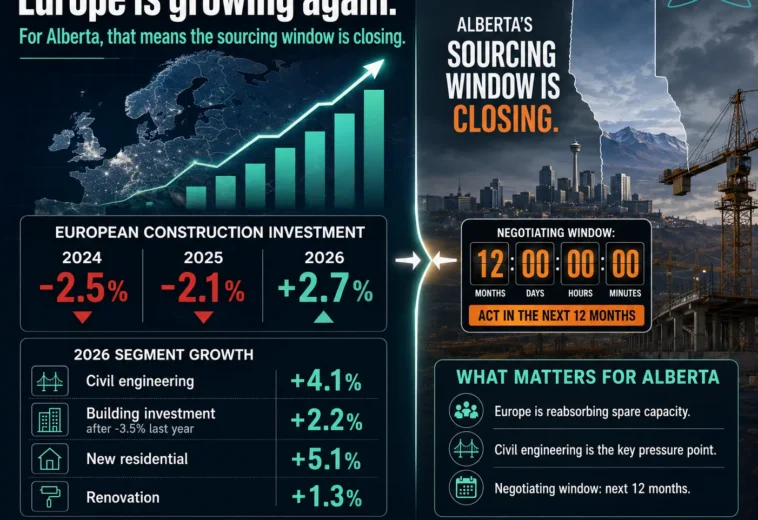
The European construction forecast 2026 points to something the market has waited two years for: growth. Investment across Europe is set to rise by 2.7% in real terms, after contracting 2.5% in 2024 and a further 2.1% in 2025.
For European contractors, that’s relief.
For developers and project managers building in Alberta, it’s a countdown — and almost nobody is treating it that way.
What the numbers actually say
The recovery is not uniform. Broken down by segment, the 2026 outlook looks like this:
- Civil engineering: +4.1% — the strongest segment, and the third consecutive year of growth after +4.6% in 2024 and +3.8% in 2025
- Building investment: +2.2% — a reversal from -3.5% the year before
- New residential: +5.1% — the headline number, but from a very low base
- Renovation: +1.3% — positive, but barely
The single figure that matters for anyone recruiting or partnering across the Atlantic is civil engineering. It is being carried by transport, energy and water infrastructure, plus European and national funding programmes. It is also the segment that draws on exactly the talent pool Alberta competes for on infrastructure and major projects.
Europe is now bidding for that talent at home.
The window nobody priced in
Here is the part that gets missed.
For the past two years, European engineers, contractors and project managers had spare capacity. Their domestic market was flat, public investment was slow to convert, and firms looked outward — partnerships, supply agreements, secondments, relocation.
Alberta benefited from that without ever having to compete for it.
That capacity is being reabsorbed right now. Not in three years — this cycle.
Access to European capability was never a structural advantage of the Alberta market. It was a window opened by a downturn in someone else’s economy. Windows close.
If your 2027 pipeline quietly assumes you can source European expertise on the terms that were available in 2024, that assumption now carries an expiry date.
What the European construction forecast 2026 means for Alberta developers
Three practical implications.
1. Sourcing timelines need to move left. If a project reaching site in late 2027 depends on specialist European input — façade engineering, prefabrication supply chains, complex civil works — the conversation happens in the next twelve months, not when the drawings are ready.
2. “Available” and “interested” are not the same thing. A firm with a thin order book will take an exploratory call. The same firm with a healthy 2027 backlog will not. The cost of that shift is not measured in fees; it is measured in who returns your email.
3. Fragility cuts both ways. The recovery is explicitly described as fragile and uneven across countries and segments. It depends on financing conditions, public investment capacity, the deployment of EU funds, energy and material costs, and administrative procedures. That unevenness is an opportunity: not every European market is recovering at the same speed, and the ones lagging are where capacity still exists. But it requires knowing which markets, specifically — not “Europe” as a single block.
The strategic read
Most cross-border sourcing strategies in construction are built reactively. A project needs something the local market cannot supply, so the search starts. That works fine when the counterparty has spare capacity. It fails when they do not.
The firms that will still have European options in 2028 are the ones building relationships in 2026, while the other side still has a reason to answer.
That is not a procurement decision. It is a business development decision, and it has a clock on it.
Sources
- EUROCONSTRUCT — 101st Conference, press release
- ifo Institute — Europe’s Construction Industry Gaining Momentum
- FIEC — Statistical Report
- 102 views
- 1 Comment

Eros Belotti 01.

Eros belotti
Construction project manager with over 20 years of experience in Europe and the Canary Islands. Specialized in modular housing, container construction, real estate development and international project management. Founder of Reforma Vivienda Tenerife and Donkey Lab.
August 7, 2026 /
Full breakdown of the 2026 European construction forecast by segment, and what it means for cross-border sourcing