
//478,182 Impressions in 90 Days: How I Managed My LinkedIn Content Strategy Like a Project
478,182 Impressions in 90 Days: How I Managed My LinkedIn Content Strategy Like a Project
Tags : B2B MarketingConstruction IndustryContent StrategyLinkedInLinkedIn AnalyticsPersonal BrandingProject ManagementReal Estate
A LinkedIn content strategy that generates 478,182 impressions in 90 days is not the product of luck, perfect timing or one post that happened to go viral. In my case, it came from something I have practiced for more than 20 years on construction sites and real estate projects: I managed it like a project.
Ninety days ago, I defined one clear objective. I wanted to reach professionals and decision-makers beyond my existing network. My aim wasn’t more reactions from people who already knew me. It was to get in front of the people I hadn’t met yet.
Then I built the operating system behind that objective. In this article I walk you through the LinkedIn content strategy behind those numbers, step by step. I cover the results it produced, and why I’m convinced the same Project Management principles apply to any part of a business that still runs on improvisation.
[TOC block here: insert the Rank Math Table of Contents block, or your theme’s TOC block]
Why One Viral Post Is Not a LinkedIn Content Strategy
When people see a strong LinkedIn result, they usually look for the single post that “made it happen.” I understand the instinct. It’s the same instinct that credits a building’s success to the inauguration day, instead of the months of planning, procurement and site management that came before it.
A viral post is an event. A LinkedIn content strategy is a process. Events are hard to repeat. Processes are designed to be repeated.
If you depend on the occasional viral post, you give up control over three things that matter in business:
- Who sees your content. Viral reach often comes from people who will never become clients, partners or collaborators.
- When it happens. You can’t plan a business around something you can’t predict.
- Why it worked. Without a system, you can’t separate the cause from the noise.
My numbers did not come from one post. They came from a sequence of posts, each one planned, produced, published and measured inside the same framework. That distinction is the whole point of this article.
[IMAGE: Simple graphic contrasting “one viral post” (a single spike) with “a managed process” (a steady upward line built from many posts) | alt: LinkedIn content strategy as a managed process versus a single viral post | linkedin-content-strategy-process-vs-viral-post.jpg]
Managing LinkedIn Like a Project: The 5-Step Framework
In construction project management, nothing starts without a defined objective, an agreed scope, a plan and a way to measure progress. A project without those elements is not a project. It’s a hope with a budget attached.
I applied exactly the same logic to my LinkedIn content strategy. The framework has five steps, and each one mirrors a phase I would recognize on any construction or real estate development project.
For a formal reference point, the [EXTERNAL LINK: Project Management Institute → pmi.org, URL TO VERIFY] describes project management as applying knowledge, skills, tools and techniques to project activities so that they meet project requirements. Nothing in that definition says the project has to involve concrete and steel. It fits content just as well.
Step 1: Define the Scope
The first decision was not what to post. It was what the content had to achieve.
The content had to support a specific professional positioning: Construction Project Manager and marketing strategist with international experience in construction, real estate and CAD design. It was not supposed to generate random visibility. Visibility without positioning is noise. It may look good on a dashboard, but it doesn’t move a professional conversation forward.
Defining the scope also meant defining what was out of scope. In practice, that ruled out trending topics with no link to my field, generic motivational content and posts designed only to trigger reactions.
On a construction project, scope creep is one of the fastest ways to lose time and money. On LinkedIn, scope creep looks like posting about whatever seems popular this week. A clear scope is what keeps a LinkedIn content strategy coherent over 90 days instead of drifting from one idea to the next.
Before you write a single post, answer three questions:
- Who exactly do I want to reach?
- What do I want them to associate with my name?
- Which business conversations do I want my content to start?
Step 2: Build the Backlog
Once the scope was clear, I built the backlog for my LinkedIn content strategy. This is a structured list of potential topics, collected before I needed them. It drew on four sources:
- Market data: figures and trends relevant to construction and real estate.
- Recurring industry problems: the issues that keep coming up on projects, such as delays, budget overruns, coordination gaps and unclear responsibilities.
- Comparisons: methods, markets, materials or approaches placed side by side so the reader can judge the trade-offs.
- Questions: the questions construction and real estate professionals actually ask, in meetings, in comments and in private messages.
The backlog solves the most common problem in content production: the blank page. When it’s time to write, I’m not asking myself “what should I post today?” I’m choosing from a list of options that already fit the scope.
Construction teams work the same way. You don’t decide what to build on the morning you arrive on site. The work is broken down and sequenced in advance. The backlog is the raw material of the whole system, and without it every post starts from zero.
Step 3: Prioritize With Three Tests
Not every interesting topic deserved to become a post. In a LinkedIn content strategy, prioritization is the step most people skip. In my experience, it’s the one that makes the biggest difference.
Each idea in the backlog had to pass three tests.
Test 1: Is it relevant to the target audience?
An idea can be fascinating to me and irrelevant to the people I want to reach. If a construction manager, a developer or a real estate investor wouldn’t stop to read it, it doesn’t make the cut.
Test 2: Can it be supported by evidence?
Professionals in construction and real estate are used to checking numbers. A claim without evidence damages credibility faster than silence does. If I couldn’t support an idea with data, a documented example or direct experience, it stayed in the backlog until I could.
Test 3: Does it create a useful business conversation?
The goal was never applause. The goal was conversation with the right people. A post that generates a thoughtful comment from a decision-maker is worth more to me than hundreds of passive reactions.
If an idea failed any of the three tests, it went back into the backlog or was dropped entirely. This filter is where a LinkedIn content strategy earns its credibility, because it protects the audience’s time and your reputation.
Step 4: Standardize Execution
The fourth step turned my LinkedIn content strategy from an improvised activity into a repeatable workflow. Every post moved through the same five stages:
- Research: verifying data, sources and context before writing.
- Writing: drafting the post around a single clear idea.
- Visual production: creating the image or graphic that supports the message.
- Review: checking accuracy, clarity and alignment with the scope.
- Publication: publishing and logging the post so its performance could be tracked.
On a building site, we rely on method statements and standard procedures so that quality doesn’t depend on who happens to be working that day. Standardization does the same thing for content. It reduces errors, saves time and makes the output consistent.
Standardizing doesn’t mean every post looks the same. It means the process is stable, so the creative energy goes into the idea instead of reinventing the workflow every time. Over the 90 days, I published.
Step 5: Monitor and Adjust
Every post produced information. The final step was to treat that information the way a project manager treats a progress report: as a basis for decisions.
After each post, I looked at four questions:
- Which topics reached the right people? Reach alone isn’t enough. The question is whether it reached the target audience.
- Which formats stopped the scroll? Some ideas worked better as short text, others needed a strong visual.
- Which opening lines generated conversation? The first lines decide whether anyone reads the rest.
- Which content travelled beyond my existing network? Since that was the objective, it was the most important signal of all.
Each answer fed back into the backlog and the priorities. Topics that worked earned follow-ups. Formats that didn’t were adjusted or abandoned.
A LinkedIn content strategy without monitoring is like a construction schedule that nobody compares with the real progress on site. It looks organized, but it isn’t managing anything.
The Results After 90 Days
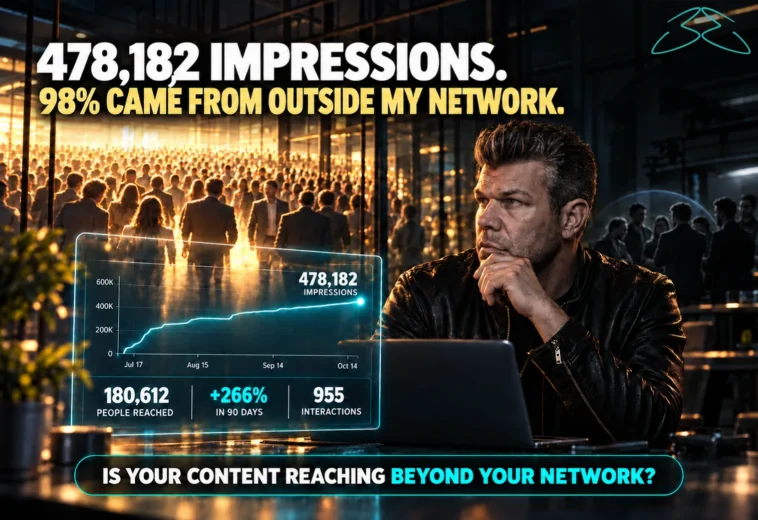
After 90 days of running this LinkedIn content strategy, these were the numbers:
| Metric | Result |
|---|---|
| Impressions | 478,182 |
| People reached | 180,612 |
| Impressions from outside my network | 98% |
| Growth compared with the previous period | 266% |
Here’s how I read each one:
- Impressions show how many times the content was displayed. They measure volume.
- People reached shows how many individual members saw it. It measures breadth.
- 98% of impressions from outside my network is the number I care about most. It measures the original objective directly: reaching people beyond my existing connections.
- 266% growth compared with the previous period shows that the change wasn’t marginal. The system produced a measurable difference.
These are not simply social media numbers. They are the output of a managed process.
What These Numbers Mean — and What They Don’t
I want to be precise here, because precision is part of the method.
Impressions are not revenue. Reach is not a signed contract. In project terms, these figures are leading indicators. They tell you the process is working and the right inputs are in place.
They don’t replace the lagging indicators that ultimately matter to a business, such as qualified conversations, partnerships and projects.
What the numbers do prove is that the approach did what it was designed to do. The objective was to reach professionals beyond my network, and 98% of impressions came from outside it. That’s not a lucky outcome. It’s the scope and the system working together.
This is also why I’m cautious about comparing results between people. Your network, your sector and your objective are different from mine. A LinkedIn content strategy should be judged against its own objective, not against someone else’s screenshot.
Project Management Principles Behind Every LinkedIn Content Strategy
The subject may be content, construction or real estate development. The Project Management principles remain the same.
Define the Objective
Every project needs a measurable target. “Be more visible” is not an objective. “Reach professionals and decision-makers beyond my existing network” is, because you can check it against the data.
Organize the Work
Scope, backlog, priorities and workflow turn a vague ambition into a sequence of manageable tasks. On site we call it planning. In content it’s exactly the same thing.
Measure Progress
What isn’t measured can’t be managed. Analytics are to a LinkedIn content strategy what progress reports are to a construction project: the only honest way to know where you stand.
Manage Uncertainty
No plan survives contact with reality unchanged. Weather delays a concrete pour; a platform changes how a format is distributed. The system doesn’t eliminate uncertainty. It gives you a structured way to respond to it.
Improve the System
The final principle is the one that compounds. Each cycle of publishing and measuring makes the next cycle better. That’s how a LinkedIn content strategy matures. After 90 days, the system I use is not the one I started with. It’s the improved version.
How to Build Your Own LinkedIn Content Strategy: A Practical Checklist
If you want to apply this approach, here’s the checklist I’d start from.
Scope
- Write your objective in one sentence that can be measured.
- Define your target audience by role, sector and market.
- List the topics that are out of scope.
Backlog
- Collect market data relevant to your audience.
- Note the recurring problems you solve in your work.
- Add comparisons your audience would find useful.
- Record the questions clients and colleagues ask you.
Prioritization
- Run every idea through the three tests: relevance, evidence, business conversation.
- Park ideas that fail a test instead of forcing them.
Execution
- Define your workflow: research, writing, visuals, review, publication.
- Use the same workflow for every post.
Monitoring
- Track which topics reach your target audience.
- Track which formats and opening lines perform.
- Track how much reach comes from outside your network.
- Review the data on a fixed schedule and update the backlog.
A LinkedIn content strategy built on this checklist won’t guarantee a specific number. It will guarantee that whatever happens, you’ll understand why, and you’ll know what to change next.
Common Mistakes That Turn a LinkedIn Content Strategy Into Improvisation
These are the mistakes that most often undermine results, in my own work and in the businesses I’ve worked with:
- Chasing virality instead of the objective. A post that goes viral with the wrong audience can be less useful than a modest post read by the right ten people.
- Starting every post from a blank page. Without a backlog, quality depends on daily inspiration, and inspiration is not a resource you can schedule.
- Publishing everything that seems interesting. Skipping prioritization dilutes your positioning.
- Improvising the process. If the workflow changes every time, quality changes every time.
- Measuring only vanity metrics. Reactions are easy to count. Whether you reached the right people is harder to measure but far more valuable.
- Overreacting to a single result. One weak post is a data point, not a verdict. Look for patterns across several posts before changing direction.
Every one of these mistakes has a direct equivalent on a construction project. And the solution is the same: a defined process, applied consistently, measured honestly.
Frequently Asked Questions
How long does it take to see results from a LinkedIn content strategy?
In my case, the results above came from a 90-day period. Timelines vary with your starting network, sector and consistency. Still, 90 days is a reasonable window to collect enough data to judge whether the system is working.
Do you need a large network to reach decision-makers on LinkedIn?
No. 98% of my impressions came from outside my existing network. Relevant, well-structured content can travel well beyond your direct connections.
Which metrics matter most in a LinkedIn content strategy?
Start with the metric that measures your objective. For me, that was the share of impressions from outside my network. Impressions and reach are useful context, but they should support the objective, not replace it.
Can project management really be applied to marketing?
Yes. Defining objectives, organizing the work, measuring progress, managing uncertainty and improving the system are not specific to construction. My LinkedIn content strategy is simply one application of those principles.
Is this approach useful for construction and real estate professionals?
It was built for them. The backlog was based on market data, industry problems and questions relevant to construction and real estate professionals. That’s why this LinkedIn content strategy fits that audience naturally.
Conclusion: A Good Result Is Evidence of a Process
A good result is rarely an isolated event. It’s usually evidence of a process working as intended.
478,182 impressions did not come from one viral post. They came from treating my LinkedIn content strategy as a project. That meant a defined scope, a backlog, clear priorities, a standard workflow and continuous monitoring.
The same logic applies to your business. So here’s the question I’d like to leave you with: what part of your business still depends on improvisation instead of a managed system?
If the answer involves a construction or real estate project, or the way you communicate it, I’d be glad to talk.
- 15 views
- 1 Comment

Eros Belotti 01.

Eros belotti
Construction project manager with over 20 years of experience in Europe and the Canary Islands. Specialized in modular housing, container construction, real estate development and international project management. Founder of Reforma Vivienda Tenerife and Donkey Lab.


October 20, 2026 /
One important clarification:The goal was never to “go viral.”The goal was to build a repeatable system:
→ A defined audience
→ A structured content backlog
→ A consistent publishing cadence
→ A review process
→ Measurable KPIs
→ Continuous improvement
The reach was the result.
The real success was creating a process that can be repeated, measured and improved.