
Construction Immigration Draws 2026: BC Invited 791, Alberta 53 in One Draw
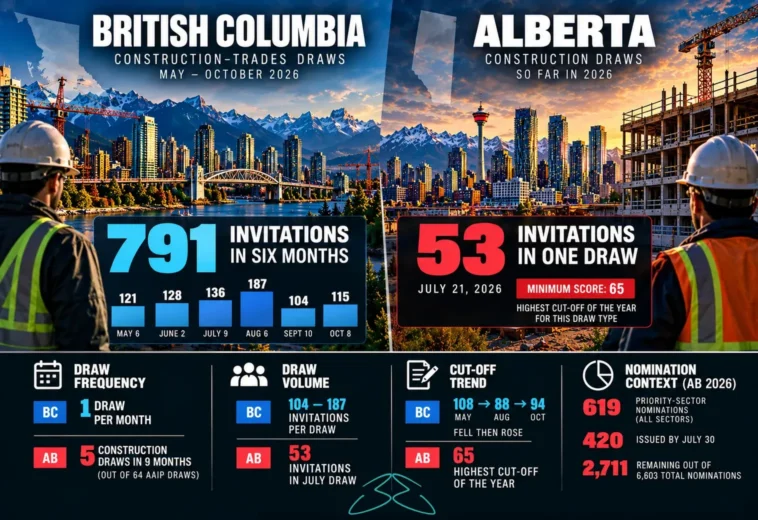
Construction immigration draws in 2026 show two very different recruiting pipelines in Western Canada. British Columbia issued 791 construction-trades invitations in six months. Alberta invited 53 candidates in its July construction draw.
Both provinces need the same trades: carpenters, electricians, plumbers, heavy equipment operators and site supervisors. But if you plan to fill part of a crew through provincial nomination, the channel you rely on looks very different on each side of the Rockies.
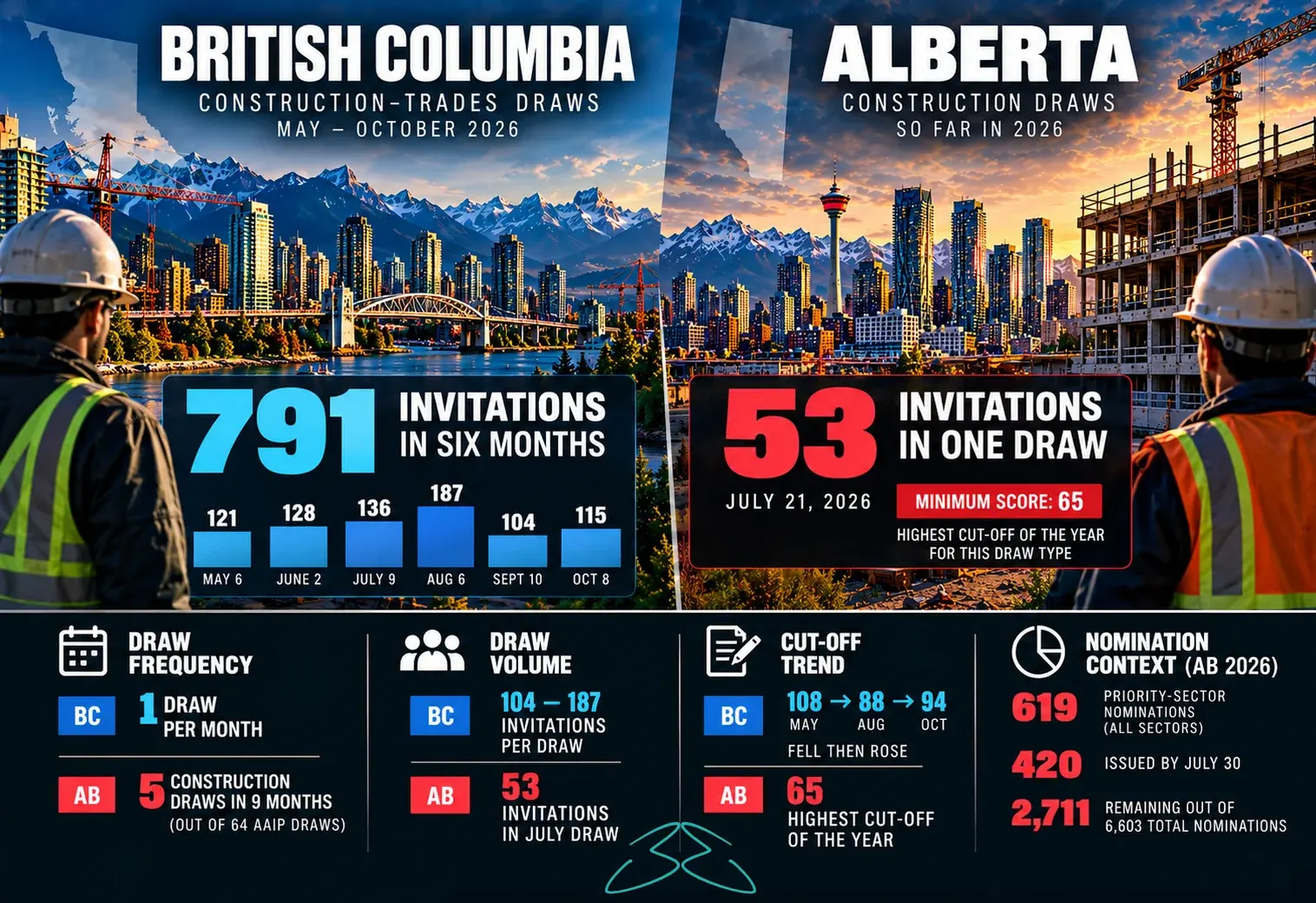
British Columbia ran six construction-trades draws between May and October 2026 through the BC Provincial Nominee Program. Alberta ran five targeted construction draws out of 64 Alberta Advantage Immigration Program (AAIP) draws so far this year.
Table of Contents
- BC Construction Draws, Draw by Draw
- Alberta’s July Construction Draw
- Frequency, Volume and Direction Compared
- Alberta’s Nomination Room Is Shared
- What This Means for Workforce Planning
1. BC Construction Draws, Draw by Draw
Under the “Build: Construction Trades” category of BC PNP Skills Immigration, British Columbia issued the following invitations:
- May 6: 121 invitations
- June 2: 128
- July 9: 136
- August 6: 187
- September 10: 104
- October 8: 115
That is 791 invitations in six months, or roughly one construction draw every month. These rounds run under B.C.’s “Care, Build, Innovate” framework, which directs nominations toward priority care and construction occupations, as CIC News reported. The October 8 round issued 115 invitations at a minimum score of 94.
2. Alberta’s July Construction Draw
Alberta’s largest recent construction round took place on July 21, 2026, under the priority-sector pathway of the Alberta Express Entry Stream:
- Invitations: 53
- Minimum score: 65
- Context: the highest cut-off of the year for this draw type
Alberta held only five construction-specific draws in the first nine months of 2026. Each was small, and the gaps between them were long.
3. Frequency, Volume and Direction Compared
Comparing the two provinces’ construction immigration draws reveals three differences that matter for planning.
Frequency changes planning
In B.C., an employer can reasonably expect a construction draw every month. In Alberta, five construction draws across nine months leave long and unpredictable gaps. A recruitment plan built around a monthly cycle works in one province and not in the other.
Volume changes the odds
B.C.’s draws ranged from 104 to 187 invitations. A 53-invitation draw is a thin pipeline for a construction sector the size of Alberta’s, especially at a time when non-residential activity is rising, as shown in Alberta’s August 2026 building permit data.
The direction differs
B.C.’s cut-off fell from 108 in May to 88 in August, then rose to 94 in October. Alberta’s July cut-off was the highest of the year.
The two scoring systems are different, so the numbers cannot be compared directly. Compare the direction, not the value: B.C. became somewhat easier to reach during the summer, while Alberta became harder.
4. Alberta’s Nomination Room Is Shared
Alberta’s construction draws do not have a dedicated allocation. They draw on the priority-sector nomination space, which is shared across several sectors.
For 2026, according to Alberta’s AAIP processing information:
- 619 priority-sector nominations were allocated for the year, across all priority sectors.
- 420 of those had been issued by July 30.
- 2,711 of Alberta’s 6,603 total provincial nominations remained at that date.
Construction competes for that room with other priority sectors. Even if demand from contractors rises, the number of nominations available to construction workers is limited by a fixed, shared allocation.
5. What This Means for Workforce Planning
My reading: a contractor who counts on nominations in Alberta is relying on a smaller and less predictable channel than the same contractor would find in British Columbia.
Immigration can fill specific roles. It should not be the base of a crew plan.
This connects with a broader issue I discussed in Alberta Construction Talent Shortage 2026 Explained and in the September 2026 Alberta labour market update: employment numbers can grow while the specific skills a project needs remain hard to find.
A practical approach for contractors and developers:
- Plan local first. Build local hiring, apprenticeships and training into the project schedule from the start.
- Map critical roles. Identify the trades and supervisory positions where a gap would delay the critical path.
- Use nominations for targeted gaps. Treat provincial nominees as a way to fill specific roles, not as the core workforce.
- Build timing contingency. Nomination, work permit and relocation take months. Do not schedule a nominee into a start date you cannot move.
- Monitor both provinces. If you operate across Western Canada, track draw frequency, size and cut-offs in each program before assigning recruitment to one channel.
The practical step is to build local hiring and training into the project schedule first, and treat any nominee as a bonus.
Same Trades, Different Pipelines
Construction immigration draws in 2026 show that British Columbia offers a regular, monthly and relatively large channel for construction trades, while Alberta’s is smaller, less frequent and more competitive.
For contractors and project managers, the conclusion is not that immigration doesn’t work in Alberta. It is that it cannot carry the weight of a workforce plan on its own.
If you recruit across provinces, which channel has been more predictable for you?
Sources: BC Provincial Nominee Program invitation results (May to October 2026); Alberta Advantage Immigration Program draw results and processing information, 2026.
- 7 views
- 0 Comment

Eros Belotti 01.

Eros belotti
Construction project manager with over 20 years of experience in Europe and the Canary Islands. Specialized in modular housing, container construction, real estate development and international project management. Founder of Reforma Vivienda Tenerife and Donkey Lab.