

//Alberta Prompt Payment Adjudication: 2026 Data & Guide
Alberta Prompt Payment Adjudication: 2026 Data & Guide
Tags : ADACCAlberta ConstructionARCANABusiness Developmentconstruction adjudicationconstruction lien actFeasibilityPrompt Payment
Getting paid on time is one of the biggest risks in construction. In Alberta, the Prompt Payment and Construction Lien Act (PPCLA) created a fast, statutory way to resolve payment disputes without going to court: adjudication. Three years into the regime, the first detailed annual data shows that Alberta prompt payment adjudication is being used more each year, but still by only a small fraction of the industry.
This guide explains how the system works, what the 2025–26 data shows, what it costs, and how contractors, subcontractors and owners can use it.
How prompt payment works in Alberta
The PPCLA applies to construction contracts entered into since August 29, 2022, and existing contracts extending beyond August 29, 2024 also had to comply. Its core rules are simple:
- Owner to contractor: payment is due within 28 calendar days of receiving a proper invoice.
- Disputes: an owner who disputes an invoice must give a notice of dispute within 14 calendar days, stating the amount withheld and the reasons.
- Contractor to subcontractor: payment is due within 7 calendar days of the contractor receiving payment from the owner.
- Holdbacks: on projects of at least $10 million lasting more than 12 months, holdbacks must be released at least annually unless the contract provides for phased release.
Government of Alberta projects fall under the Public Works Act instead, which has its own prompt payment and adjudication rules.
What adjudication is
Adjudication is a fast, binding process run by a certified adjudicator. It can be used for disputes about the valuation of work or materials, payment, notices of non-payment, holdback amounts and other matters the parties agree to. It is not available if a court application about the same dispute has already been filed.
Alberta has two Authorized Nominating Authorities that train and certify adjudicators and appoint them when the parties cannot agree: ARCANA (AB), run by the ADR Institute of Alberta, and ADACC, linked to the Alberta Construction Association. Owners and contractors choose one when they sign the contract.
How the process runs
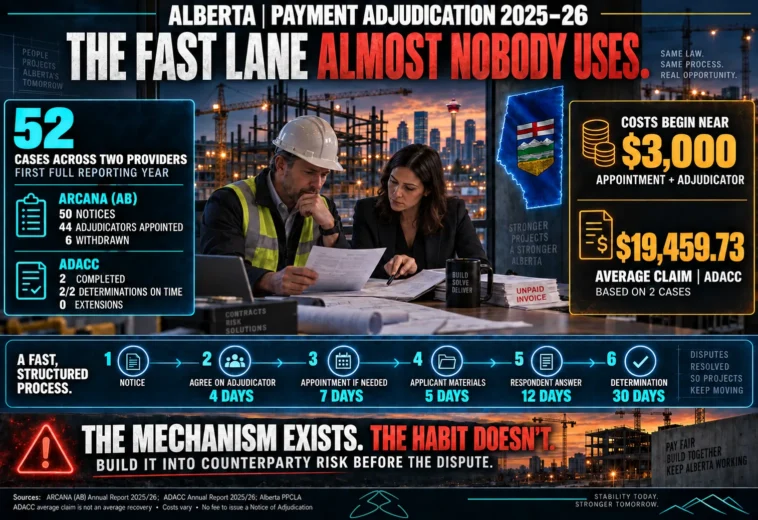
The process starts when a party serves a Notice of Adjudication. The parties then have a short window, four days, to agree on an adjudicator. If they cannot, the nominating authority appoints one. Both sides file their documents on a tight schedule, and the adjudicator normally issues a determination about 30 days after receiving the submissions. The decision is binding on an interim basis: it must be paid, but the dispute can still be taken to court or arbitration later. A determination can be filed with the Court of King’s Bench and enforced like a court order.
Because of these deadlines, a payment dispute that might take years in litigation can usually be decided in a couple of months.
The 2025–26 data
ARCANA (AB)’s annual report for April 1, 2025 to March 31, 2026 gives the clearest picture so far of how adjudication is being used:
- 50 Notices of Adjudication received, up from 26 the year before
- 44 adjudicator appointments, up from 29 in 2024–25 and 19 in 2023–24
- 31 determinations and orders issued, up from 14
- 6 notices withdrawn before appointment and 6 cases settled after appointment
- 3 cases terminated, including for jurisdictional reasons, and 2 still active at year end
By sector, 27 notices concerned commercial projects, 18 residential, 3 industrial and 2 public works. Calgary accounted for 19 notices and Edmonton for 14, with the rest spread across smaller communities. ARCANA’s roster grew to 16 adjudicators, with backgrounds in law, engineering, surveying and construction management.
One finding is worth noting: about 41.5% of adjudicator time was spent on jurisdictional challenges. In at least one case the challenge succeeded because the notice was served outside the required timeframe. Getting the procedure right matters as much as the merits.
What adjudication costs
ARCANA’s fee schedule, effective February 1, 2026, is tiered by the amount in dispute. For example:
- Claims under $25,000: no filing fee, adjudicator at $200 per hour, capped at $1,800
- Claims under $50,000: $225 filing fee, $200 per hour, capped at $3,600
- Claims under $100,000: $250 filing fee, $200 per hour, capped at $6,000
- Claims from $100,000 to $500,000: higher hourly rates, capped at 7.5% of the amount in dispute
- Larger claims: fees agreed with the adjudicator
Compared with the cost and time of litigation, these fees are low, especially for small and mid-sized claims. The adjudicator can also decide how costs are shared between the parties.
Why it is still underused
Fifty notices a year is small compared with the number of active construction contracts in Alberta. The growth trend is clear, but most companies still default to negotiation, lien claims, litigation or simply absorbing the loss. The likely reasons are awareness and habit: many contractors, especially smaller trades, do not yet think of adjudication as a practical tool, and some worry about damaging relationships with clients.
Adjudication and liens work together
Adjudication does not replace lien rights. Under the PPCLA, lien deadlines were extended, generally to 60 days, and to 90 days for concrete suppliers and certain oil and gas work. A company that relies only on adjudication and misses its lien deadline may lose important security. A sound payment strategy tracks both deadlines from the start.
Practical tips for contractors and owners
- Know your nominating authority. Check which authority your contract names before a dispute arises.
- Issue proper invoices. The payment clock starts with a proper invoice that meets the Act’s requirements.
- Track notice deadlines. Late notices are a common source of jurisdictional challenges.
- Document everything. Adjudicators decide quickly, based mainly on written submissions and records.
- Owners should respond on time. Missing the 14-day dispute notice can mean paying an invoice in full.
- Get advice on complex claims. For large or legally complex disputes, consult a construction lawyer.
What it means for firms entering Alberta
For companies entering Alberta from other provinces or from Europe, prompt payment and adjudication are part of the risk picture. Payment security is stronger than in many jurisdictions, but only for firms that understand the deadlines and the process. Including this in contract reviews and project controls from day one is a low-cost way to protect cash flow.
The bottom line
Alberta prompt payment adjudication is working: ARCANA’s caseload almost doubled in 2025–26, determinations more than doubled, and decisions are typically issued about 30 days after submissions. Costs are modest relative to most claims. Yet with only around 50 notices a year, it remains underused. Companies that build adjudication into their contracts and payment processes now gain a practical edge in managing payment risk.
Need help assessing contract and payment risk on an Alberta project? Get in touch.
Frequently asked questions
How long does adjudication take in Alberta?
Adjudicators normally issue a determination about 30 days after receiving the parties’ submissions, so most disputes are decided within a couple of months.
How much does Alberta adjudication cost?
Under ARCANA’s 2026 fee schedule, claims under $25,000 have no filing fee and adjudicator fees capped at $1,800. Higher claims have higher fees.
Is an adjudication decision final?
It is binding and must be complied with, but either party can still pursue the dispute in court or arbitration afterwards.
When must an owner pay a contractor in Alberta?
Within 28 calendar days of receiving a proper invoice, unless a notice of dispute is issued within 14 days.
Sources: Government of Alberta, Prompt payment rules for the construction industry; ARCANA (AB) Annual Report 2025–26, ADR Institute of Alberta; Miller Thomson, Alberta’s new prompt payment and construction lien legislation; Prompt Payment and Construction Lien Act, RSA 2000, c P-26.4. This article is general information, not legal advice.
- 119 views
- 1 Comment

Eros Belotti 01.

Eros belotti
Construction project manager with over 20 years of experience in Europe and the Canary Islands. Specialized in modular housing, container construction, real estate development and international project management. Founder of Reforma Vivienda Tenerife and Donkey Lab.



September 21, 2026 /
Sources for the numbers above: ARCANA (AB) and ADACC’s FY2025–26 annual reports, via the ADR Institute of Alberta (adralberta.com/prompt-payment) and the Alberta Construction Association (albertaconstruction.org). Full statutory deadlines are set out in the Prompt Payment and Construction Lien Act, RSA 2000, c P-26.4 (CanLII).
For anyone thinking about actually using it, the clock works like this: 4 days to agree on an adjudicator (or notify ARCANA you can’t), 7 days for ARCANA to appoint one, 5 days for the applicant to submit materials, 12 days for the respondent to respond, 30 days for the determination. Budget for the retainer upfront — the applicant is typically expected to cover the initial cost, though the adjudicator can reallocate it in the final decision.
One thing worth adding: adjudication doesn’t replace your lien rights — it runs alongside them. If you’re structuring subcontracts for Alberta work, it’s worth building the adjudication clause in now, not after the first invoice goes 60 days past due.