

//Calgary vs Edmonton: What Two Opposite Zoning Bets Mean for Alberta Feasibility Studies
Calgary vs Edmonton: What Two Opposite Zoning Bets Mean for Alberta Feasibility Studies
Tags : Alberta Real EstateCalgaryConstruction RegulationEdmontonfeasibility studyHousing PolicyUrban PlanningZoning
In 2024, Calgary vs Edmonton made the same regulatory bet: citywide upzoning, pitched as the fix for the same problem — a population growing faster than housing supply could keep up. Two years later, the two cities are running opposite plays, and the split has real consequences for anyone underwriting a construction or development project in Alberta right now.
Calgary just reversed its reform. Edmonton kept going. Here’s what the numbers actually show, and why it matters more for feasibility work than it does for local politics.
Two Cities, One Playbook, 2024
Both Calgary and Edmonton entered 2024 with a version of the same idea: loosen zoning across most residential land, allow more row housing and secondary suites by default, and let the market respond to demand instead of forcing every project through a rezoning application. The stated goal in both cities was the same — more housing, built faster, without waiting years for site-by-site approvals.
That’s where the similarity ends.
Two Years Later: The Results Split
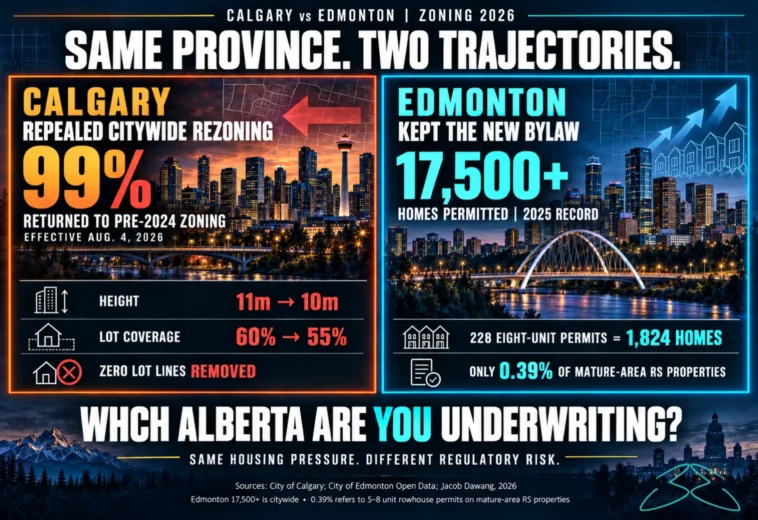
Edmonton doubled down. Its zoning bylaw has been in effect since January 1, 2024, and the city’s own 2025 permit data shows the clearest signal yet that it’s working as intended:
- Over 17,500 homes were permitted in Edmonton in 2025 — a record.
- For the first time ever, 5–8 unit rowhomes outnumbered single-family homes in permits issued.
- Roughly 30% of new homes were permitted within an 800-metre walk of transit, also a record share.
Calgary hit reverse. On August 4, 2026, the city repealed its version of the same reform:
- 99% of Calgary properties reverted to their pre-2024 zoning.
- In the R-CG zone, maximum building height dropped from 11m to 10m and lot coverage from 60% to 55%.
- Zero lot line development was banned again, and rules around combining secondary and backyard suites were tightened.
Same province, same starting point, same stated objective — and two years later, one city is compounding the policy and the other has undone it.
The Mechanism Nobody’s Talking About
The most interesting number in this comparison isn’t the 17,500 permits — it’s how little land it actually took to produce them. In Edmonton’s mature neighbourhoods, less than 0.5% of RS-zoned properties were redeveloped under the new rules. That sliver of the city — under half a percent of eligible lots — still produced more than 2,300 new homes in 2025 alone.
In other words, the change that reshaped Edmonton’s permit numbers touched almost none of the city physically. Calgary’s version of the reform pointed at similar math. It was repealed anyway, which suggests the decision had less to do with the scale of actual redevelopment and more to do with how the policy was perceived.
That distinction matters if you’re trying to predict what happens next in either city.
Why This Matters for Feasibility, Not Politics
For anyone running a feasibility study or underwriting a site in Alberta, the Calgary-Edmonton split isn’t really a policy story — it’s a live regulatory-risk variable that just moved in opposite directions in the province’s two largest markets.
A site that pencilled out under Calgary’s 2024–2026 rules in July doesn’t pencil out the same way in September. Height, coverage, and suite allowances that were assumed as of right are gone for most properties, and any project that didn’t have an approved permit or a submitted application before the bylaw’s first reading now has to work within the reinstated pre-2024 zoning.
A site in Edmonton, by contrast, comes with two full years of real permit data behind the policy instead of a stated intention that could still be reversed by a future council. That doesn’t make Edmonton risk-free — zoning policy can change anywhere — but it does mean the risk is easier to price today, because there’s a track record to underwrite against rather than a promise.
The Real Question for Developers
The question worth asking isn’t “is Alberta easy to build in?” Alberta isn’t one regulatory environment — it’s several, and they’re moving in different directions inside the same province, sometimes inside the same metro region.
The more useful question is: which Alberta are you actually underwriting? A site’s zoning risk now depends heavily on which city it sits in, how long the current rules have been in place, and how politically durable those rules have proven to be so far.
For developers, builders, and anyone doing pre-construction and feasibility work across more than one Alberta city, that’s not a detail to check once — it’s a variable to keep tracking as both cities’ councils face their next election cycles.
Sources
- City of Calgary — Repeal of Citywide Rezoning
- City of Edmonton — Zoning Bylaw Renewal (in effect since January 1, 2024) and 2025 building permit data
- Independent analysis of Edmonton’s two-year zoning bylaw results (permit and redevelopment-footprint figures)
This article reflects publicly available municipal data as of September 2026. Zoning policy can change; readers should confirm current rules with the relevant municipality before relying on this analysis for a specific project.
- 81 views
- 1 Comment

Eros Belotti 01.

Eros belotti
Construction project manager with over 20 years of experience in Europe and the Canary Islands. Specialized in modular housing, container construction, real estate development and international project management. Founder of Reforma Vivienda Tenerife and Donkey Lab.


September 17, 2026 /
Sources for the numbers above:
→ Calgary repeal of blanket rezoning, effective Aug 4, 2026 — City of Calgary (calgary.ca)
→ Edmonton 2025 permit data, zoning bylaw in effect since Jan 1, 2024 — City of Edmonton building permit records