

//Canada’s Productivity Super Deduction: What It Means
Canada’s Productivity Super Deduction: What It Means
Tags : Alberta manufacturingCanada tax incentivescapital cost allowancefeasibility studyfederal budget 2026foreign direct investment CanadaProductivity Super Deduction
Canada just made its biggest capital-investment tax change in a generation — and most companies evaluating a manufacturing or industrial footprint in North America haven’t fully priced it into their numbers yet.
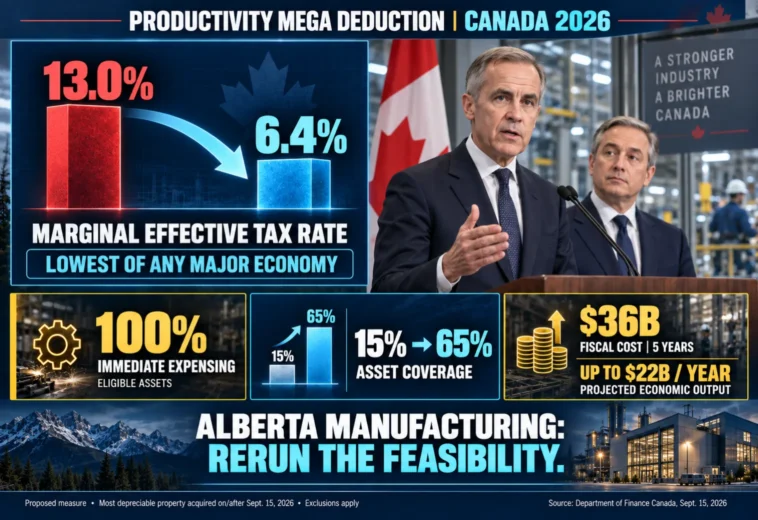
On September 15, 2026, the federal government expanded the Productivity Super Deduction introduced in Budget 2025 into what officials are now calling the Productivity Mega Deduction. The headline effect: the marginal effective tax rate on new business investment in Canada drops from roughly 13% to 6.4% — the lowest of any major economy, according to the Department of Finance.
For a European manufacturer, developer, or industrial operator weighing whether to build in Alberta, this isn’t a talking point. It’s a number that belongs in the return-on-investment model, and it changes that model in a way worth understanding before you finalize a site.
This article breaks down what actually changed, what qualifies, what doesn’t, and how to think about it if you’re running a feasibility study for a project in Alberta.
What Is the Productivity Super Deduction?
The Productivity Super Deduction started in Canada’s 2025 federal budget as an accelerated depreciation measure aimed at manufacturing and processing buildings, machinery, equipment, and digital tools, including AI-related investments. The original goal was to bring Canada’s effective tax rate on new investment down from 15.6% to 13.2%, positioning the country as competitive among G7 economies.
The September 2026 expansion goes further. Instead of accelerated depreciation over a few years, qualifying assets can now be written off at 100% in the year they become available for use — full immediate expensing, not a multi-year schedule.
In practical terms: a company that previously depreciated a $10 million manufacturing facility over 20 to 30 years can now deduct the entire $10 million against taxable income in year one.
The Numbers Behind the Headline
A few figures matter more than the rest if you’re modeling this for a real project:
- Effective tax rate on new investment: falls from roughly 13% to 6.4%
- Immediate expensing coverage: expands from about 15% to 65% of depreciable business assets nationwide
- Federal fiscal commitment: an estimated $36 billion over five years, starting in the 2026-27 fiscal year
- Projected economic return: up to $22 billion annually, according to Department of Finance estimates
- Effective date: applies to eligible property acquired after September 15, 2026
These aren’t marketing figures from a provincial investment-attraction campaign. They’re the government’s own fiscal projections, published alongside the policy announcement.
What Actually Qualifies
This is the part that gets glossed over in headline coverage, and it’s the part that actually matters for a feasibility study. The deduction is not a blanket incentive for any capital spending — it’s targeted at productive, physical investment.
Assets that qualify for the 100% immediate deduction include:
- Manufacturing and processing buildings
- Production machinery and equipment
- Clean energy generation and conservation equipment
- Zero-emission vehicles
- Data network infrastructure, computers, and software
- Patents and scientific research and experimental development (SR&ED) capital expenditures
- Certain infrastructure assets: fibre-optic cable, mining property, pipelines, rail track, bridges
Assets that are excluded:
- Most generic commercial buildings (office, retail, and similar space not used for manufacturing or processing)
- Passenger vehicles and rental vehicles
- Franchises, licenses, and goodwill
- Certain natural gas distribution pipelines
The distinction matters. A company planning a pure office or logistics footprint won’t see the same benefit as a company building a production facility. If your project mixes uses — a manufacturing floor with an attached office and showroom — the qualifying and non-qualifying portions need to be separated out in the capital budget from the start.
Why This Matters More for Alberta Specifically
Tax policy announcements are federal, but their practical effect is local — and Alberta has a structural reason this measure lands harder here than in most provinces.
Alberta already runs one of the lowest combined corporate tax environments in Canada, without a provincial sales tax. Layering a federal deduction that cuts the effective tax rate on new manufacturing investment to 6.4% on top of that existing advantage compounds rather than simply adds — the two effects interact in the same pro forma.
For a European company already comparing Alberta against a European industrial site, the comparison that used to come down to labour cost, energy cost, and logistics now includes a capital-recovery timeline that’s dramatically shorter on the Alberta side of the spreadsheet. That’s a genuine, quantifiable point of differentiation — not a generic “come invest here” pitch.
How to Model This in a Feasibility Study
If you’re at the stage of running numbers on a manufacturing or industrial project in Alberta, here’s where this deduction actually enters the calculation:
- Separate qualifying and non-qualifying capital costs early. Manufacturing buildings and production equipment get full first-year expensing; ancillary office or retail space typically doesn’t. Get this split right before you build your pro forma, not after.
- Re-run your discounted cash flow with the compressed depreciation schedule. A project that looked marginal under a 20-year depreciation assumption can look materially different when the tax shield arrives in year one instead of being spread over two decades.
- Check the acquisition date. The deduction applies to property acquired after September 15, 2026. If your project timeline straddles that date, the timing of specific purchase and in-service dates matters for what qualifies.
- Don’t treat this as static. Federal tax measures of this size get reviewed, adjusted, and sometimes narrowed in subsequent budgets. A project that’s economically sound today shouldn’t be modeled as though today’s rules are locked in for the next decade — build in a sensitivity case.
- Combine it with provincial-level analysis. The federal number is only half the picture. A full feasibility study needs to stack this against Alberta’s own tax structure, site-specific costs, and labour market conditions before it becomes a real investment case.
The Bottom Line
Canada’s Productivity Super Deduction — now the Productivity Mega Deduction — is a real, quantifiable change to the economics of building a manufacturing or industrial facility in Canada, and Alberta’s existing tax position makes the effect more pronounced here than in most provinces.
It’s not a reason to move a project forward on its own. It’s a reason to rerun the numbers on a project that might have been shelved, and to make sure a feasibility study for a new one reflects the actual rules in place today rather than the assumptions from a year ago.
Frequently Asked Questions
What is the Canada Productivity Super Deduction? It’s a federal tax measure, introduced in Budget 2025 and expanded on September 15, 2026, that allows companies to immediately deduct 100% of the cost of qualifying manufacturing buildings, equipment, and related capital assets in the year they’re put into use, instead of depreciating them over many years.
Who qualifies for the Productivity Mega Deduction? Companies investing in manufacturing and processing buildings, production machinery and equipment, clean energy equipment, zero-emission vehicles, data infrastructure, software, and certain other capital assets acquired after September 15, 2026. Most generic commercial buildings and passenger vehicles are excluded.
How much does the deduction reduce Canada’s effective tax rate? The federal government estimates the marginal effective tax rate on new business investment falls from roughly 13% to 6.4%, which it describes as the lowest among major economies.
Does this apply to companies expanding into Alberta from Europe? Yes — the deduction applies to any company investing in qualifying capital assets in Canada, regardless of where the parent company is based. For a European company evaluating Alberta specifically, the federal deduction stacks on top of Alberta’s existing low corporate tax environment.
Is this incentive guaranteed to stay in place? The measure is current federal policy as of September 2026, backed by a five-year, $36 billion fiscal commitment. As with any tax policy, future budgets could adjust it — feasibility studies should account for that possibility rather than assuming permanence.
- 148 views
- 1 Comment

Eros Belotti 01.

Eros belotti
Construction project manager with over 20 years of experience in Europe and the Canary Islands. Specialized in modular housing, container construction, real estate development and international project management. Founder of Reforma Vivienda Tenerife and Donkey Lab.



September 16, 2026 /
One thing worth adding: this federal deduction stacks on top of Alberta’s own capital cost allowances and its already-low corporate tax rate. For a manufacturing project, the combined effect is what actually moves the pro forma — not just the federal number.