

//Alberta’s Construction Pipeline: Are You Positioned to Capture It?
Alberta’s Construction Pipeline: Are You Positioned to Capture It?
Tags : ACAAlberta ConstructionAlberta Real EstateCanada Construction 2026CMHCConstruction ManagementFeasibilityHousing Startsproject pipeline
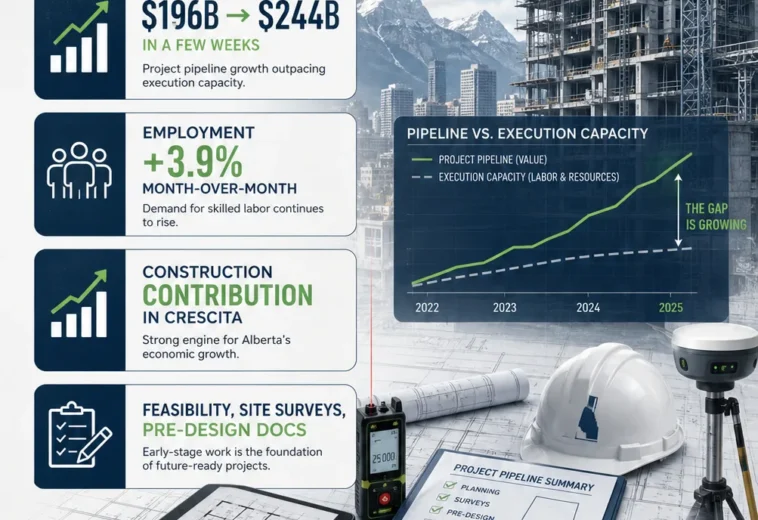
Alberta’s construction pipeline is large by any measure. ICBA’s Winter 2026 Construction Monitor estimates the value of major projects in the province at about $166 billion, with roughly $71 billion under construction. Industry estimates of capital projects across all stages run even higher. The province is pursuing a $100 billion data centre target, energy and petrochemical investments, transportation and public infrastructure, and a housing sector that set records in 2025.
The opportunity is real. But a large pipeline does not automatically turn into work for every company. Most firms will not see a dollar of it unless they are positioned to move from proposal to shovel in the ground. This article explains where the bottlenecks are and how consultants, contractors and developers can position themselves.
The pipeline is growing faster than execution capacity
Projects are being proposed faster than teams, subcontractors and documentation can support them. ATB Financial, citing BuildForce Canada, estimates that Alberta’s non-residential construction sector must hire about 42,400 workers by 2035 and will still face a gap of about 15,500. The specialty trade job vacancy rate reached 4.3% in Q2 2026. ICBA reports 248,400 people working in Alberta construction and 21,080 construction companies with employees.
The bottleneck is not opportunity. It is the ability to turn opportunity into well-defined, financeable and buildable projects.
Where projects get stuck
Between idea and feasibility
Many proposed projects lack the basic studies needed for a decision: site surveys, market analysis, cost plans and schedules. Without them, owners cannot secure financing or approvals.
Between feasibility and design
Design teams are stretched. Projects wait for consultants, and early design decisions are made without input from builders.
Between design and construction
Permits, procurement of long-lead equipment and trade availability all delay mobilisation. Projects that reach this stage with incomplete documentation lose months.
Why early-stage work is worth more than ever
Feasibility work, site surveys, pre-design documentation and early coordination are becoming more valuable. Not because there is more money in the room, but because the cost of getting the first steps wrong has gone up. With labour scarce and costs rising, a project that starts with a weak scope or inaccurate site data will pay for it in delays and overruns that the market no longer absorbs.
How to position your company
For consultants and project managers
- Offer structured early-stage services: feasibility, surveys, as-built documentation, cost planning and permit strategy.
- Build repeatable processes that let you deliver quickly without losing accuracy.
- Partner with designers and contractors to offer integrated pre-construction.
For contractors and trades
- Engage early through pre-construction and constructability reviews.
- Invest in recruitment, training and retention; capacity is the competitive advantage.
- Choose projects with clear scope and documentation; they are less risky and more profitable.
For developers and owners
- Prepare projects to a decision-ready standard before seeking financing.
- Secure key consultants and trades early.
- Use phase gates so that money is committed only when each stage is ready.
Speed with control
The companies that capture Alberta’s pipeline will be those whose processes move fast enough without losing control: standard templates for feasibility and scope, document control from day one, early procurement of long-lead items and clear decision rights. Speed without control produces rework; control without speed loses the opportunity. The goal is both.
The risks behind the pipeline
A large inventory of proposed projects is not a guarantee of construction. Some projects depend on commodity prices, federal and provincial approvals or financing that may not materialise. ICBA notes risks from lower oil prices and the province’s operating deficit, and ATB points out that some policy milestones linked to major energy projects have been missed. Companies should treat the pipeline as a set of probabilities, not certainties, and avoid overexpanding on the basis of projects that are still only proposed. Diversifying across sectors (housing, institutional, industrial and infrastructure) reduces exposure to any single source of work.
What to watch
Three signals will show how much of the pipeline turns into real work: the share of projects moving from proposed to under construction in the provincial inventory, construction employment and vacancy data, and announcements of financing or final investment decisions on the largest projects. Tracking them helps companies time hiring and investment.
Documentation as a competitive advantage
In a constrained market, owners prefer partners who reduce uncertainty. A contractor or consultant who arrives with accurate surveys, clear scopes, realistic schedules and a documented change process makes the owner’s decision easier and the lender’s approval faster. Documentation quality is becoming a selection criterion in its own right. Firms that invest in standard templates, CAD capability and disciplined document control can bid with more confidence, price risk more accurately and deliver with fewer disputes, which in turn builds the reputation that brings repeat work.
Building capacity without overextending
Growth should be planned as carefully as projects. Hiring too fast, taking on too many simultaneous projects or entering unfamiliar sectors without the right expertise are common ways for firms to damage their reputation during a boom. A measured approach (adding capacity in line with secured work, developing key people internally and partnering for specialised scopes) lets firms capture more of the pipeline while protecting quality.
The bottom line
For anyone scoping construction or development work in Alberta, the question is not whether the opportunity exists. It is whether your process is built to move fast enough to take it. The pipeline is real and money is moving; the winners will be those ready to receive it.
If you are working on a project in Alberta and want a second read on the numbers or the structure, see my construction project management services, read about large-scale project management, or contact me.
Frequently asked questions
How large is Alberta’s construction pipeline?
ICBA’s Winter 2026 Construction Monitor estimates major projects at about $166 billion, with about $71 billion under construction.
What limits Alberta’s ability to build its project pipeline?
Mainly execution capacity: skilled labour, consultants and the time needed to prepare projects to a decision-ready standard.
Which services are most in demand early in projects?
Feasibility studies, site and as-built surveys, cost planning, permit strategy and pre-construction coordination.
Sources
- ICBA: Alberta Construction Monitor, Winter 2026
- ATB Financial: Who is going to build? Part 2
- ATB Financial: Alberta housing starts, April 2026
- 209 views
- 1 Comment

Eros Belotti 01.

Eros belotti
Construction project manager with over 20 years of experience in Europe and the Canary Islands. Specialized in modular housing, container construction, real estate development and international project management. Founder of Reforma Vivienda Tenerife and Donkey Lab.


June 17, 2026 /
A few things worth adding to this.
The $49B pipeline jump comes from Alberta Major Projects data — tracked by the Alberta Construction Association in their May 2026 statistics package. It’s not a projection. It’s a snapshot of what’s already been proposed and logged.
What makes this number meaningful isn’t the size. It’s the speed.
When a pipeline grows that fast, the companies that win aren’t necessarily the biggest. They’re the ones who show up early — with accurate site data, solid feasibility documentation, and a clear picture of what the project actually requires before anyone breaks ground.
That’s where most of the value gets created. And lost.
If you’re a developer, contractor, or owner navigating this market in Alberta — I work on exactly this: early-stage project structure, feasibility analysis, and technical documentation that makes the rest of the process faster and cleaner.