

//Alberta’s 2026 Capital Plan: Execution Is the Real Competitive Advantage
Alberta’s 2026 Capital Plan: Execution Is the Real Competitive Advantage
Tags : ACAAlbertacapital planConstruction ManagementprocurementProject Managementpublic infrastructurerisk management
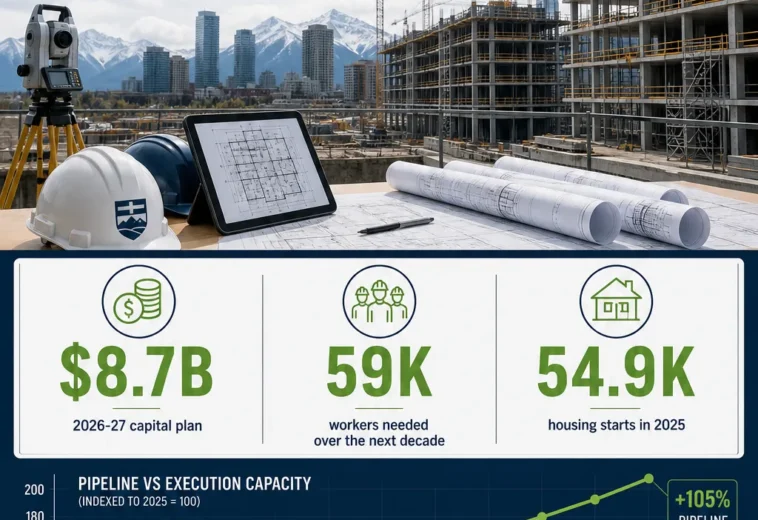
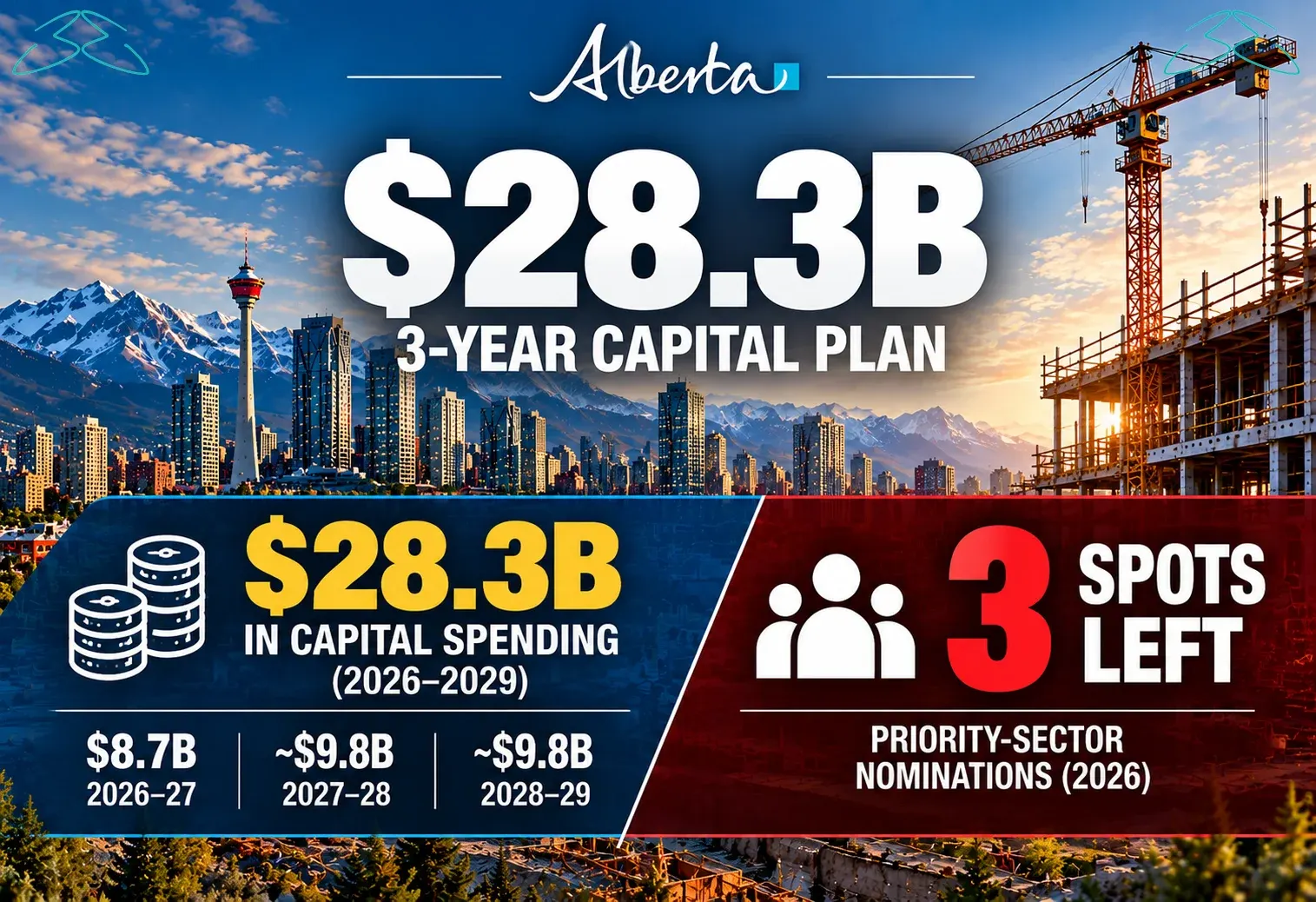
Alberta’s Budget 2026 includes a $28.3 billion capital plan for 2026 to 2029, $2.2 billion more than the previous budget. It allocates $4.9 billion to health care capacity, $3.3 billion to schools, $2.7 billion to provincial highways and bridges, $7.1 billion to municipal infrastructure and $4.2 billion to maintenance and renewal of existing assets. For contractors, consultants and suppliers, the money is confirmed. The harder question is whether the industry can deliver it on time and on budget.
This article looks at what the capital plan includes, why public projects stall even when funding is secure, and what contractors and project managers should prepare for.
What the 2026-29 capital plan funds
- Health: $4.9 billion to expand health care capacity, $1.3 billion more than in Budget 2025.
- Schools: $3.3 billion for new and ongoing school projects.
- Roads: $2.7 billion for highways, bridges and road improvements.
- Municipal infrastructure: $7.1 billion.
- Maintenance and renewal: $4.2 billion for existing infrastructure.
- Other areas: post-secondary institutions, housing and social supports, public safety and service delivery.
The plan comes in a difficult fiscal year: ICBA notes a projected deficit of $9.4 billion in Budget 2026, linked largely to lower oil revenue. That increases scrutiny on how efficiently public capital is spent.
Funding is not the bottleneck
Public projects rarely stall because funding disappears. They stall for more practical reasons.
Procurement timelines not built for volume
When many projects tender at the same time, owners, consultants and contractors compete for the same capacity. Procurement processes designed for a steady flow of work struggle with peaks, and tender periods, evaluations and contract negotiations stretch.
Risk allocated without mapping dependencies
Contracts often transfer risk to contractors without first mapping the dependencies that create it: utility relocations, approvals, site access, existing conditions, long-lead equipment. When those dependencies slip, schedules collapse regardless of the contract terms.
Coordination gaps between owner, consultant and contractor
Public projects involve layered decision-making. When roles are unclear, questions wait for answers, design changes are approved slowly and the project loses weeks at every interface.
Labour capacity is downstream of planning
Industry associations consistently identify labour as a central constraint. BuildForce Canada’s 2026 to 2035 outlook projects that employment in Alberta’s industrial, commercial and institutional building sector will grow 31% by 2035, driven partly by health care and education projects such as the Red Deer Regional Hospital expansion and the School Construction Accelerator Program. The province must add 48,800 construction workers by 2035 while 43,700 retire.
But labour shortages hit hardest on projects that are poorly planned. When schedules are realistic, sequences are coordinated and procurement is early, crews are used efficiently. When planning is weak, scarce labour is wasted waiting for information, materials or decisions.
The contractors at risk
The companies most exposed are not those without contracts. They are those with contracts and no execution structure behind them: firms that win work on price but lack the project management, document control and scheduling capacity to deliver multiple public projects at once.
How to prepare for public capital work
For contractors
- Bid selectively, based on real capacity, not on the size of the pipeline.
- Review risk allocation carefully and price dependencies you do not control.
- Invest in scheduling, cost control and document management before winning more work.
- Secure key subcontractors and long-lead equipment early.
For consultants and project managers
- Map dependencies at the start: approvals, utilities, existing conditions, procurement.
- Set clear decision rights and response times between owner, consultant and contractor.
- Use phase gates so construction does not start on incomplete design.
For public owners
- Stagger tenders to match market capacity where possible.
- Invest in pre-construction: surveys, constructability reviews and realistic schedules.
- Allocate risk to the party best able to manage it.
Maintenance and renewal: the overlooked opportunity
The $4.2 billion for maintenance and renewal of existing infrastructure deserves attention. Renewal projects in occupied schools, hospitals and public buildings involve existing conditions, phasing around operations and strict safety requirements. They reward contractors and consultants with strong survey, documentation and coordination skills, and they are often more accessible to small and mid-size firms than large new builds.
Lessons from recent public projects
Public projects across Canada have shown repeatedly that the most expensive problems appear at interfaces: between design and construction, between owner departments, between contractors on adjacent packages and between new work and existing infrastructure. Projects that invest in early coordination, realistic schedules and clear decision rights tend to finish closer to budget than those that rely on the contract to manage risk after the fact. The same lessons apply whether the project is a rural school or a major hospital.
Opportunities for smaller firms
Large public programs are not only for the biggest contractors. School additions, health facility renovations, municipal buildings, road and bridge rehabilitation and maintenance contracts create work for small and mid-size firms, either directly or as subcontractors. Firms that want to participate should register with public procurement portals, build prequalification packages with safety records and references, and develop the documentation and reporting capability that public owners require. Partnering with larger contractors on specific packages is often the fastest way to gain public-sector experience.
The bottom line
Alberta has committed billions to public infrastructure. Growth does not mean every project gets delivered well; execution does. For developers, contractors, project managers and owners, the most important question is who is managing each project end to end, and whether the structure behind them can handle the volume.
If you are working on a public or mixed-use project in Alberta and want a second read on scheduling, procurement structure or risk allocation, see my construction project management services, read about project governance, or contact me.
Frequently asked questions
How large is Alberta’s 2026 capital plan?
$28.3 billion over 2026 to 2029, $2.2 billion more than Budget 2025.
How much does Alberta’s capital plan allocate to health and schools?
$4.9 billion for health care capacity and $3.3 billion for school projects over three years.
Why do public construction projects get delayed?
Mainly because of procurement bottlenecks, unmanaged dependencies, unclear decision-making and labour constraints, rather than lack of funding.
Sources
- Government of Alberta: Capital plan
- ICBA: Strong capital plan, but Alberta’s fiscal foundation needs attention
- BuildForce Canada: Alberta outlook 2026 to 2035
- 228 views
- 1 Comment

Eros Belotti 01.

Eros belotti
Construction project manager with over 20 years of experience in Europe and the Canary Islands. Specialized in modular housing, container construction, real estate development and international project management. Founder of Reforma Vivienda Tenerife and Donkey Lab.



June 19, 2026 /
Alberta’s three-year capital plan is now at $28.3B — up $2.2B from last year. That’s not a signal to chase volume. It’s a signal to tighten execution.
I work with developers, contractors, and owners in Alberta on scheduling, procurement structure, and risk allocation — from early planning through delivery.
If you’re scoping a project and want a second read before commitments are made, feel free to reach out or visit erosbelotti.com