

//King County Condo Market 2026: Why Weak Pro Formas Break
King County Condo Market 2026: Why Weak Pro Formas Break
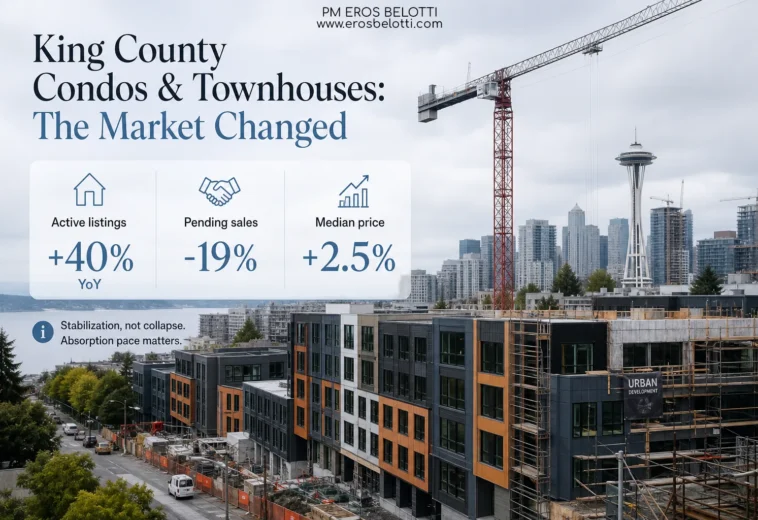
Many condominium and townhouse pro formas in King County, Washington, were built for a market that no longer exists. In spring 2026 the Seattle area recorded some of the sharpest price softening among major US markets, with inventory rising quickly. But the county-wide headlines hide what matters most for builders and infill developers: the difference between attached and detached product, and what slower absorption does to small-project margins.
This article reviews the March 2026 data from the Northwest Multiple Listing Service (NWMLS) for King County, explains why attached product is feeling the pressure first and shows how to stress-test an infill pro forma.
The March 2026 numbers
According to NWMLS data for King County in March 2026, compared with March 2025:
- Condominium active listings: 1,843, up 24.7%.
- Condominium pending sales: 542, down 12.9%.
- Condominium closed sales: 465, down 12.1%.
- Condominium median price: $550,000, down 6.8%.
- Condominium months of inventory: 3.96.
For single-family homes:
- Active listings: 3,147, up 41.6%.
- Pending sales: 1,951, down 4.4%.
- Median price: $975,000, essentially flat (-0.3%).
- Months of inventory: 2.23.
Reading the three signals together
Read the condo numbers together: supply is up by a quarter, demand is down by an eighth and prices are falling. Detached homes also have more listings, but demand has held much better and prices are stable, with months of inventory still low. This is not a crash. It is stabilisation in detached housing and a real adjustment in attached product.
Why attached product feels it first
Condominiums and infill townhomes are often the most price-sensitive part of the market. Buyers of attached product tend to be first-time buyers, downsizers or investors, all groups that react quickly to interest rates and price expectations. When those buyers become selective, absorption slows and builders must compete with resale inventory and other new projects.
Supply has also caught up. Builders kept delivering projects started during stronger conditions while buyers turned cautious. In infill projects, margins depend heavily on how quickly units sell, because construction loans and holding costs keep running until the last unit closes.
What a two-month slip does to an infill project
Consider a six-unit infill townhouse project. If the pro forma assumed all units would sell within two months of completion, and absorption slows to four months, the developer carries additional interest, property taxes, insurance, utilities and marketing costs. On a small project with thin margins, those extra months can quietly erase the profit the pro forma promised, even if the final sale prices are close to target. If prices also fall a few percent, as the condo median did in March, the effect compounds.
How to stress-test a King County infill pro forma
1. Use segment-specific data
Base prices and absorption on attached product in the specific submarket, not on county-wide or detached averages.
2. Model slower absorption
Test sell-out periods of two, four and six months after completion and calculate the effect on interest and holding costs.
3. Test price adjustments
Run scenarios with prices 5% and 10% below the base case.
4. Review construction costs and schedule
Confirm current trade pricing and realistic durations, including permitting.
5. Check the exit options
If sales are slow, can units be rented? Does the financing allow that, and do the rents cover the debt?
6. Consider product and phasing
Larger family-sized units, private outdoor space or phasing construction can reduce exposure to slow absorption.
Which segment, which submarket, which pace
King County is not one market. Urban Seattle neighbourhoods, Eastside cities and south county areas behave differently, and detached and attached product diverge within each. For developers, general contractors and investors, the questions that matter are which segment, which submarket and which absorption pace the project depends on.
Lessons that apply beyond Seattle
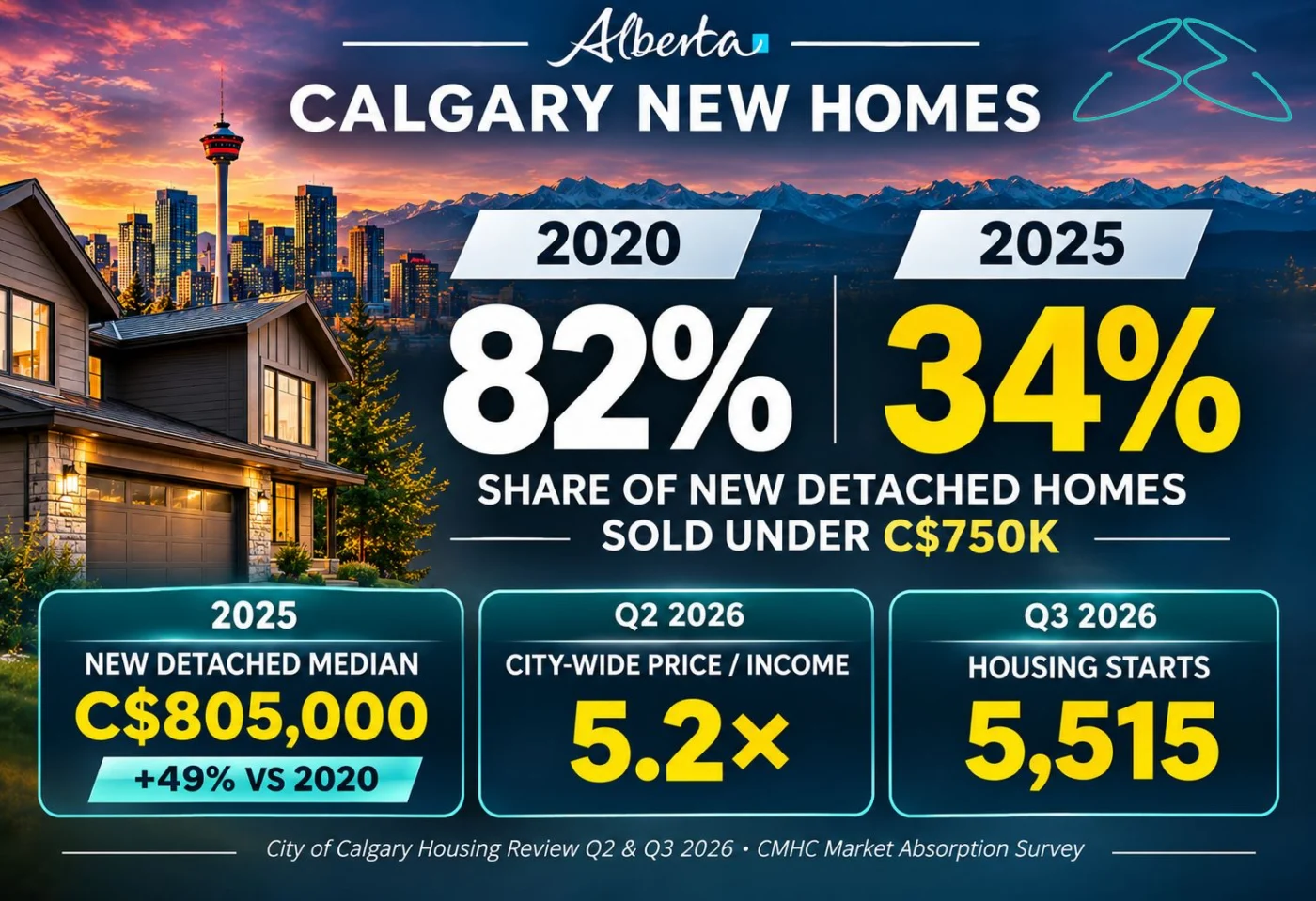
The King County data illustrate a pattern visible in many North American markets in 2026, including Calgary: detached homes holding value while attached and condominium product adjust. The same discipline applies everywhere. Underwrite infill projects with segment-specific absorption, include realistic holding costs and keep an exit strategy if sales slow. Markets with strong long-term demand can still punish projects that were underwritten for a faster pace than buyers are willing to sustain.
Signals to watch
Over the coming months, watch condominium months of inventory, the ratio of pending sales to new listings and the share of listings with price reductions. If condo inventory stabilises below four months and pending sales stop falling, the adjustment may be nearing its end. If inventory keeps rising, developers should expect further price pressure on attached product and plan launches accordingly.
What this means for general contractors
Slower absorption also affects contractors. Developers under margin pressure delay new starts, renegotiate prices or phase projects, which reduces backlog visibility. General contractors working on infill projects should watch their clients’ sales closely, protect cash flow with clear payment terms and avoid concentrating too much of their workload on attached product in the same submarket. Diversifying into detached, renovation or commercial work reduces exposure while the condo segment adjusts.
The bottom line
Seattle and King County are still growing markets, but growth does not mean every project pencils. Attached product is adjusting while detached holds, and infill margins live and die on absorption pace. Feasibility built on current, segment-level data is what separates projects that survive the adjustment from those that do not.
If you are evaluating a condo or townhouse infill deal and want a second read on the numbers before you commit, see my feasibility services, read about cost scenarios in feasibility studies, or contact me.
Frequently asked questions
Are condo prices falling in King County?
Yes. NWMLS data show the King County condominium median price at $550,000 in March 2026, down 6.8% year over year.
How much has inventory increased in King County?
Condominium active listings rose 24.7% and single-family listings 41.6% year over year in March 2026.
Is the Seattle housing market crashing?
The data show adjustment rather than a crash: detached prices were flat, while condominium prices and sales declined.
Sources
- 146 views
- 1 Comment

Eros Belotti 01.

Eros belotti
Construction project manager with over 20 years of experience in Europe and the Canary Islands. Specialized in modular housing, container construction, real estate development and international project management. Founder of Reforma Vivienda Tenerife and Donkey Lab.


June 30, 2026 /
Source: NWMLS March 2026 Market Snapshot, King County condo segment. The detached numbers tell a calmer story — which is exactly the point. The county-wide median hides what’s happening segment by segment.