
Alberta Capital Investment 2026: Construction Up, Machinery Down vs BC
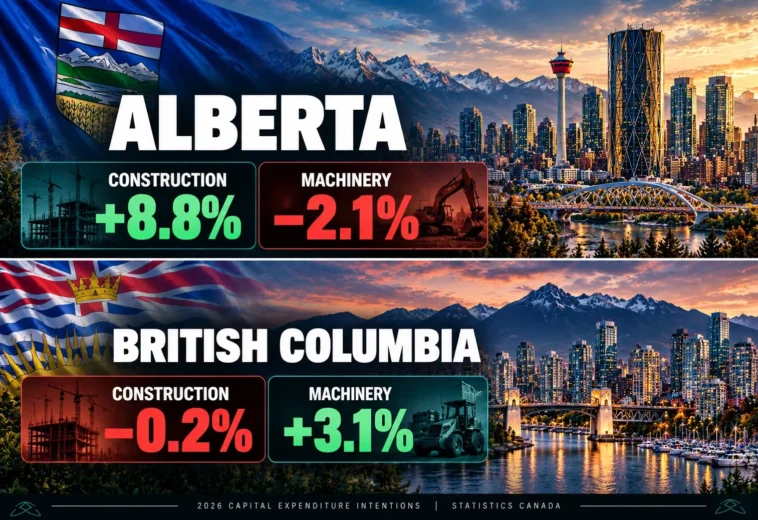
Alberta capital investment in 2026 is heading in a different direction from British Columbia’s. Alberta: construction +8.8%, machinery -2.1%. B.C.: construction -0.2%, machinery +3.1%.
Same country. Two neighbouring provinces. Opposite investment patterns.
According to Statistics Canada’s 2026 capital expenditure intentions, Alberta plans to invest C$80.6 billion in non-residential capital assets, compared with C$64.9 billion in British Columbia. Nationally, total non-residential capital spending is projected to rise by about 3.7%, with lower machinery and equipment purchases more than offset by growth in buildings and structures.
But the total isn’t the most useful figure. What matters is where the money is going, and what that means for contractors, suppliers and companies evaluating Western Canada.
Table of Contents
- Alberta Capital Investment by Asset Type
- British Columbia Shows the Opposite Pattern
- Why the Split Matters More Than the Total
- Investment Is Not the Same as Productivity
- How to Read Intentions Data Before Entering a Market
1. Alberta Capital Investment by Asset Type
Alberta capital investment for 2026 is weighted heavily toward physical construction:
- Non-residential construction: C$60.9 billion, up 8.8%
- Machinery and equipment: C$19.7 billion, down 2.1%
Roughly three of every four capital dollars in Alberta are planned for buildings, plants, pipelines, roads and other structures. Machinery and equipment, the assets that go inside those structures or upgrade existing operations, is expected to decline.
This is consistent with other signals from the province. Non-residential building permits in Alberta rose sharply in August 2026, as I covered in Alberta Building Permits Jump 54.8% in Non-Residential. Permits and capital intentions are different datasets, but they point the same way: more physical construction.
2. British Columbia Shows the Opposite Pattern
British Columbia’s 2026 intentions look almost like a mirror image:
- Non-residential construction: C$47.4 billion, down 0.2%
- Machinery and equipment: C$17.5 billion, up 3.1%
B.C. is broadly holding construction flat while increasing spending on equipment.
That pattern can reflect several things: a market where serviced land and new sites are constrained, companies choosing to upgrade existing facilities instead of building new ones, or sectors where productivity gains come from equipment rather than space. The intentions data alone does not tell us which explanation dominates, but it does show that capital in B.C. is being allocated differently.
I looked at one side of this constraint earlier in Alberta Industrial Real Estate vs BC: The 2026 Numbers, where land and delivery capacity mattered more than price.
3. Why the Split Matters More Than the Total
A company building a new facility has very different needs from one investing in equipment to improve an existing operation.
- Different contractors: general contractors, civil and structural trades versus equipment installers and integrators.
- Different suppliers: concrete, steel and building envelope versus machinery vendors and automation suppliers.
- Different engineering: site, structural and MEP design versus process and controls engineering.
- Different timelines: multi-year delivery versus shorter procurement and installation cycles.
- Different capital risks: permitting, escalation and schedule risk versus technology and integration risk.
For a construction firm or project manager, Alberta’s numbers suggest a larger pool of building and structures work. For an equipment supplier or industrial automation company, B.C. may currently show the stronger growth signal.
The same headline, “Western Canada is investing”, produces two very different opportunity sets.
4. Investment Is Not the Same as Productivity
The split also raises a question about productivity.
More construction spending does not automatically translate into greater efficiency. A new building adds capacity, but its economic value depends on how quickly it is delivered, how well it is used and whether the cost of building it was controlled.
Equally, buying more equipment does not guarantee better financial performance. Machinery delivers value only when it is integrated, staffed and operated effectively.
What ultimately matters is what those investments deliver. For Alberta, where so much capital is directed into construction, delivery capability becomes central: cost control, schedule management, trade availability and procurement strategy. Those are project management questions, not just economic ones.
5. How to Read Intentions Data Before Entering a Market
These figures represent spending intentions, not completed investments. Statistics Canada surveys businesses and governments about planned expenditures, and actual spending may change with interest rates, commodity prices, trade policy and project approvals.
Used correctly, the data is still valuable. A practical approach when evaluating Alberta or British Columbia:
- Start with allocation, not totals. Check whether capital is going into structures or equipment, and whether that matches what your company actually delivers.
- Cross-check with permits and project lists. Intentions should be confirmed by building permits, tenders and announced projects.
- Look at sectors. Provincial totals can hide a single dominant industry, such as oil and gas in Alberta.
- Assess delivery capacity. High construction intentions mean competition for trades, materials and contractors.
- Revisit after actuals are published. Compare intentions with revised figures to understand how reliable each province’s plans have been.
If your company is considering a move into Alberta, incentives such as the Productivity Super Deduction may also affect whether capital goes into new buildings or equipment.
The Question Isn’t How Much, but What For
Alberta capital investment in 2026 is concentrated in construction, while British Columbia is shifting toward machinery and equipment. Two provinces can invest billions of dollars and create very different opportunities for the companies operating within them.
The question isn’t just how much capital is being invested. It’s what that capital is being used to build.
When evaluating a market, do you look first at total investment, or at how that investment is allocated?
Source: Statistics Canada, Non-residential Capital and Repair Expenditures, 2026 intentions (February 25, 2026).
- 8 views
- 0 Comment

Eros Belotti 01.

Eros belotti
Construction project manager with over 20 years of experience in Europe and the Canary Islands. Specialized in modular housing, container construction, real estate development and international project management. Founder of Reforma Vivienda Tenerife and Donkey Lab.