
Calgary Rezoning Repeal and Edmonton Rollback: Who Carries the Risk
The Calgary rezoning repeal has turned zoning into a feasibility variable. 99% of Calgary properties went back to their previous zoning. Edmonton has three months to roll back its own rules. Same province, same rule change, and the risk is landing on whoever already bought land.
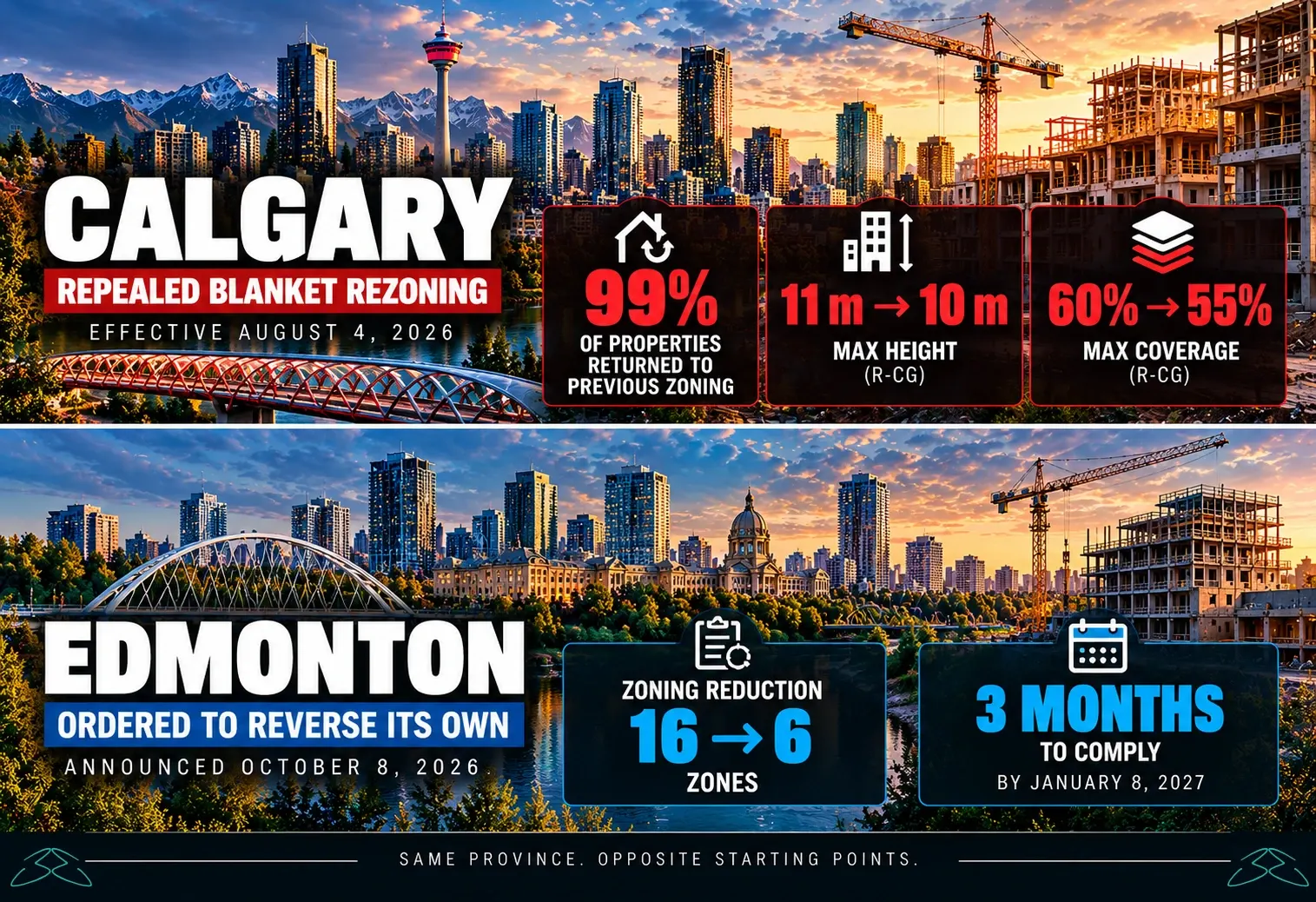
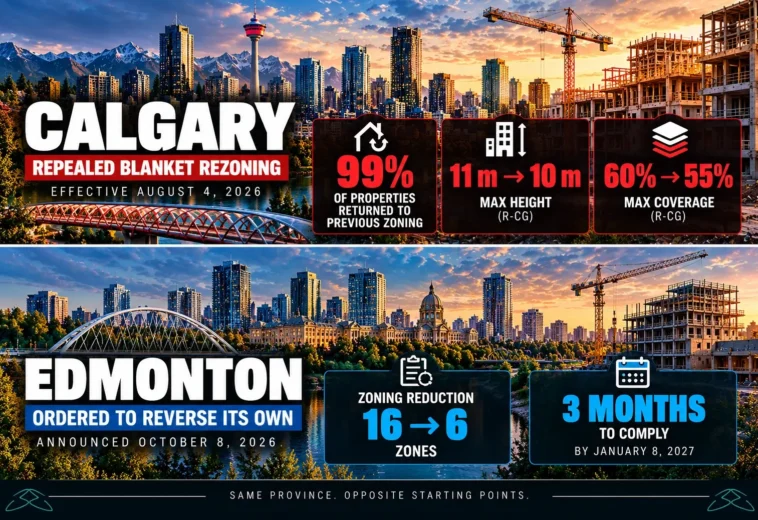
Calgary repealed the citywide (blanket) rezoning it adopted in 2024. The change took effect on August 4, 2026, and 99% of properties returned to their pre-2024 zoning. Then, on October 8, 2026, the Government of Alberta ordered Edmonton to restore its earlier rules on housing types, density, height and parking, as reported by Global News and CTV News.
For developers, builders and lenders, this is not just a policy debate. It changes what a site can carry.
Table of Contents
- What the Calgary Rezoning Repeal Actually Changed
- Edmonton: Ordered to Reverse Its Own Bylaw
- The Pro Forma Impact: 60% to 55% Coverage
- Regulatory Risk Sits in the Land Basis
- How to Stress-Test an Alberta Infill Site Now
1. What the Calgary Rezoning Repeal Actually Changed
With the Calgary rezoning repeal, almost every property affected by the 2024 citywide change reverted to its previous district. Only three situations were exempted:
- An approved permit: a development permit already approved under the 2024 rules.
- An application filed in time: an application submitted before first reading of the repeal bylaw.
- Owner-initiated rezoning: a land-use redesignation applied for by the owner after August 6, 2024.
The rules for R-CG (Residential – Grade-Oriented Infill) lots were also tightened:
- Maximum height: from 11 m to 10 m
- Maximum lot coverage: from 60% to 55%
According to CTV News, the province has also directed Calgary to keep the restored low-density zoning in place until a broader land-use review, expected in 2027, is complete.
2. Edmonton: Ordered to Reverse Its Own Bylaw
Edmonton took the opposite route in 2024. Its new zoning bylaw, in force since January 1, 2024, cut residential zones from 16 to 6 and allowed more units on standard lots. In 2025 the city permitted a record number of homes, as I described in Calgary vs Edmonton: What Two Opposite Zoning Bets Mean for Alberta Feasibility Studies.
On October 8, 2026, the province ordered Edmonton to restore the earlier parameters for housing types, density and height, together with minimum on-site parking requirements. The city has roughly three months, to around January 8, 2027, to comply, followed by a longer review of its land-use bylaw.
The practical result:
- Calgary chose to reverse.
- Edmonton was told to.
Details of the Edmonton order were still being clarified in the weeks after the announcement, according to CTV News Edmonton. Under the Municipal Government Act, applications can still be made under the current Edmonton rules until the bylaw is amended, which creates a short and uncertain window.
3. The Pro Forma Impact: 60% to 55% Coverage
The driver is simple, and it’s on every developer’s spreadsheet.
Going from 60% to 55% lot coverage is roughly an 8% reduction in building footprint per lot (5 divided by 60). Add the loss of one metre of height, and the buildable envelope on a typical R-CG infill lot shrinks further.
On a small infill site, that is often the difference between:
- a four-unit rowhouse that covers land, construction and financing costs, and
- a three-unit scheme that no longer supports the price paid for the land.
Construction costs do not fall when the envelope shrinks. Site servicing, permits, design fees and financing are largely fixed per project. Spreading them across fewer square metres or units raises the cost per unit and reduces margin.
Developers aren’t losing the market. They’re re-pricing the rules.
4. Regulatory Risk Sits in the Land Basis
The same rule moved twice in under three years. That is the definition of regulatory risk.
And it isn’t in the construction budget. It’s in the land basis.
A buyer who paid for a lot in 2025 based on the 2024 zoning paid for density that, in most of Calgary, no longer exists. The building did not get more expensive; the land became worth less for that use. The loss is borne by whoever holds the land when the rules change.
This matters for:
- Developers holding sites acquired under the 2024 rules.
- Lenders whose valuations assumed the higher density.
- Builders with pre-sales or designs based on the old envelope.
- Investors comparing Calgary and Edmonton as if regulation were stable in both.
5. How to Stress-Test an Alberta Infill Site Now
The question for developers and builders isn’t “is density allowed?” It’s “does my pro forma survive the next change?”
A practical checklist before optioning or closing on an infill site in Calgary or Edmonton:
- Confirm the current district. Verify the parcel’s zoning today, not as listed in marketing material.
- Check exemption status. In Calgary, confirm whether an approved permit or qualifying application protects the site.
- Run two envelopes. Model the project under both the current and the previous rules, and price the land on the more conservative one.
- Watch the Edmonton deadline. Assess whether an application can realistically be filed before the bylaw is amended, and what happens if it cannot.
- Add a regulatory contingency. Treat zoning change as a risk with a probability and a cost, not as a fixed assumption.
This is the core of a sound feasibility study: separating what is certain from what can move, and pricing the land accordingly.
Same Province, Opposite Starting Points
Calgary reversed its rezoning by choice. Edmonton is being required to reverse by the province. Both decisions push density back down and shift risk onto land already acquired at higher-density assumptions.
For anyone underwriting an Alberta site, zoning is no longer background information. It is an active variable in the pro forma.
Where do you see the bigger risk right now: Calgary’s exemptions, Edmonton’s January deadline, or somewhere no one is checking yet?
- 4 views
- 0 Comment

Eros Belotti 01.

Eros belotti
Construction project manager with over 20 years of experience in Europe and the Canary Islands. Specialized in modular housing, container construction, real estate development and international project management. Founder of Reforma Vivienda Tenerife and Donkey Lab.