

//Alberta Construction Labour Shortage: 48,800 Workers Needed by 2035
Alberta Construction Labour Shortage: 48,800 Workers Needed by 2035
Tags : AlbertaBuildForce CanadaCalgaryconstruction labour shortageEdmontonnon-residential constructionProject Managementskilled tradesworkforce planning
Alberta’s construction market is sending two signals that look contradictory. Housing starts are down 5% year-over-year. Non-residential activity is forecast to climb through 2035. Both are true — and the Alberta construction labour shortage is what connects them.
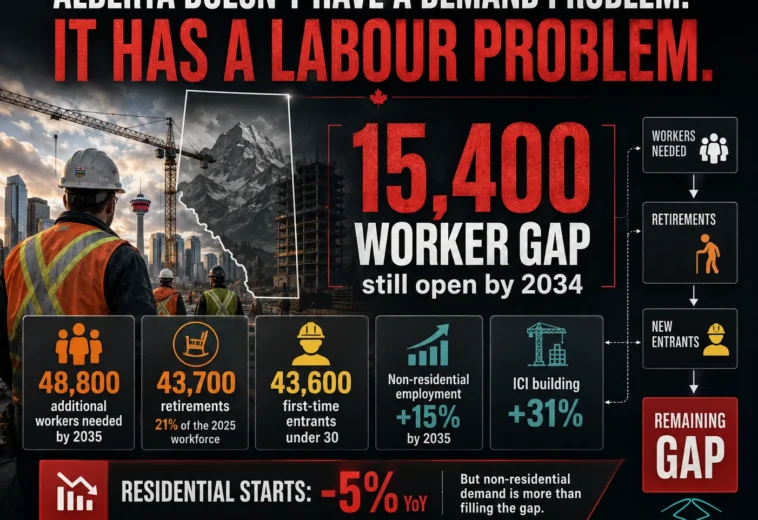
The forecast from BuildForce Canada is blunt: the province needs to add 48,800 construction workers by 2035, while 43,700 current workers — 21% of the 2025 construction labour force — head into retirement.
That is not a hiring inconvenience. It is the single constraint most likely to break your schedule, your budget, and your bid.
The numbers behind the Alberta construction labour shortage
- 48,800 additional workers needed by 2035
- 43,700 retirements — 21% of the 2025 construction labour force
- 43,600 first-time entrants under 30 from the local population
- 15,400 net recruiting gap still open by 2034
- 512,300 new immigrants expected in Alberta between 2026 and 2035
Read the third and fourth figures together, because this is where most analysis stops too early. Alberta has a younger demographic than most provinces, and roughly 43,600 new entrants under 30 are projected to join the labour force over the period. That covers most of the retirement wave.
What it does not cover is expansion. Once you add the workers needed for growth, a recruiting gap of 15,400 remains by 2034. In other words: the Alberta construction labour shortage is not primarily about replacing who is leaving. It is about staffing what is being built on top.
Demand is not slowing — it is shifting to non-residential
Headlines about cooling housing starts create the impression of a market in retreat. The data says otherwise, and it explains why the Alberta construction labour shortage is tightening rather than easing.
Residential is moderating. Alberta’s annualised housing starts sat at 46,064 units as of March 2026, down 5% year-over-year, with Calgary at 24,023 (−4%) and Edmonton at 17,217 (−8%). At the same time, 137,324 units across Canada held approved building permits without having broken ground as of June 2026 — approved demand waiting on capacity.
Non-residential is moving the other way. BuildForce projects Alberta’s non-residential construction employment to rise 15% above 2025 levels by 2035, with ICI (industrial, commercial, institutional) building employment up 31%.
The pipeline behind that number is concrete: light rail transit expansion in Calgary and Edmonton, the Yellowhead Mainline natural gas pipeline, Scotia Place arena and Arts Commons in Calgary, and a provincial ambition to attract $100 billion in data centre investment.
One caveat worth stating honestly: a large share of that data centre figure rests on a small number of very large projects, and those timelines move. Wonder Valley — a proposed $70-billion, 7.5-gigawatt campus near Grande Prairie — was originally slated to break ground in 2026; construction is now hoped for late 2028. Plan against the confirmed pipeline, not the press releases.
Why the Alberta construction labour shortage changes bidding strategy
For most of the last decade, competitive advantage in this market was a pricing question. The Alberta construction labour shortage rewards a different capability over the next decade: the ability to actually crew the job.
A sharp price means nothing if you cannot staff the work. A realistic schedule means nothing if the trades are unavailable in the week the Gantt chart says they should be on site. When labour is the binding constraint, the contractor who can guarantee crews commands a premium — and sophisticated clients already know it.
Practically, three things move up the priority list:
- Workforce planning as a pre-bid activity, not a post-award scramble.
- Retention economics. The cost of losing a trained crew now exceeds the cost of keeping one.
- Apprenticeship and training pipelines on a three-to-five-year horizon, because that is the real lead time on a journeyperson.
Immigration is the largest single lever
Alberta is expected to welcome more than 512,300 new immigrants between 2026 and 2035. On paper, that dwarfs the 15,400-worker gap. In practice, it only closes the Alberta construction labour shortage if the industry can convert arrivals into productive tradespeople.
That conversion is an operational problem, not a policy one: credential recognition, structured onboarding, mentorship, and safety training delivered in more than one language. Firms that build a working intake process will reach a labour pool their competitors are not touching. Firms that wait for the system to solve it will be bidding against them.
What this means if you are planning a capital project in Alberta
Build the labour strategy before the schedule and the budget. In a market defined by the Alberta construction labour shortage, crew availability is the assumption every other number depends on — and right now it is the one most likely to break.
- Validate trade availability during the feasibility study, not at mobilisation.
- Stress-test the schedule against a crew-availability scenario, not only weather and permitting.
- Price labour risk explicitly instead of burying it in contingency.
- Sequence the works to flatten peak crew demand wherever the design allows.
This is where disciplined front-end work pays for itself. Industry data puts average rework at roughly 5% of construction value, and design errors are the most commonly cited single cause of cost overruns. Add a labour market with no slack to absorb slippage, and the cost of getting the front end wrong rises sharply.
Frequently asked questions
How many workers does the Alberta construction labour shortage represent?
BuildForce Canada projects Alberta needs to add 48,800 construction workers by 2035. After accounting for an estimated 43,600 young local entrants, a net recruiting gap of 15,400 workers remains to be filled by 2034.
Is Alberta construction actually growing in 2026?
Yes, on the non-residential side. Residential is moderating — annualised housing starts were 46,064 as of March 2026, down 5% year-over-year. Non-residential is expanding, with employment forecast to rise 15% above 2025 levels by 2035 and ICI building employment up 31%. That divergence is precisely what makes the Alberta construction labour shortage a growth constraint rather than a downturn symptom.
Which sectors are driving Alberta construction demand?
Light rail transit in Calgary and Edmonton, pipeline and utilities work including the Yellowhead Mainline, commercial projects such as Scotia Place arena, and a provincial push to attract $100 billion in data centre investment — though the latter is concentrated in a few large projects with shifting timelines.
The bottom line
Alberta is not short of work. It is short of people to do the work. The firms that treat the Alberta construction labour shortage as a strategic problem rather than an HR problem will be the ones still delivering on time in 2030.
If you are scoping a project in Alberta and want a second opinion on the feasibility assumptions — particularly on labour availability and schedule risk — I am happy to talk it through.
Sources
- BuildForce Canada — Alberta labour market outlook
- CMHC — Housing starts and construction data
- Daily Commercial News — Alberta construction growth to 2035
- 196 views
- 1 Comment

Eros Belotti 01.

Eros belotti
Construction project manager with over 20 years of experience in Europe and the Canary Islands. Specialized in modular housing, container construction, real estate development and international project management. Founder of Reforma Vivienda Tenerife and Donkey Lab.
August 7, 2026 /
Sources for the numbers, for anyone who wants to check them:
BuildForce Canada — Alberta labour market outlook to 2035 (48,800 workers, 43,700 retirements, 15,400 gap):
https://www.buildforce.ca/en/press-release/employment-demands-increase-in-alberta-to-2034-with-growth-greatest-in-the-non-residential-sector/
CMHC — housing starts and construction data (46,064 annualised starts, Calgary and Edmonton splits):
https://www.cmhc-schl.gc.ca/media-newsroom/news-releases/2026/housing-starts-june-2026
Daily Commercial News — Alberta construction growth to 2035 (non-residential +15%, ICI +31%, project pipeline):
https://canada.constructconnect.com/dcn/news/economic/2026/07/pipelines-and-megaprojects-help-fuel-alberta-construction-growth-to-2035-buildforce