

//Alberta Construction Market 2026: Why Growth Is Shifting, Not Slowing
Alberta Construction Market 2026: Why Growth Is Shifting, Not Slowing
Tags : Alberta ConstructionAlberta EconomyBuildForce Canadaconstruction market 2026FeasibilityHousing Startsnon-residential construction
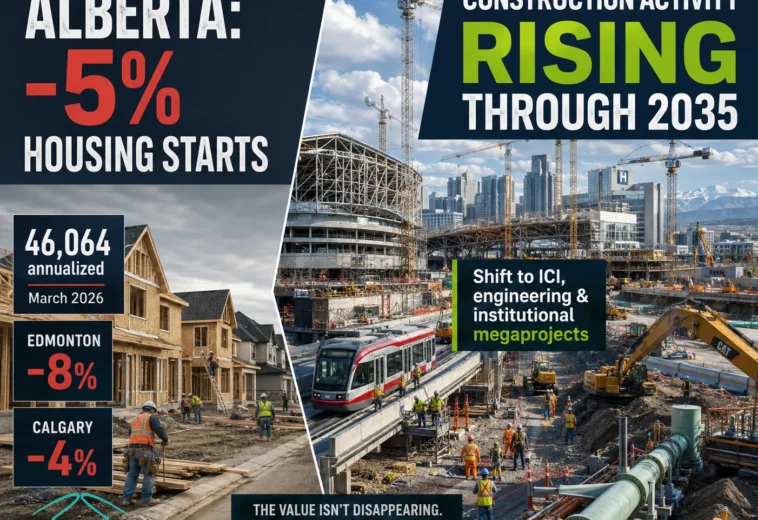
If you only read the residential headlines, you might conclude that the Alberta construction market in 2026 is cooling. Housing starts are down from the record set in 2025, and both Calgary and Edmonton are building fewer homes than a year ago. But the data behind those headlines tells a more useful story. Construction activity in Alberta is not shrinking. It is shifting, from new housing toward industrial, commercial, institutional and engineering work.
For developers, contractors and firms planning to enter the province, understanding that shift matters more than any single housing number.
Residential: a moderation from a record
2025 was an exceptional year for Alberta housing. The province recorded 54,858 housing starts, according to ATB Economics, beating the previous record of 48,962 set in 2006. Around 90% of those starts were in the Calgary and Edmonton metro areas, and rental construction also set records.
In 2026, the pace has eased. BILD Alberta’s second-quarter report shows provincial starts down about 21% year-over-year in the first half of the year, with Calgary down about 23% and Edmonton down about 20%. Rental starts fell by around 27% from their record pace.
That is a real slowdown, but context matters. BuildForce Canada describes it as “a moderation from peak levels rather than a significant contraction.” Its forecast sees residential investment peaking in 2026 and then receding as population growth slows, with housing starts falling into the early 2030s before recovering. Renovation work is expected to grow throughout the period.
Where the Alberta construction market is growing
BuildForce Canada’s 2026 to 2035 outlook, published in July 2026, projects that Alberta construction activity will rise through 2035 because non-residential growth more than offsets softer residential demand. By 2035, compared with 2025 levels, it expects:
- Non-residential employment up about 15%
- Industrial, commercial and institutional (ICI) building employment up about 31%
- Engineering construction employment up about 10%
- Residential employment down about 16%, with losses concentrated in new housing
The projects behind that forecast are concrete and largely funded:
- Light rail transit expansions in Calgary and Edmonton
- The Yellowhead Mainline natural gas pipeline
- Scotia Place, the new Calgary arena, and the Arts Commons transformation
- The Red Deer Regional Hospital expansion
- The provincial School Construction Accelerator Program
On top of these, industrial megaprojects in Alberta’s Industrial Heartland, such as Dow’s Path2Zero complex and Pembina’s Greenlight Electricity Centre, add billions of dollars of engineering and industrial construction through the end of the decade.
The labour bottleneck
A growing non-residential pipeline meets a tightening workforce. BuildForce estimates that Alberta will need to add about 48,800 workers by 2035. The main driver is retirement: about 43,700 workers, or 21% of the 2025 construction labour force, are expected to retire over the decade. Local new entrants are expected to cover most of that gap, but BuildForce warns of a possible shortfall of up to 5,300 workers by the end of the decade.
The shift also changes the skills mix. Workers leaving residential construction do not automatically move into industrial or institutional work, which often requires different trades, certifications and safety programs. Firms that can retrain staff or bring in experienced supervision will be better positioned.
A caveat for planners
A large share of the non-residential growth depends on a limited number of major engineering and institutional projects. BuildForce notes that engineering construction is expected to dip around 2031 as current projects finish, before growing again. Industrial activity will fluctuate with the timing of large manufacturing investments.
That concentration makes project selection and timing more important. A single deferred megaproject can shift regional demand for trades, equipment and subcontractors. Reading the pipeline correctly matters more than reading the headline.
What this means for developers
For residential developers, the slowdown is not a reason to stop, but it is a reason to be more selective:
- Test absorption carefully. With fewer starts and slower population growth, demand assumptions from 2024 and 2025 may be too optimistic.
- Watch construction costs. Non-residential projects will compete for trades, which can keep costs high even as housing activity eases.
- Look at renovation and conversion. Renovation demand is expected to grow, and office-to-residential conversions remain supported in Calgary.
- Consider purpose-built rental with financing support. Programs such as CMHC MLI Select can still improve project economics where affordability and energy commitments fit.
What this means for contractors and new entrants
For contractors and firms entering Alberta, the opportunity lies in following the non-residential dollars:
- ICI work such as hospitals, schools, arenas and transit facilities is growing fastest.
- Engineering construction such as pipelines, power plants and industrial facilities remains elevated into the medium term.
- Project management and controls are in demand because large projects need disciplined scheduling, cost control and risk management.
For European firms, these sectors often match existing strengths in technical engineering, prefabrication and project delivery. The usual path is to partner with an established Alberta contractor on a defined scope, then build a track record.
How to use this in a feasibility study
A feasibility study for an Alberta project should not rely on a single housing statistic. It should consider the provincial pipeline, the timing of nearby megaprojects that will compete for labour, the specific trades the project needs, and realistic cost escalation. Testing the project under a delayed-schedule and higher-cost scenario helps reveal whether it still works if conditions tighten.
The bottom line
The Alberta construction market in 2026 is not slowing so much as changing direction. Residential construction is moderating from a record year, while non-residential activity, led by ICI buildings, transit and industrial projects, is set to grow through 2035. The constraint is labour, not demand. Firms that read where the money is going and plan for the workforce they will need are best placed to benefit.
Planning a project or market entry in Alberta? Get in touch to discuss a feasibility study tailored to your plans.
Frequently asked questions
Is the Alberta construction market slowing in 2026?
Residential construction is slowing from a record 2025, but total construction activity is forecast to keep rising through 2035 because of non-residential growth.
Which construction sectors are growing in Alberta?
Industrial, commercial and institutional buildings and engineering construction, including transit, pipelines, hospitals, schools and industrial facilities.
How many construction workers will Alberta need?
BuildForce Canada estimates Alberta will need to add about 48,800 workers by 2035, mainly to replace about 43,700 retirements.
How many housing starts did Alberta have in 2025?
Alberta recorded 54,858 housing starts in 2025, a provincial record.
Sources: BuildForce Canada, Alberta Construction and Maintenance Looking Forward 2026–2035 (July 2026); ATB Economics, Alberta housing starts December 2025; BILD Alberta Quarterly Report Q2 2026; CMHC housing starts data.
- 151 views
- 1 Comment

Eros Belotti 01.

Eros belotti
Construction project manager with over 20 years of experience in Europe and the Canary Islands. Specialized in modular housing, container construction, real estate development and international project management. Founder of Reforma Vivienda Tenerife and Donkey Lab.

July 31, 2026 /
Data sources for anyone who wants to dig in: BuildForce Canada’s 2026–2035 Alberta forecast and CMHC housing starts (March 2026).
I work on the feasibility and project side of this shift — helping companies read where Alberta’s non-residential dollars are actually landing before they commit. Happy to compare notes if you’re planning a move into this market.