

//Alberta Industrial Heartland: The $80B Construction Opportunity
Alberta Industrial Heartland: The $80B Construction Opportunity
Tags : Alberta ConstructionAlberta Industrial HeartlandCanada investmentEuropean contractorsFeasibilityforeign direct investmentpetrochemical projectsProject Management
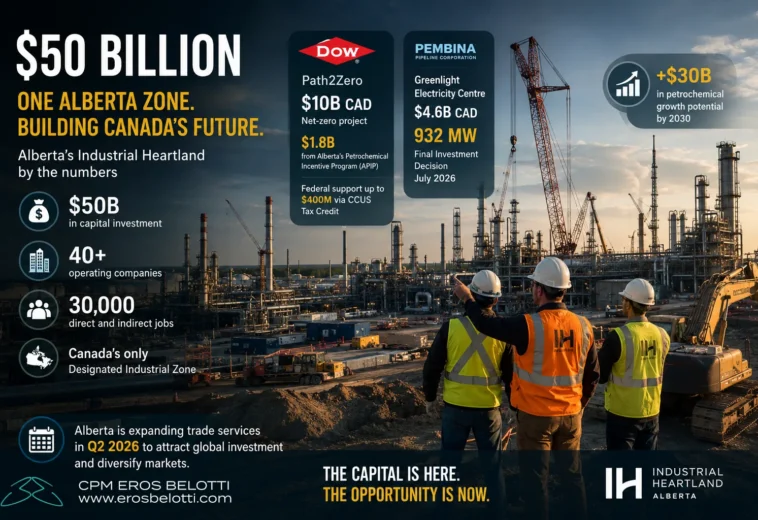
Alberta’s Industrial Heartland, northeast of Edmonton, is one of the largest concentrations of industrial capital in North America. Around $50 billion is already invested there, about $30 billion more is under construction, and the region is expected to reach roughly $80 billion in total investment by the early 2030s. Most of the coverage frames this as an energy story. For contractors, engineers, project managers and real estate developers, it is a construction and project delivery story first.
This article looks at what is being built in Alberta’s Industrial Heartland, who is building it, and what the opportunity means for firms, including European ones, considering a move into the Canadian market.
What Alberta’s Industrial Heartland is
The Heartland covers about 582 square kilometres of industrial land across five municipalities: the City of Edmonton, the City of Fort Saskatchewan, Lamont County, Strathcona County and Sturgeon County. These municipalities coordinate planning and investment attraction through the Alberta’s Industrial Heartland Association (AIHA). The region is often described as the third largest industrial cluster in the world by geographic area.
More than 40 companies operate there, producing fuels, fertilizers, petrochemicals, chemicals, hydrogen, natural gas liquids, plastics and electricity. The cluster benefits from proximity to feedstock, pipeline corridors, rail connections and an experienced industrial workforce around Edmonton.
The projects driving the next wave
Two recent decisions show the scale of what is coming.
Dow Path2Zero
Dow’s Path2Zero project in Fort Saskatchewan is designed as the world’s first net-zero Scope 1 and 2 emissions ethylene and derivatives complex. When Dow took its final investment decision in 2023, it committed about US$6.5 billion of its own capital, with roughly US$2 billion more expected from third parties for hydrogen, carbon capture and infrastructure assets. Canadian estimates for the total project range from about C$10 billion to C$11.6 billion. The Government of Alberta supports it with about $1.8 billion through the Alberta Petrochemicals Incentive Program.
In 2025 Dow delayed the project by about two years. Phase 1 is now expected to start up in late 2029 and Phase 2 in 2030. At peak, construction is expected to employ 7,000 to 8,000 workers, with 400 to 500 permanent jobs once the complex is operating.
Pembina’s Greenlight Electricity Centre
In July 2026, Pembina Pipeline announced a positive final investment decision on the Greenlight Electricity Centre in Sturgeon County. It is a 932 MW natural gas combined-cycle plant, permitted for expansion to 1,864 MW, that will supply behind-the-meter power to a data centre developer. The total cost is about $4.6 billion including financing costs. Pembina and Morgan Stanley Infrastructure Partners each hold 47.5%, and Kineticor holds 5%. Engineering, procurement and construction will be delivered by a consortium of Aecon and Técnicas Reunidas under lump-sum, fixed-price agreements, with Siemens Energy supplying the turbines. The plant is scheduled to enter service in the second half of 2030.
The Greenlight project is worth noting for another reason: a Spanish engineering firm is part of the EPC consortium. European technical capability is already being used on Heartland megaprojects.
Why this is a construction story
Every billion dollars of industrial capital passes through the same sequence: feasibility, permitting, design, procurement, construction, commissioning and handover. Each stage creates demand for specialised services. The most visible are the large EPC contracts, but behind them sit hundreds of smaller scopes:
- Site preparation, civil works, piling and foundations
- Structural steel, modules and pipe racks
- Electrical, instrumentation and controls
- Temporary facilities, camps and logistics
- Quality control, inspection and commissioning support
- Cost control, scheduling and project controls
Large projects also create secondary demand: housing for workers, commercial space, roads and utility upgrades in surrounding communities such as Fort Saskatchewan, Sherwood Park and Gibbons. For real estate developers, the Heartland is a demand driver for the whole north-east Edmonton region.
The workforce constraint
Capital is not the bottleneck. People are. BuildForce Canada’s 2026 to 2035 outlook estimates that Alberta will need to add about 48,800 construction workers by 2035, largely because 43,700 workers, about 21% of the 2025 labour force, are expected to retire. Engineering construction is expected to remain elevated into the medium term, which is exactly the category that Heartland projects fall into.
When several megaprojects overlap, they compete for the same trades, supervisors and project managers. That raises costs and increases schedule risk for everyone, including smaller projects in the region. Firms that can bring experienced supervision, productivity tools or prefabrication capacity have a clear advantage.
Risks to keep in view
An honest assessment needs to include the risks:
- Timing risk. Dow’s two-year delay shows that even approved projects can move. A business plan that depends on a single project’s schedule is fragile.
- Commodity and policy risk. Petrochemical and energy investment depends on global prices, carbon policy and federal and provincial incentives, all of which can change.
- Concentration risk. A few very large projects account for a large share of the investment. Their timing can swing regional demand significantly.
- Cost escalation. Labour and material inflation can erode margins on fixed-price work, which is why the risk allocation in contracts matters.
How European firms can enter
For European contractors, engineers and developers, the Heartland offers a credible entry point to North America, but it rewards preparation:
- Start as a subcontractor or partner. Joining an established EPC or general contractor on a defined scope is usually faster than bidding as a prime contractor.
- Align with Canadian codes and certifications. Provincial safety programs such as a Certificate of Recognition (COR), engineering registration with APEGA and familiarity with Canadian standards are often prerequisites.
- Plan for the workforce. Understand how trades are certified in Alberta and how temporary foreign workers can or cannot be used.
- Use public resources. Alberta’s investment and trade offices and the AIHA can help identify opportunities and local partners.
- Run a feasibility study before committing capital. Market entry needs the same discipline as any project: demand, costs, risks and a realistic timeline.
The bottom line
Alberta’s Industrial Heartland already holds about $50 billion of investment and has about $30 billion more under construction. Projects like Dow Path2Zero and Pembina’s Greenlight Electricity Centre will need thousands of workers and many specialised firms through the end of the decade. The capital has largely been committed. The open question is who will deliver it, and firms that prepare now, with the right partners, certifications and feasibility work, will be in the best position to take part.
If you are a construction or real estate firm weighing a move into Alberta, get in touch to discuss how a feasibility study can test the opportunity for your business.
Frequently asked questions
Where is Alberta’s Industrial Heartland?
It is located northeast of Edmonton and spans parts of five municipalities: Edmonton, Fort Saskatchewan, Lamont County, Strathcona County and Sturgeon County.
How much has been invested in the Heartland?
About $50 billion of capital is already invested, about $30 billion more is under construction, and total investment is expected to reach about $80 billion by the early 2030s.
When will Dow’s Path2Zero project be completed?
After a two-year delay announced in 2025, Phase 1 is expected to start up in late 2029 and Phase 2 in 2030.
Can foreign construction firms work on Heartland projects?
Yes. International firms already participate, including in EPC consortia. Most new entrants start as partners or subcontractors and must meet Canadian safety, engineering and certification requirements.
Sources: Alberta’s Industrial Heartland Association data as reported by EnergyNow (September 2026); Dow Path2Zero coverage by Business Facilities (2026) and CBC News; Pembina Pipeline press release on the Greenlight Electricity Centre FID (July 2, 2026); BuildForce Canada, Alberta Construction and Maintenance Looking Forward 2026–2035.
- 134 views
- 1 Comment

Eros Belotti 01.

Eros belotti
Construction project manager with over 20 years of experience in Europe and the Canary Islands. Specialized in modular housing, container construction, real estate development and international project management. Founder of Reforma Vivienda Tenerife and Donkey Lab.
July 23, 2026 /
A few numbers behind this, for anyone who wants to dig in:
→ Dow Path2Zero: $10B CAD, with $1.8B from Alberta’s petrochemical incentive program
→ Pembina Greenlight Electricity Centre: $4.6B, 932 MW — FID reached July 2026
→ Alberta’s Industrial Heartland: $50B in capital, 40+ companies, 30,000 jobs
→ Province targeting +$30B in petrochemicals by 2030
Sources: Alberta’s Industrial Heartland Association + Invest Alberta (links below).
Question for the construction and real estate people here: what’s the single biggest barrier stopping European firms from bidding on North American projects — capital, local partnerships, or regulatory know-how?