
- Alberta
- Alberta Construction
- Alberta Economy
- Alberta Real Estate
- Calgary Real Estate
- Canada Construction
- Construction Canada
- Construction Management
- Feasibility
- Housing Starts
- HousingMarket
- New Builds
- Project Management
- Property Development
- Real Estate Canada
- Real Estate Development
- Real Estate Investing
- Urban Development
Design Freeze in Construction: The One-Page Agreement That Protects Your Budget
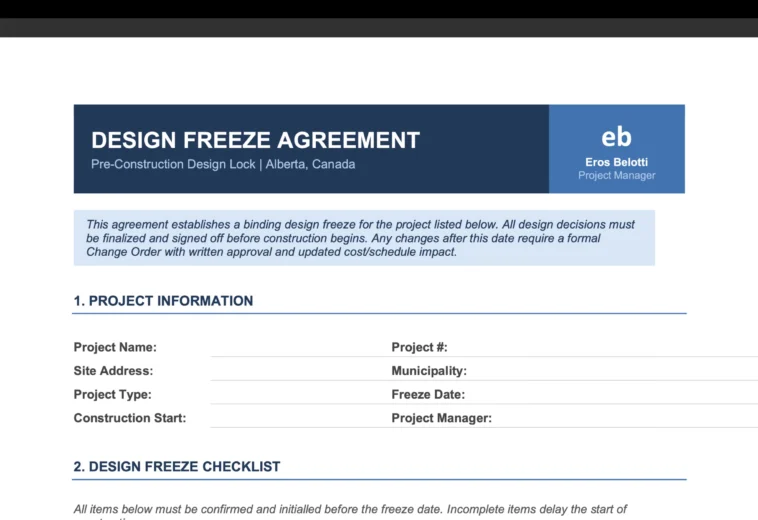
In construction, the most expensive sentence is “we can decide that later.” Flooring, layouts, window sizes, kitchen configurations: when these choices stay open after work begins, every one of them becomes a potential change order. A design freeze is the simplest tool I know to stop that from happening.
This article explains what a design freeze is, why late design changes are so costly, and how to introduce a one-page design freeze agreement on residential and renovation projects.
The real problem is not finding land or materials
For a long time the main concern for developers in Alberta was securing land and approvals. After a record construction year in 2025, with more than 54,000 housing starts in the province, the pressure has moved: margins are tighter, sales are slower in some segments and the projects that suffer are the ones losing money after ground is broken.
Research on cost performance supports this. KPMG’s Global Construction Survey found that only 31% of projects came within 10% of their budget. When owners analysed the causes, scope definition, information quality and governance featured as prominently as site problems.
How late changes multiply cost
A change made on paper costs the time of a designer. The same change made after demolition or framing affects work already completed, trades already scheduled and materials already ordered. Typical examples I see on residential projects:
- Flooring changed after demolition: new material lead times, re-levelling of subfloors and a gap in the trade schedule that can stop the job for one to two weeks.
- Layout revised during framing: walls removed and rebuilt, electrical and plumbing rough-ins redone, inspections repeated.
- Permit shortcuts to save time: work that needs a permit carried out without one, exposing the owner to stop-work orders, rework and fines far larger than the permit fee.
None of these are caused by market conditions, material costs or labour shortages. They are caused by decisions that were not made, or not documented, before work began.
What a design freeze is
A design freeze is an agreed point after which the design is considered final for construction. From that moment, any change must go through a formal request that states the cost, the schedule impact and who approves it.
It does not forbid changes. Clients still have the right to change their minds. It simply ensures that every change is a conscious decision with a known price, rather than a casual request that turns into an unbudgeted cost weeks later.
What to include in a design freeze agreement
A design freeze agreement can fit on one page. The version I use on every project covers:
- The documents frozen: drawing numbers and revisions, specification and finish schedule.
- The freeze date: signed before site start, or before each phase on larger projects.
- Open items: any decision still pending, with a deadline and a provisional sum.
- The change procedure: request in writing, priced by the contractor, approved by the owner before work proceeds.
- Signatures: owner, designer and contractor or project manager.
Who signed off on the design, and when
When I review a project that is bleeding money, the first question I ask is not whether the budget was realistic. It might have been. The question is: who signed off on the design, and when? If the answer is “nobody” or “it was still being discussed when demolition started,” the overrun was predictable.
A realistic budget does not survive a design that keeps moving. Process does.
How to introduce a design freeze without friction
Explain it as protection, not restriction
Clients accept a design freeze when they understand it protects their budget and their move-in date. Showing a simple example of what a late change costs is usually enough.
Freeze in stages on complex projects
On larger developments, freeze structural and envelope decisions first, then mechanical and electrical layouts, then interior finishes. Each freeze aligns with the procurement deadline for that package.
Keep a visible change log
A shared log of every change request, its cost and its status keeps everyone aligned and prevents disputes at final account.
Link it to procurement
Long-lead items such as windows, custom millwork and mechanical equipment should never be ordered on an unfrozen design. Tie each purchase order to a frozen drawing revision.
Common objections, and how to answer them
“We are still waiting for the client to choose finishes.” Then freeze everything else and list the finishes as open items with a deadline and a provisional sum. The structure, layout and services can be priced and scheduled while finishes are selected, as long as the deadline is tied to the procurement date.
“A formal process will slow us down.” A change request can be one email with three lines: what changes, what it costs, how many days it adds. The few minutes spent writing it are nothing compared with the days lost when a change is discovered by the trade that has to undo work.
“Our clients do not like signing documents.” In my experience, clients like surprises at the end much less. When they see that the agreement also protects them from unapproved extras, most sign it willingly. It gives them control, which is what they want.
“We trust each other.” Good. A written freeze keeps that trust intact when memories differ three months later about who asked for what.
The bottom line
Design freezes are not bureaucracy. They are one of the cheapest ways to protect a construction budget, especially in a market where margins no longer absorb mistakes. Every project I manage starts with a signed one-page agreement before day one.
You can download my Design Freeze Agreement template (PDF), read more about why construction budgets fail before site, or contact me to discuss your project.
Frequently asked questions
What is a design freeze in construction?
It is an agreed point after which the design is final for construction and any further change requires a formal, priced change request.
When should the design be frozen?
Before site work starts, and before ordering the materials and equipment affected by that design. On large projects, freeze in stages aligned with procurement.
Does a design freeze stop the client from making changes?
No. It makes every change visible, priced and approved, so the client decides with full information.
Sources
- Building Design + Construction: KPMG Global Construction Survey
- ATB Financial: Housing starts in Alberta, December 2025
- 239 views
- 0 Comment

Eros Belotti 01.

Eros belotti
Construction project manager with over 20 years of experience in Europe and the Canary Islands. Specialized in modular housing, container construction, real estate development and international project management. Founder of Reforma Vivienda Tenerife and Donkey Lab.