

//Alberta Labour Shortage: Workers or Entrepreneurs? What Alberta Actually Needs
Alberta Labour Shortage: Workers or Entrepreneurs? What Alberta Actually Needs
November 9, 2026Category : Alberta Business Development Construction Economy Immigration Market Analysis
Tags : AAIPAlberta Labour ShortageBuildForceBusiness InvestmentConstruction WorkforceEntrepreneur ImmigrationImmigration Levels Planskilled tradesUnemployment Alberta
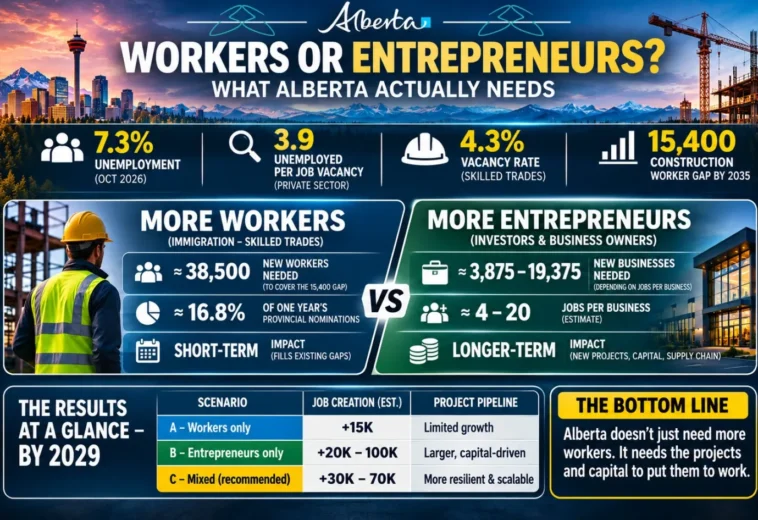
The Alberta labour shortage is not what most headlines suggest: in October 2026 the province had about 3.9 unemployed people for every private-sector job vacancy, yet specialty trade contractors still say they cannot find crews. Both statements are true, and together they answer a question I keep hearing: does Canada need more workers, or more investors who bring capital and create the jobs?
My reading of the data is this. Over the next 12 to 24 months, Alberta’s constraint is not headcount. It is the flow of projects and capital that puts people to work. From 2028, if the large projects go ahead, the constraint moves back to skilled trades, not labour in general. Federal policy today leans almost entirely on one channel and barely uses the other.
This article walks through the evidence, shows where my numbers are calculations and not data, and says what I could not find.
Table of Contents
- The question and the short answer
- What federal immigration policy actually does
- Alberta’s labour market: not short of people, short of specific trades
- The capital side: what the signals say
- Workers vs entrepreneurs: the numbers side by side
- Three scenarios to 2029
- What this means for contractors, developers and lenders
- Limits of the data and sources
The Question and the Short Answer
Workers and capital are not substitutes. Capital creates the work; qualified people make it buildable. But they are not equally scarce at the same time. The data below shows which one is short right now: today it is viable projects and the capital behind them, while the trades gap builds over the next decade.
What Federal Immigration Policy Actually Does
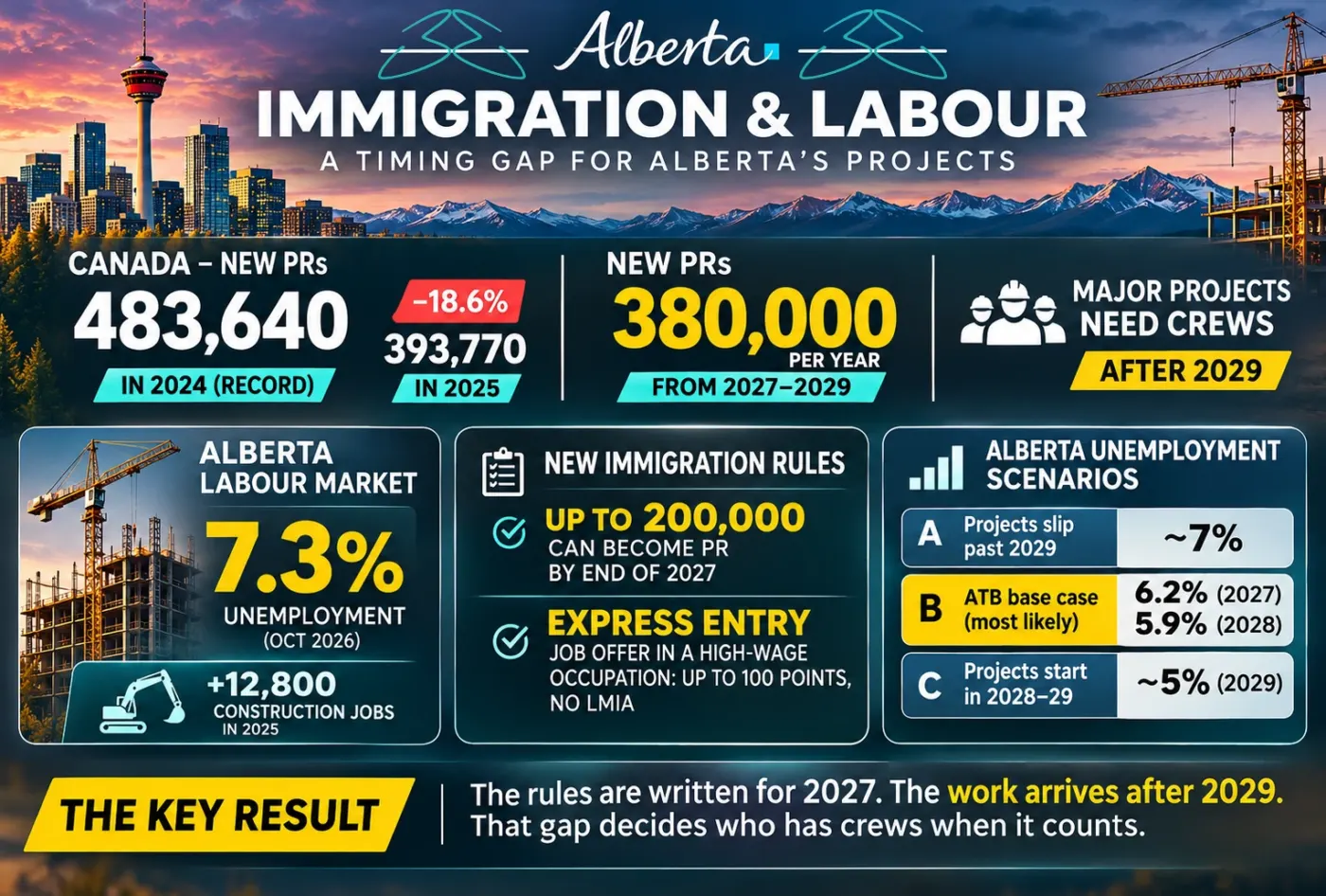
The 2026-2028 Immigration Levels Plan keeps permanent admissions at 380,000 a year for three years, with about 63 to 64 percent in the economic class. Inside that class, the targets are:
| Channel | 2027 target (people) | Share of 380,000 |
|---|---|---|
| Federal High Skilled (Express Entry) | 111,000 | 29.2% |
| Provincial Nominee Program | 92,500 | 24.3% |
| Federal Business (Start-up Visa and self-employed, combined) | 500 | 0.13% |
The shares are my calculation from the IRCC targets. The business channel is roughly one admission in 760.
Temporary entry has been cut hard. New temporary arrivals fall from 673,650 in 2025 to 385,000 in 2026 and 370,000 in 2027 and 2028. Workers are set at 230,000 in 2026 and 220,000 after that. Students drop from 305,000 to 155,000. The goal is to bring non-permanent residents below 5 percent of the population by the end of 2027; they were at 6.5 percent in January 2026 (MLT Aikins summary).
The federal Start-Up Visa program closed on January 1, 2026, according to CIC News. I could not confirm that its announced replacement pilot has launched.
Alberta runs its own entrepreneur streams. The Foreign Graduate Entrepreneur stream asks for at least $100,000 invested in an urban area ($50,000 in a regional area) and at least 34 percent ownership of the business, with residence in Alberta. Job creation is optional: it earns up to 15 points on a wider scoring grid. The province publishes no dedicated allocation for the stream. On the worker side, the construction draws remain small, as I covered in construction immigration draws in BC vs Alberta.
In short, the system keeps admitting workers at a steady pace and has narrowed the capital and entrepreneur route to a handful of people.
Alberta’s Labour Market: Not Short of People, Short of Specific Trades
In October 2026, Alberta had 2,659,900 people employed and an unemployment rate of 7.3 percent, the highest in a year (Alberta Labour Market Notes; ATB). Employment fell by about 24,000 in the month, with the losses in services. Edmonton sits at 7.1 percent and Calgary at 6.6 percent.
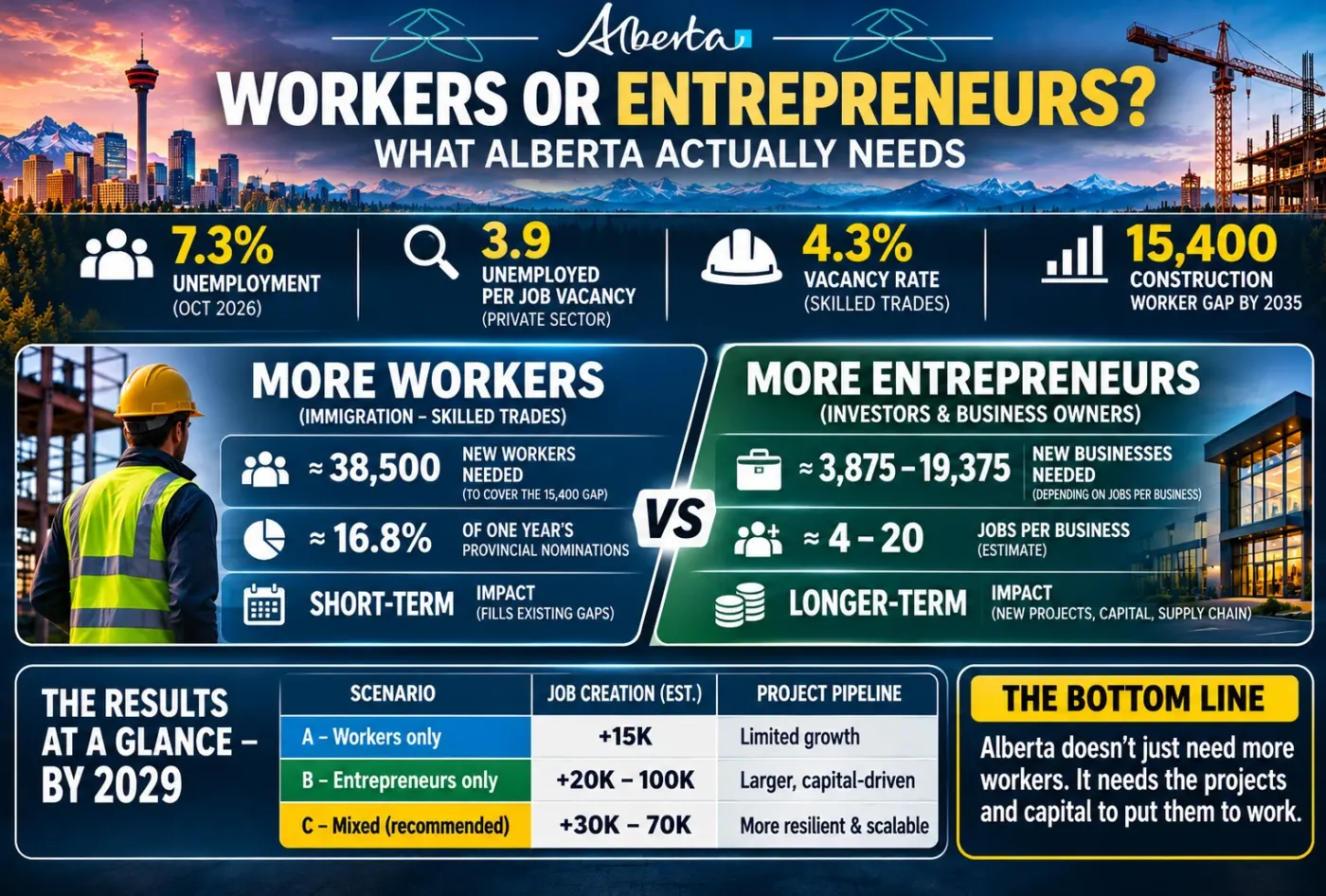
The vacancy side is quiet. The private-sector job vacancy rate was 3.0 percent in the third quarter, which is 53,300 vacancies (CFIB, from Statistics Canada). With roughly 209,000 unemployed people (my estimate from the employment figure and the unemployment rate), that is about 3.9 unemployed people per private vacancy. Youth unemployment for ages 15 to 24 was 15 percent in August.
The shortage is real in a narrower place:
- Alberta specialty trade contractors had a vacancy rate of 4.3 percent in Q2 2026, against 3.1 percent across all industries (ATB).
- 18.4 percent of construction workers are 55 or older, against about 10 percent in the mid-2000s (ATB).
- For non-residential construction, BuildForce Canada, cited by ATB’s “Who is going to build?”, estimates 42,400 hires are needed by 2035, over half to replace retirees. Expected young entrants of 26,900 leave a gap of 15,500 under current trends.
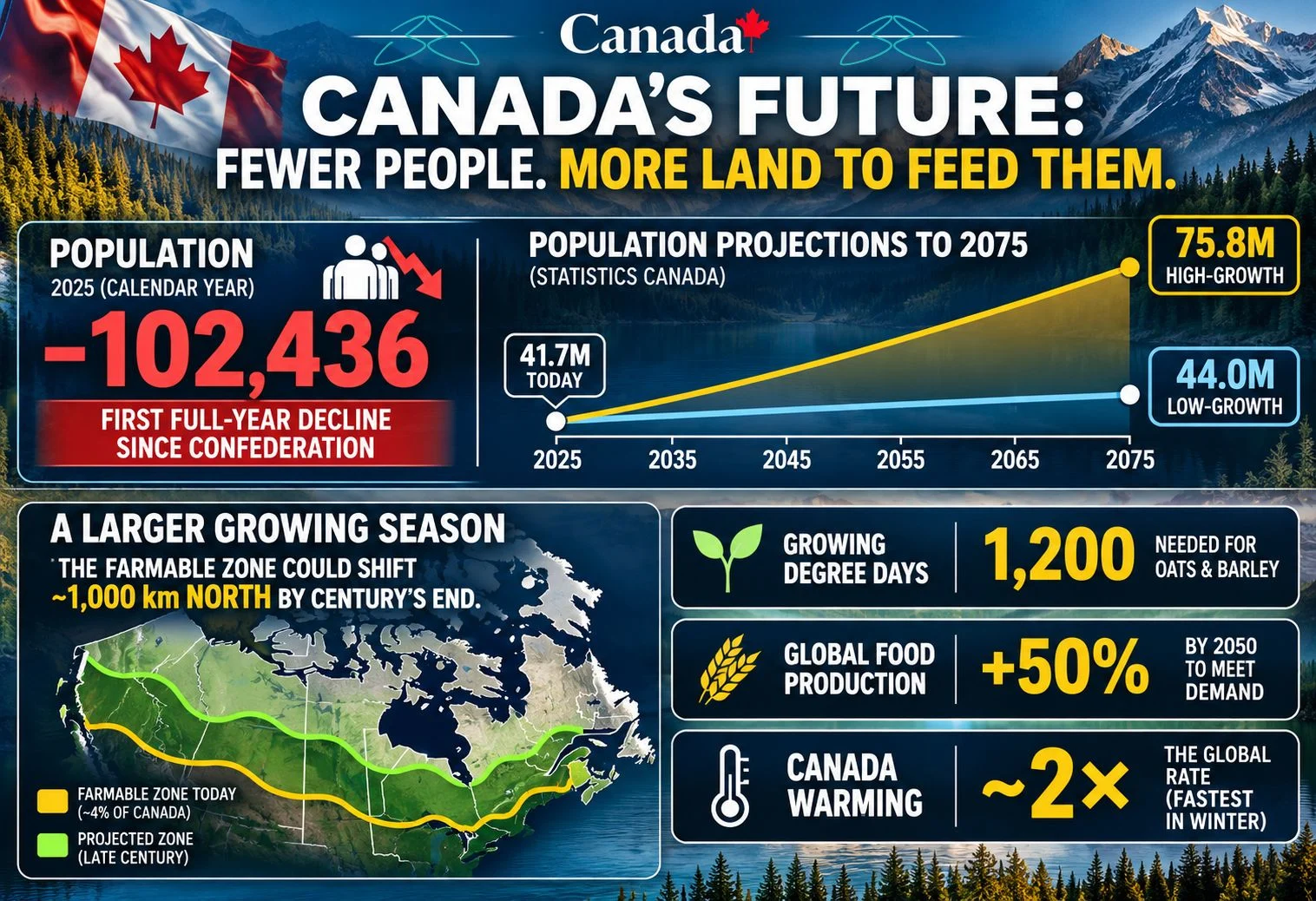
Population growth is also changing. ATB expects Canada to grow 0.5 to 1 percent a year over the next decade, and Alberta around 1 to 1.5 percent, against roughly 3 percent a year over the past four years. Fewer new residents means less demand for housing and services, and less residential work.
So the Alberta labour shortage is a mismatch, not a general shortage. The 15,500 gap is a trades problem, concentrated over a decade. For the longer view on the trades side, see Alberta’s construction talent shortage.
The Capital Side: What the Signals Say, and What I Could Not Find
Private capital is not getting cheaper or more patient. The signals I have been tracking in recent weeks all point the same way:
- Rates. The Bank of Canada moved from 2.25 to 2.50 percent in October 2026. On a $50 million floating-rate construction loan, fully drawn, 25 basis points is about $125,000 a year (my arithmetic). More in what the rate hike means for construction loans.
- Business stress. Alberta business insolvencies were 99 in Q2 2026, up 35.6 percent year over year, against +0.2 percent nationally (Calgary vs Edmonton insolvencies).
- Housing demand. Calgary averages 3.9 months of housing supply, but apartments sit at 5.3 months with prices down 7.9 percent, and North Calgary apartments at 9.5 months (Calgary housing market, October 2026).
- Population. The City of Calgary’s forecast takes net migration from 80.2 thousand to 40.5 thousand and then 15.5 thousand (Calgary population forecast).
- Public money. Alberta’s Budget 2026 sets a $28.3 billion three-year capital plan. These are spending plans, not awarded contracts (Alberta capital plan and construction labour).
Taken together: public money is scheduled, private money is more selective, and the residential pipeline is cooling where supply was already high. That is the profile of an economy short of viable projects, not one short of hands.
Here is the gap in my evidence. I did not find verified 2026 data on Alberta business formation, foreign direct investment, or private non-residential capital spending. So I cannot say how much capital is arriving, or how many jobs an immigrant entrepreneur creates on average in Alberta. Anyone who gives you a precise figure for either should show you the source.
Workers vs Entrepreneurs: The Numbers Side by Side
This is an order-of-magnitude exercise, not a forecast. To compare the two routes on one scale, I ask a simple question: how many entrepreneurs would it take to create 15,500 jobs, the size of the projected non-residential construction gap to 2035? The 15,500 is from BuildForce via ATB. Everything else below is my assumption, because no verified Alberta data exists for it.
| Jobs created per business | If 40% survive | If 60% survive | If 80% survive |
|---|---|---|---|
| 2 | 19,375 entrepreneurs | 12,917 | 9,688 |
| 3 | 12,917 | 8,611 | 6,458 |
| 5 | 7,750 | 5,167 | 3,875 |
The value of 3 jobs per business matches the top of the Alberta scoring grid for the Foreign Graduate Entrepreneur stream. The survival rates are illustrative.
How this compares with the channels that exist:
- Covering 15,500 positions with workers equals 16.8 percent of one year of national provincial nominations (92,500). It is feasible on paper.
- Covering the same volume with entrepreneurs takes between 3,875 and 19,375 business starts, against about 500 federal business-class admissions a year. It is not feasible with current policy, and the jobs created would not necessarily be in construction.
The point is not that entrepreneurs are less valuable. It is that a trades gap is filled by trades, and capital solves a different problem: whether there is work for the trades to do.
Three Scenarios to 2029, and the One the Data Supports
These are reasoned scenarios anchored to ATB’s published baseline, not statistical forecasts.
| Scenario | What happens | Likely effect on Alberta | Main risk |
|---|---|---|---|
| A. More workers, same projects | Worker channels reopen; the project pipeline does not change | Unemployment stays near current levels (ATB expects 6.7 to 6.9% on average in 2026); more competition for the same jobs | Crews wait for work; wages and productivity do not improve |
| B. More capital, same workers | More projects start with today’s labour pool | Trade shortages bite again; schedules and costs rise | Delays from missing crews |
| C. Selective mix | Workers for the trades in short supply; a measurable capital and entrepreneur channel | ATB’s baseline has unemployment at 6.2% in 2027 and 5.9% in 2028; about 5% in 2029 if the Pacific Link and Pathways projects proceed | Depends on federal decisions about those projects |
Scenario C fits the evidence best. The 5 percent figure for 2029 is ATB’s scenario and is conditional on those projects going ahead; I have not verified the project status independently.
The order matters. Workers without projects add to unemployment, which is already 7.3 percent. Projects without trades add to cost and delay. The sequence that works is capital first, then trades timed to the pipeline.
What This Means for Contractors, Developers and Lenders
For anyone planning work in Alberta, four practical checks follow from the data:
- Plan crews before the bid, not after the award. Trades vacancy is 4.3 percent while overall vacancy is 3.1 percent. The scarce resource is a qualified crew at a specific date.
- Split the labour question by trade and by year. A general statement about “labour shortage” hides that the gap is concentrated in trades and in the 2028-2035 window.
- Test pro formas against two demand scenarios. Calgary’s net migration forecast falls from 80.2 thousand to 15.5 thousand. A model built on one scenario is a bet.
- Price debt as a moving input. After the October increase to 2.50 percent, re-run models at +25 and +50 basis points and see which projects still clear their hurdle rate.
For policy, the practical ask is narrow: a dedicated, measurable construction line in provincial nominations (see AAIP draws), and a business channel whose size is published and tied to projects, not a pool of 500 people for the whole country.
Limits of the Data and Sources
What I can say: unemployment exceeds private vacancies by nearly four to one; the shortage is in specific trades and builds over a decade; the federal business-class channel is about 500 admissions a year.
What I cannot say: how many jobs an immigrant entrepreneur creates in Alberta on average, how much foreign capital is arriving, or what the optimal mix is. The scenario table is an illustration with stated assumptions. Several inputs come from secondary sources (ATB’s reading of BuildForce, CIC News on the Start-Up Visa, trade press on the Bank of Canada and OSB figures) and should be checked against the primary source before anyone relies on them.
If you plan crews or capital in Alberta: which do you expect to be harder to find in 2028, the people or the projects?
Sources (data as of November 9, 2026): IRCC 2026-2028 Levels Plan; MLT Aikins; Alberta.ca (Foreign Graduate Entrepreneur Stream, Labour Market Notes, AAIP); CIC News; ATB (Labour Force Survey October 2026, Who is going to build? Part 2); CFIB Main Street Quarterly Q3 2026; CREB; OSB. Ratios, shares and scenario counts are the author’s calculations.
- 52 views
- 1 Comment

Eros Belotti 01.

Eros belotti
Construction project manager with over 20 years of experience in Europe and the Canary Islands. Specialized in modular housing, container construction, real estate development and international project management. Founder of Reforma Vivienda Tenerife and Donkey Lab.

November 9, 2026 /
Sources and notes 👇
Policy
IRCC Levels Plan 2026-28: https://www.canada.ca/en/immigration-refugees-citizenship/corporate/transparency/committees/cimm-mar-23-2026/permanent-resident-targets.html
Alberta entrepreneur stream: https://www.alberta.ca/aaip-foreign-graduate-entrepreneur-stream-eligibility
Labour market
Alberta Labour Market Notes: https://www.alberta.ca/labour-market-notes
ATB, trades gap: https://www.atb.com/company/insights/the-twenty-four/who-is-going-to-build-part-2/
CFIB Q3 2026 (vacancies): https://www.cfib-fcei.ca/hubfs/research/msq/MSQ-Q3-2026/CFIB_MSQ_Q3-2026_HW.pdf
Housing
CREB, Oct 2026: https://www.creb.com/News/CREBNow/2026/November/October_2026_Stats/
My own calculations: 209,000 unemployed, 1 in 760, 8,600 entrepreneurs. The BuildForce gap comes via ATB.
Which of the four checks do you apply first?