

//Alberta Construction Market 2026: -21% Rotation Explained
Alberta Construction Market 2026: -21% Rotation Explained
Tags : AlbertaCalgarycapacity planningConstructionEdmontonHousing Startsmarket outlookNon-Residential
Alberta’s Construction Market Is Rotating, Not Slowing: What the 2026 Data Actually Says
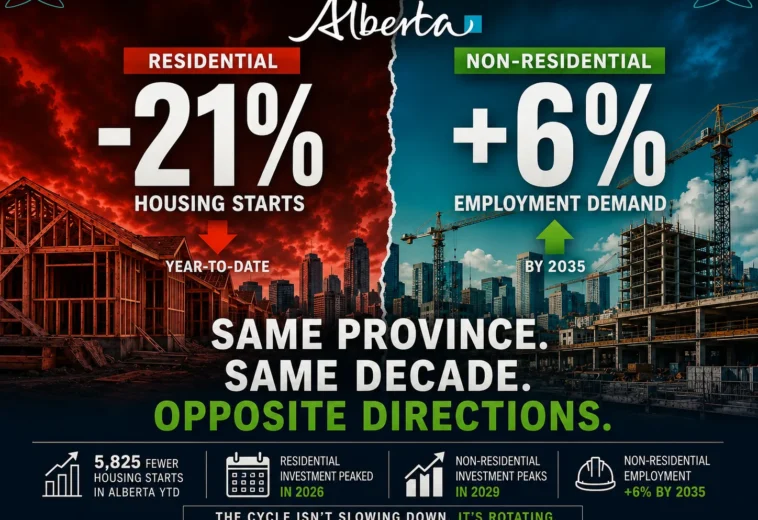
Minus 21% residential. Plus 6% non-residential. Same province, same decade, opposite directions.
Both numbers are real, both come from credible sources, and almost every conversation about the Alberta construction market 2026 quotes only the first one. That omission is expensive, because the two figures describe completely different strategic situations — and companies are making capacity decisions based on half the picture.
Here is what the full data set says.
The residential number everyone is quoting
Housing starts across Alberta are down 21% year-to-date compared with Q2 2025 — a decline of 5,825 units. Calgary is off 23% (3,361 units). Edmonton is down 20% (2,184 units).
Taken alone, the story writes itself: Alberta is slowing down.
One caveat belongs in the first paragraph of any honest analysis, not buried at the end. 2025 was a record year. A 21% decline from a record is normalization, not collapse. Starts remain historically strong against long-run averages. Anyone selling a crash narrative is skipping that line — and it is the line that determines whether you cut capacity or move it.
The non-residential number almost nobody quotes
BuildForce Canada’s Construction and Maintenance Looking Forward report for 2026–2035 projects the opposite trajectory for the other half of the market.
Residential investment peaked in 2026 and contracts through the remainder of the decade. Non-residential construction employment, meanwhile, is forecast to sit 6% above 2025 levels by 2035, with investment reaching its peak in 2029. The growth is carried by ICI buildings — industrial, commercial, institutional — and by non-residential maintenance activity, offsetting a modest decline in engineering construction employment.
Two cycles. Opposite directions. One market.
Alberta construction market 2026: the two cycles side by side
| Indicator | Direction | Figure | Source |
|---|---|---|---|
| Alberta housing starts, YTD 2026 | ▼ | −21% (5,825 units) | CMHC |
| Calgary housing starts, YTD 2026 | ▼ | −23% (3,361 units) | CMHC |
| Edmonton housing starts, YTD 2026 | ▼ | −20% (2,184 units) | CMHC |
| Rental share of Alberta starts | — | 37% of YTD starts | CMHC |
| Rental units under construction (Calgary + Edmonton) | — | 23,000+ | CMHC |
| Residential investment peak | ▲ then ▼ | 2026 | BuildForce |
| Non-residential employment vs 2025 | ▲ | +6% by 2035 | BuildForce |
| Non-residential investment peak | ▲ | 2029 | BuildForce |
| Workers retiring by 2035 | ▼ | 43,700 (21% of workforce) | BuildForce |
Why the split matters more than either number
A market that contracts and expands simultaneously punishes a specific mistake: planning against the headline.
If your capacity, your equipment base and your crew composition are built for single-family and low-rise residential, you are entering a multi-year contraction with a cost structure sized for a peak that has already passed. Overhead does not shrink at the same speed as backlog.
If you can redeploy toward ICI work — institutional buildings, industrial facilities, commercial fit-out — the cycle is working in your favour rather than against you. Non-residential demand is not a rumour on a forecast slide; it is already showing up in the data. Alberta led commercial construction growth nationally in April 2026 with a $10.0 million monthly increase, and provincial building permit values rose 19.6% month-over-month in June 2026.
The rotation is visible in permits before it becomes visible in revenue. That lag is the planning window.
The constraint nobody has priced in
There is a third number that turns this from a market shift into an operational problem.
The same BuildForce report projects 43,700 Alberta construction workers retiring by 2035 — 21% of the 2025 labour force. Meeting demand and replacing those retirements requires recruiting roughly 59,000 people. Local under-30 entrants are projected at about 43,600. Factor in expansion hiring and the province faces a recruiting gap of 15,400 workers by 2034.
So the rotation toward ICI happens into a shrinking labour pool. Companies redeploying capacity are not competing for projects — they are competing for crews. Every schedule built on 2025 labour availability is already optimistic.
This is where planning discipline stops being a soft skill. When labour is the binding constraint, hours lost to rework are hours you cannot buy back on the open market at any price. Industry research puts direct field rework at roughly 5% of total project cost, rising toward 12% on the worst-performing projects — and the dominant causes are informational, not executional: miscommunication accounts for around 26% of rework, inaccurate data another 14–22%.
Accurate surveys, clean drawings and disciplined document control stop being back-office hygiene. They become capacity.
What to do with this in the next 36 months
Three practical implications for anyone operating in the Alberta construction market 2026:
1. Re-baseline your pipeline against 2029, not 2026. Capex committed this quarter will be judged against conditions three years out. The non-residential peak is the reference point, not this year’s residential softness.
2. Audit how transferable your capacity actually is. “We could do ICI work” and “we are prequalified, bonded and staffed for ICI work” are different statements. The gap between them is the real project.
3. Treat labour as the scarce input in every estimate. Not cost — availability. Schedules that assume crews can be added on demand will slip, and the slip will be blamed on the wrong thing.
The pattern worth remembering
Companies that struggle during a market rotation are rarely the ones with weak execution. They are the ones who read the headline number, believed it described the whole market, and planned against it.
Alberta is not contracting. It is redistributing — away from residential, toward industrial, institutional and commercial, against a tightening labour base. That is a harder market to read than a boom or a bust, and a considerably more forgiving one for anyone who reads it correctly.
Frequently asked questions
Is the Alberta construction market slowing down in 2026? Not overall. Residential housing starts are down 21% year-to-date, but non-residential construction employment is forecast to rise 6% above 2025 levels by 2035, with investment peaking in 2029. The market is rotating between sectors rather than contracting as a whole.
Why are Alberta housing starts down in 2026? The decline is measured against a record 2025. Contributing factors include high inventory levels, slower population growth and a return to more balanced market conditions. CMHC characterises this as moderation following rapid expansion, not a downturn.
Which construction sector is growing in Alberta? Non-residential — specifically ICI buildings (industrial, commercial, institutional) and non-residential maintenance. BuildForce Canada forecasts non-residential investment peaking in 2029, supported by major industrial and data centre projects.
How severe is Alberta’s construction labour shortage? BuildForce projects 43,700 workers retiring by 2035, equal to 21% of the 2025 labour force. After accounting for approximately 43,600 new local entrants under 30 and expansion demand, the province faces a projected recruiting gap of 15,400 workers by 2034.
Sources
- CMHC — Spring 2026 Housing Supply Report: https://www.cmhc-schl.gc.ca/professionals/housing-markets-data-and-research/market-reports/housing-market/housing-supply-report
- CMHC — Housing Market Outlook 2026: https://www.cmhc-schl.gc.ca/professionals/housing-markets-data-and-research/market-reports/housing-market/housing-market-outlook
- BuildForce Canada — LMI 2026–2035: https://www.buildforce.ca/en/lmi-2026/
- BuildForce Canada — Construction activity rises in Alberta to 2035: https://www.globenewswire.com/news-release/2026/07/20/3329832/0/en/Construction-activity-rises-in-Alberta-to-2035-as-non-residential-growth-offsets-moderating-residential-demands.html
- Statistics Canada — Building permits, June 2026: https://www150.statcan.gc.ca/n1/daily-quotidien/260812/dq260812a-eng.htm
- Statistics Canada — Investment in building construction, April 2026: https://www150.statcan.gc.ca/n1/daily-quotidien/260622/dq260622b-eng.htm
- ASCE — How much does field rework in construction actually cost: https://www.asce.org/publications-and-news/civil-engineering-source/article/2026/01/22/how-much-does-field-rework-in-construction-actually-cost
- 118 views
- 1 Comment

Eros Belotti 01.

Eros belotti
Construction project manager with over 20 years of experience in Europe and the Canary Islands. Specialized in modular housing, container construction, real estate development and international project management. Founder of Reforma Vivienda Tenerife and Donkey Lab.

August 14, 2026 /
Sources, for anyone who wants to check the numbers:
→ Housing starts data: CMHC Spring 2026 Housing Supply Report
https://www.cmhc-schl.gc.ca/professionals/housing-markets-data-and-research/market-reports/housing-market/housing-supply-report
→ Non-residential forecast: BuildForce Canada, Construction and Maintenance Looking Forward 2026–2035 (Alberta)
https://www.buildforce.ca/en/lmi-2026/
One number I left out of the post because it deserves its own conversation: the same BuildForce report projects 43,700 Alberta construction workers retiring by 2035 — 21% of the 2025 labour force.
The rotation toward ICI is happening into a shrinking labour pool. That’s the part that turns a market shift into a scheduling problem.