

Categories
//Alberta Construction 2026: ICI Growth vs Residential Moderation
Alberta Construction 2026: ICI Growth vs Residential Moderation
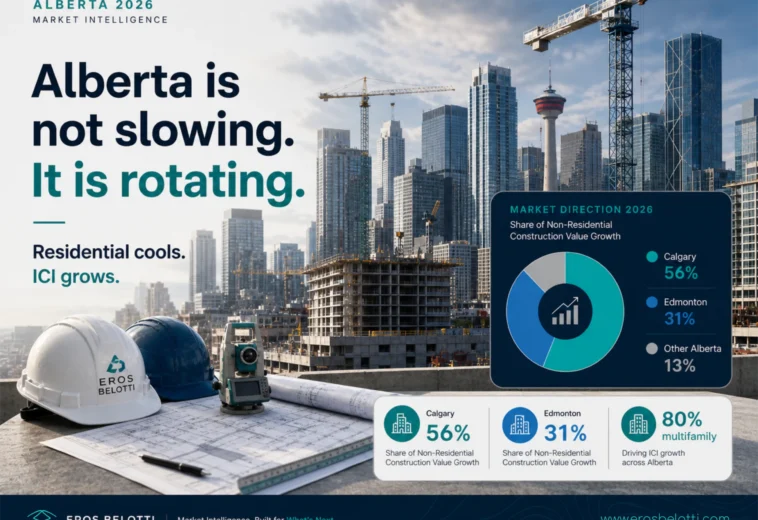
Alberta’s construction market is not slowing down. It is rotating. After a residential boom that set a provincial record of 54,858 housing starts in 2025, new housing construction is moderating while industrial, commercial and institutional (ICI) building is accelerating. For developers, contractors and investors, the key question in 2026 is no longer whether Alberta is growing, but which sector their pipeline is actually exposed to.
Residential: past the peak
Several sources point in the same direction. CMHC’s mid-2026 outlook expects Calgary starts to fall from 27,684 in 2025 to about 22,000 in 2026 and Edmonton’s from 21,337 to about 16,000, with further declines to 2028. ATB Financial reported that Alberta’s year-to-date starts in April 2026 were down 23%, with multi-unit and rental construction hit hardest. Calgary and Edmonton show softer resale demand and weaker new home sales than a year earlier.
BuildForce Canada’s 2026 to 2035 outlook, released in July 2026, describes residential investment as peaking in 2026 and then declining in the near term as population growth slows, with housing starts falling into the early 2030s before growing again. It projects residential construction employment in Alberta down 16% from 2025 levels by 2035, with losses concentrated in new housing, while renovation activity keeps rising.
ICI: the cycle that is starting
The same outlook projects non-residential construction employment in Alberta rising 15% by 2035, with ICI building employment up 31% and engineering construction up 10%. The drivers include:
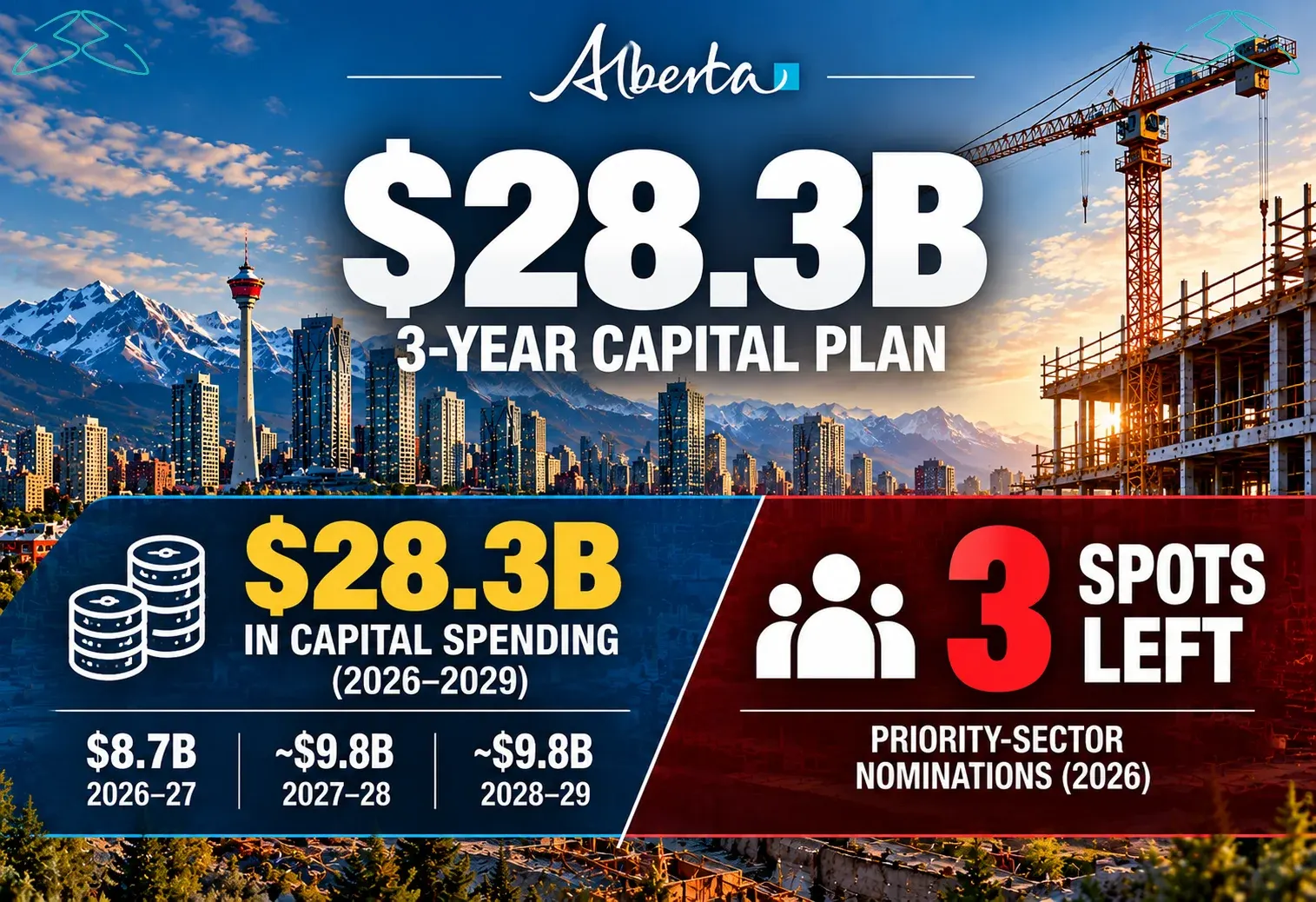
- Institutional: health care and education, including the Red Deer Regional Hospital expansion and the School Construction Accelerator Program, supported by the province’s $28.3 billion 2026-29 capital plan.
- Commercial: population growth and major projects such as the Scotia Place arena and the Arts Commons expansion in Calgary.
- Industrial: manufacturing, logistics, data centres and energy-related facilities, which fluctuate with the timing of major projects.
- Engineering: oil and gas, utilities and transportation, including light rail in Calgary and Edmonton.
BuildForce’s executive director describes the residential change as “a moderation from peak levels rather than a significant contraction.” Altus Group’s 2026 cost guide likewise notes that in Calgary and Edmonton, health care and institutional projects are leading cost increases, a sign of where demand is concentrated.
Why the rotation matters for feasibility
Feasibility assumptions built on recent residential momentum can now work against developers. Land prices, absorption rates and financing structures calibrated for the boom may no longer apply. At the same time, ICI growth changes the cost and labour environment for everyone:
- Trades shift: electricians, mechanical trades and specialised installers move toward institutional and industrial work, keeping residential labour costs elevated even as housing starts fall.
- Material demand changes: steel, concrete, mechanical and electrical equipment are in higher demand for ICI projects, and tariffs affect metals in particular.
- Land use evolves: sites once planned for apartments may suit commercial, mixed-use, seniors housing or institutional uses better.
Who benefits from the rotation
Contractors with ICI capability
Firms experienced in institutional and commercial work, with strong safety, quality and documentation systems, will find steady demand.
Renovation and retrofit specialists
BuildForce expects renovation activity to keep rising. Existing homes, rental buildings and public facilities need upgrades, which favour firms with survey and documentation skills.
Consultants and project managers
Institutional projects require structured pre-construction, phase gates and rigorous change control, which increases demand for experienced project management.
Developers who adapt product
Mixed-use, seniors housing, purpose-built rental with differentiation and ground-oriented housing in under-supplied markets can still perform.
How to assess your exposure
- List your current and planned projects by sector: new housing, renovation, commercial, institutional, industrial, engineering.
- Compare that mix with the sector outlooks for the next three to five years.
- Identify where you depend on a single sector or client type.
- Decide which capabilities, partnerships or certifications you need to diversify.
- Stress-test residential feasibility models with post-boom assumptions.
Moving from residential to ICI work
For residential builders, moving into ICI work is not simply a matter of bidding on different projects. Institutional and commercial clients expect formal safety programs, prequalification documentation, bonding capacity, detailed scheduling and structured reporting. Mechanical and electrical systems are more complex, and commissioning is a distinct phase with its own requirements. Firms that want to make the transition often start with smaller tenant improvements, renovations of public facilities or subcontract roles on larger projects, building the track record and systems they need step by step.
What it means for land and property owners
Owners of development land should revisit their highest and best use analysis. A site zoned and priced for a large apartment building in 2024 may now be better suited to a phased project, a mixed-use scheme with commercial space, seniors housing or an institutional partner. Owners of existing buildings may find that renovation and repositioning offer better returns than redevelopment. In a rotating market, flexibility in land use and timing is valuable, and decisions should be based on current sector outlooks rather than the momentum of the last cycle.
The bottom line
The residential boom has peaked; the ICI cycle is starting. Alberta is cooling from a strong base, with durable population growth and better affordability than other provinces, but growth no longer underwrites every project the way it did 18 months ago. Knowing which sector your pipeline is exposed to is now a strategic decision.
If you are stress-testing a feasibility model for an Alberta project, see my feasibility and project management services, read about the 2026 capital plan, or contact me.
Frequently asked questions
What is ICI construction?
Industrial, commercial and institutional building construction: factories and warehouses, offices and retail, hospitals, schools and other public buildings.
Is ICI construction growing in Alberta?
Yes. BuildForce Canada projects ICI building employment in Alberta to grow 31% from 2025 levels by 2035.
Is residential construction declining in Alberta?
New housing construction is moderating from its 2025 peak. BuildForce expects residential employment to fall 16% by 2035, mainly in new housing, while renovation activity rises.
Sources
- BuildForce Canada: Alberta outlook 2026 to 2035
- CMHC: Summer update, 2026 Housing Market Outlook
- ATB Financial: Alberta housing starts, April 2026
- Altus Group: 2026 Canadian Cost Guide insights
- Government of Alberta: Capital plan
- 219 views
- 1 Comment

Eros Belotti 01.

Eros belotti
Construction project manager with over 20 years of experience in Europe and the Canary Islands. Specialized in modular housing, container construction, real estate development and international project management. Founder of Reforma Vivienda Tenerife and Donkey Lab.


June 22, 2026 /
The rotation happening in Alberta’s construction market isn’t just a data story — it’s a feasibility discipline story.
When a market shifts from residential-led to ICI-led, the variables that matter most change with it. Absorption timelines are longer. Tenant mix assumptions replace unit sales projections. Financing structures look different. And the stakeholders you need to align — municipal, institutional, corporate — operate on different decision cycles than residential buyers.
Most feasibility models get built once and updated rarely. That works in a stable cycle. It becomes a liability when the cycle rotates.
The developers and contractors who will bid competitively in Alberta over the next 24 months are the ones stress-testing their assumptions now — not after the pipeline dries up.