
//Alberta Construction Procurement Is Shifting: Here’s What Wins
Alberta Construction Procurement Is Shifting: Here’s What Wins
Tags : agile procurementAlberta ConstructionAlberta real estate developmentConstruction Project ManagementFeasibilityoutcome-based paymentPPPprocurementproject delivery
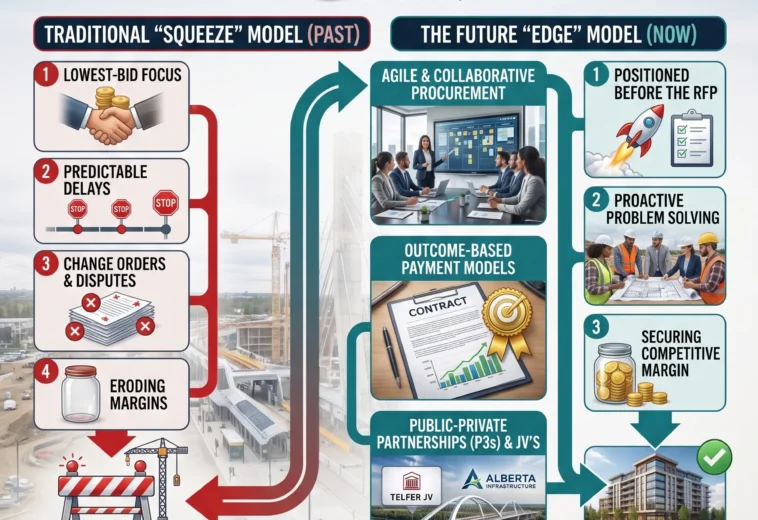
Procurement is changing how construction projects in Alberta and across Canada are delivered, and many developers and contractors are still organised for the old system. Traditional lowest-bid, fixed-scope procurement remains common, but on complex projects it keeps producing the same results: delays, change orders and disputes that consume the margin everyone fought to win. Owners are responding with public-private partnerships, collaborative models and procurement that rewards outcomes rather than the lowest price.
This article explains the three main shifts, why they are happening and how firms can structure themselves to compete in them.
Why traditional procurement is struggling
In a design-bid-build model, the owner completes the design, tenders it and selects the lowest compliant bid. It works well for simple, well-defined projects. On complex projects, incomplete design, unknown existing conditions and market volatility make fixed prices fragile. Contractors price risk defensively or bid low and recover through changes. Owners and contractors end up in claims-based relationships that neither side wants.
Industry analysis has described the claims-based, adversarial approach as unsatisfying for both owners and contractors, and on some very large Canadian projects bidders hesitated because the risk transferred to them was too great. Alberta has also modernised its standard construction management, design-build and design-bid-build contracts to address cost escalation, dispute resolution and prompt payment.
Shift 1: more public-private partnerships
Alberta has used P3s mainly for school bundles, delivering around 40 operational schools since 2010, and has signalled interest in broader use, including health care, transit and larger projects. In January 2026 the Canadian Council for Public-Private Partnerships recommended that the province expand P3 bundling and engage private proponents earlier, and in June 2026 the province created a minister’s council to explore financing models for municipal infrastructure, including P3s. With a $28.3 billion capital plan for 2026 to 2029, alternative financing is likely to play a larger role.
Shift 2: collaborative delivery models
Other provinces have moved further. British Columbia has used design-build, progressive and alliance models on major projects, and Ontario follows a “right model for the right project” approach. Collaborative models share some common features:
- Progressive design-build: the owner selects a design-builder early, develops the design together and agrees the price once the project is better defined.
- Integrated project delivery (IPD): owner, designer and contractor share risk and reward under a multi-party agreement, often using the CCDC 30 form in Canada.
- Alliance contracting: participants act as one team with shared governance and a no-blame culture.
These models reduce adversarial behaviour and bring construction knowledge into design, but they require strong governance, transparency and the right partners.
Shift 3: outcome-based procurement
Owners increasingly evaluate bids on more than price: team experience, methodology, schedule, lifecycle cost, risk management and sometimes performance after completion. In P3s, availability payments tie the private partner’s income to how well the asset performs. Even on conventional projects, technical scoring and early contractor involvement are becoming more common.
What wins under the new models
Early positioning
Firms that can operate inside these models do not wait for the request for proposals. They build relationships, understand owners’ needs and prepare teams before the scope is even written.
Pre-construction capability
Progressive and collaborative models reward contractors and consultants who can contribute to design development, cost planning, constructability and risk identification. Surveys, CAD documentation and cost estimating become selling points.
Transparent cost management
Open-book pricing and target cost arrangements require firms to manage and present costs clearly. Disorganised cost data is a disadvantage.
Governance and documentation
Collaborative contracts depend on decision logs, risk registers, change control and reporting. Firms with these systems in place are trusted partners.
Lifecycle thinking
When firms are responsible for long-term performance, durable design and accurate as-built information protect their returns.
How to check whether your firm is ready
- Can you contribute to design development and cost planning, not only build to drawings?
- Do you have a structured process for risk registers, change control and reporting?
- Can you present costs transparently in an open-book arrangement?
- Do you have partners for design, financing or maintenance where needed?
- Do you track relationships with owners before projects reach procurement?
Opportunities for smaller firms
Procurement reform is not only for large contractors. Smaller firms can join collaborative teams as designers, specialised trades, survey and documentation providers or project management consultants. Early involvement in design development often creates more value for specialised firms than competing on price at tender.
Risks to manage in collaborative models
Collaborative models are not risk-free. If a project runs into serious trouble, shared fee or profit pools can be exhausted, and risk may shift back to the owner. Relationships can deteriorate if governance is weak or if parties stop using the agreed processes after signing. Successful collaborative projects invest in joint early due diligence, clear decision rights and regular performance reviews, and they choose partners for capability and culture, not only for price.
The bottom line
Procurement reform does not reward the loudest critics of the old system. It rewards whoever moves first. The real question for developers and contractors is not whether the shift will hurt them, but whether they are structured to bid the way projects will be delivered in the next decade, or the way they were delivered ten years ago.
If you want to strengthen your pre-construction and project controls for new delivery models, see my construction project management services, read about P3 infrastructure in Alberta, or contact me. Which side of the gap is your process on?
Frequently asked questions
What is progressive design-build?
A delivery model where the owner selects a design-builder early and they develop the design together before agreeing a final price.
How many schools has Alberta delivered through P3s?
Around 40 operational schools since 2010, according to Alberta’s infrastructure minister in 2024.
Why are owners moving away from lowest-bid procurement?
Because on complex projects it often leads to defensive pricing, change orders, delays and disputes, while collaborative and outcome-based models align incentives better.
Sources
- BLG: Alberta Infrastructure, a positive outlook for P3s in Alberta
- Lexpert: New delivery models, new risks
- CCPPP: 2026-27 Alberta Budget Submission
- Government of Alberta: Capital plan
- 107 views
- 1 Comment

Eros Belotti 01.

Eros belotti
Construction project manager with over 20 years of experience in Europe and the Canary Islands. Specialized in modular housing, container construction, real estate development and international project management. Founder of Reforma Vivienda Tenerife and Donkey Lab.




July 2, 2026 /
One quick way to tell which side of the gap you’re on: look at how your last three bids were actually scored.
If price was the deciding factor every time, you’re still bidding into the old model — even when the client is using partnership language.
The shift almost always shows up in the evaluation criteria before it shows up in the contract type. Firms that read those criteria early adjust the proposal. The rest find out at the award stage.