

Construction Rework Costs: Why Coordination, Not Labour, Is the Real Bottleneck
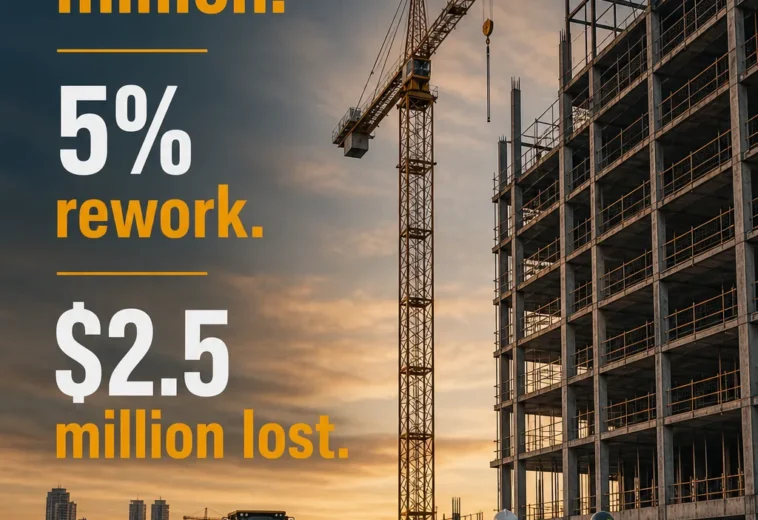
On a $50 million project, a conservative rework rate of 5% means $2.5 million spent doing work twice. That is why I do not think labour is the only bottleneck in construction. Labour shortages are real, but even when crews are available, projects lose time and money when the information that guides them is incomplete, inconsistent or late. Rework is one of the most expensive forms of waste in construction, and most of it starts before the first shovel enters the ground.
This article looks at what causes rework, how much it costs, why it matters more in Alberta’s busy market and how better pre-construction information reduces it.
The labour story is only part of the story
Alberta faces real workforce pressure. BuildForce Canada’s 2026 to 2035 outlook projects that the province must add 48,800 construction workers by 2035 while 43,700 retire. Statistics Canada reported that in February 2026 Alberta was the only province where job vacancies increased year over year, up 8.9%, with a vacancy rate of 3.0%. Nationally, the construction vacancy rate had already fallen to 3.3% by February 2025, from much higher levels two years earlier, as the market cooled.
But adding people does not fix a project that is working from conflicting drawings, unclear scope or inaccurate survey data. It just means more people redoing work.
What causes rework
The FMI and PlanGrid study Construction Disconnected surveyed 600 construction professionals and estimated that 26% of rework is caused by poor communication and 22% by poor project data, nearly half of all rework. Respondents spent about 35% of their time on non-optimal activities, including searching for information and dealing with mistakes. Typical causes on site include:
- Missing details: drawings that do not show how elements connect or finish.
- Conflicting drawings: architectural, structural and mechanical documents that disagree.
- Poor communication between teams: changes not passed on to every trade.
- Unclear scope: work included in one contractor’s understanding but not another’s.
- Uncoordinated systems: ducts, pipes and cables designed separately and clashing in the field.
- Inaccurate site data: design based on assumed existing conditions.
How rework compounds
Rework rarely costs only the direct work redone. It also causes schedule delay, extended supervision and equipment rental, disruption to following trades, material waste and, often, disputes about who pays. On a tight schedule, rework in one area can push critical path activities and trigger overtime. The visible rework cost is usually a fraction of the total impact.
Why scale makes it worse
A coordination problem that is manageable on a small renovation becomes much more expensive on large projects. Alberta’s major projects inventory is estimated at about $166 billion by ICBA. When demand is strong, the margin for mistakes gets smaller, not bigger: crews redoing work are crews not available for the next task, and in a tight labour market they cannot easily be replaced.
Support functions are risk control
Project management, surveying, CAD drafting and feasibility work are often treated as support functions. In reality they are risk control:
- Better information at the start means fewer surprises on site.
- Better drawings mean fewer clashes.
- Better planning means fewer delays.
- Better coordination means less rework and better margins.
How to reduce rework
Survey existing conditions accurately
Measured surveys and verified as-built drawings remove one of the main sources of design errors on renovations and additions.
Coordinate disciplines before construction
Overlay architectural, structural and services drawings, or use model-based coordination, to find clashes on screen rather than on site.
Complete details before tender
Details for interfaces, waterproofing, fire separations and finishes should be resolved before pricing.
Control document versions
Every trade must work from the current revision. A drawing register and one shared repository prevent work from superseded documents.
Answer questions quickly
A fast, logged RFI process prevents trades from guessing.
Measure rework
Track rework incidents, causes and costs. Patterns reveal where the information process is failing.
A practical example
On a renovation, a contractor installs new ductwork following the mechanical drawings, only to discover that the structural drawings show a beam in the same location. The ductwork must be removed and rerouted, the ceiling framing adjusted and the inspection rebooked. A one-hour coordination review of overlaid drawings before construction would have found the conflict. The cost of that review is trivial compared with two days of rework for three trades.
The questions owners should ask
Owners can reduce rework without technical expertise by asking a few simple questions before construction starts. Has someone checked that the drawings from different consultants agree with each other? Were existing conditions surveyed or assumed? Is there a single, current set of documents on site? Who answers questions from the trades, and how quickly? Projects where these questions have clear answers have far less rework than those where nobody has asked them.
The bottom line
Labour shortages matter. But the deeper problem is often earlier in the process: in the drawings, the coordination, the survey data and the planning decisions that shape everything that follows. Instead of asking only how to find more labour, the industry should ask how many projects are losing money before the first shovel hits the ground.
If you want to reduce rework on your next project through better surveys, CAD documentation and coordination, see my CAD and project management services, read about the design-to-construction handoff, or contact me.
Frequently asked questions
How much does rework cost in construction?
It varies, but even a conservative 5% rework rate on a $50 million project equals $2.5 million. Indirect costs such as delays and disruption add to that.
What causes most rework?
The FMI and PlanGrid study attributed 26% of rework to poor communication and 22% to poor project data, along with design errors, unclear scope and inaccurate site information.
How can rework be reduced?
Through accurate surveys, coordinated drawings, complete details, document control, fast RFI responses and measuring rework causes.
Sources
- Construction Dive: FMI and PlanGrid Construction Disconnected study
- BuildForce Canada: Alberta outlook 2026 to 2035
- Statistics Canada: Payroll employment, earnings and job vacancies, February 2026
- ICBA: Alberta Construction Monitor, Winter 2026
- 105 views
- 0 Comment

Eros Belotti 01.

Eros belotti
Construction project manager with over 20 years of experience in Europe and the Canary Islands. Specialized in modular housing, container construction, real estate development and international project management. Founder of Reforma Vivienda Tenerife and Donkey Lab.