

- Alberta Construction
- Alberta Economy
- Alberta Real Estate
- Business Development
- Calgary Construction
- Calgary Real Estate
- Canada Construction
- Construction Management
- Feasibility
- Housing Starts
- HousingMarket
- New Builds
- Photography
- Project Management
- Property Development
- Real Estate Canada
- Real Estate Development
- Real Estate Investing
- Urban Development
Alberta Continuing Care Construction: $400M for 1,100 New Spaces
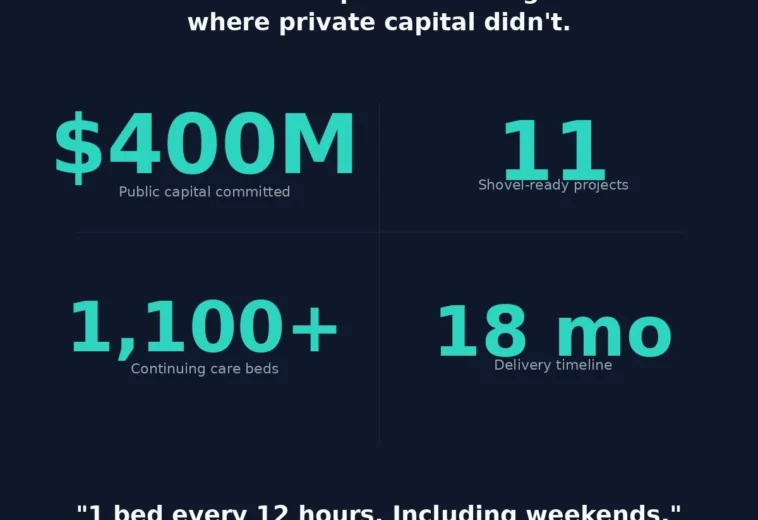
On April 30, 2026, the Government of Alberta announced more than $400 million for 11 shovel-ready continuing care projects that will add over 1,100 net-new spaces. While much of the attention in Alberta’s construction market has focused on housing starts and condo inventory, continuing care has quietly become one of the most active and best-funded segments in the province.
This article explains what the announcement includes, why demand for continuing care is structural rather than cyclical, and what developers, contractors and investors should consider before entering the segment.
What the announcement includes
The funding comes from the New Capacity Stream of the Continuing Care Capital Program, under the province’s Assisted Living Framework launched in December 2025. Key details:
- More than $400 million for 11 projects that are ready to start construction.
- Over 1,100 net-new continuing care spaces.
- Projects located in Calgary, Cochrane, Edmonton, Leduc, Red Deer, Red Deer County and Wetaskiwin.
- Funded homes must operate for at least 30 years and provide 24-hour professional health care and personal support.
The province also noted that about 2,200 spaces are already under construction, that roughly 30,000 publicly subsidised spaces operate today, and that Alberta’s senior population is expected to exceed one million within ten years.
Why continuing care demand is structural
Residential housing responds to migration, interest rates and investor sentiment. Continuing care responds to demographics. As the baby boom generation moves into its late seventies and eighties, the number of Albertans needing supportive living, long-term care and specialised dementia care grows every year, regardless of the housing cycle.
That makes continuing care a counter-cyclical opportunity. In 2026, apartment and row-home segments in Calgary are absorbing a wave of new supply, while care facilities are being funded because supply has not kept pace with need.
Public capital moves first
Continuing care projects are expensive to build and operate, and private developers rarely deliver them at scale without public support. Capital grants, operating agreements and long-term commitments reduce risk for operators and lenders. When the province commits capital, it effectively signals where the next wave of construction activity will be.
The policy is not without debate. Some commentators, such as the Canadian Centre for Policy Alternatives, have questioned whether capital grants to private operators represent good value for public money. For developers and contractors, the practical point is that funding rules, accountability requirements and public scrutiny are higher than in market housing, and projects must be planned accordingly.
What makes continuing care projects different
Design and code requirements
Care facilities combine residential, institutional and healthcare requirements: fire separations, accessibility, nurse call systems, infection control, medical gases in some cases and specialised kitchens and laundry. Design teams need experience with these standards.
Operator involvement
The operator, not the developer, defines how the building must work: staffing ratios, room clusters, circulation and secure areas. Bringing the operator into design early avoids costly redesign.
Funding milestones
Grant programs typically tie payments to milestones and reporting. Schedule and cost control are therefore not only good practice; they affect cash flow directly.
Long-term performance
With a minimum 30-year operating commitment, life-cycle cost matters as much as capital cost. Durable finishes, efficient mechanical systems and maintainable layouts reduce operating budgets for decades.
Feasibility questions to ask first
- Which care levels are needed in this community: supportive living, long-term care, memory care?
- Is there an experienced operator committed to the project?
- Which funding stream applies and what are its milestones and reporting requirements?
- Can the site support the required building size, parking and service access?
- Are construction cost estimates based on current Alberta pricing and trade availability?
- How will the project recruit and retain staff once open?
Delivery risk: the timeline
Delivering more than 1,100 new spaces quickly requires very disciplined project management. Care facilities involve many specialised systems, inspections and commissioning steps. Common risks include long-lead mechanical equipment, late operator changes and labour shortages in skilled trades, which ATB Financial has highlighted as a growing constraint in Alberta’s construction workforce. Projects that freeze design early, procure long-lead items promptly and manage commissioning as a dedicated phase are the ones that open on time.
Opportunities beyond the 11 funded projects
The capital announcement is only the most visible part of the opportunity. Every new care facility creates related work: site servicing and road upgrades, specialised mechanical and electrical contracting, commercial kitchens and laundries, furniture and equipment procurement, and long-term maintenance contracts. Existing facilities also need renovation and modernisation to meet current standards, including infection-control upgrades, accessibility improvements and energy retrofits.
For smaller contractors and consultants, these supporting packages are often more accessible than the main construction contract. For investors, seniors housing that combines independent living with on-site care services is a related market driven by the same demographic trend, even when it does not receive public capital.
How this fits the wider Alberta market
Alberta recorded record housing starts in 2025, with 70% of them in multi-unit buildings, and apartment inventory in Calgary rose in early 2026. In that context, a segment backed by long-term public commitments and demographic need offers a different risk profile from speculative condominium development. It is not easier, because the technical and regulatory demands are higher, but its demand drivers are more predictable.
The bottom line
Alberta is still building, but the segments that are growing have changed. While parts of the residential market adjust, continuing care is backed by public capital and long-term demographic demand. For developers, contractors and investors, the questions are which segment, which timeline and which funding source, and whether the feasibility numbers support the project for the next 30 years.
If you are evaluating a continuing care or seniors housing project in Alberta and want a second read on feasibility and delivery planning, see my project management services or get in touch.
Frequently asked questions
How much is Alberta investing in new continuing care spaces?
On April 30, 2026 the province announced more than $400 million for 11 shovel-ready projects that will add over 1,100 net-new spaces.
Where are the new continuing care projects located?
In Calgary, Cochrane, Edmonton, Leduc, Red Deer, Red Deer County and Wetaskiwin.
Why is continuing care a growth segment for construction?
Because demand is driven by an ageing population. Alberta expects more than one million seniors within ten years, and existing capacity is not sufficient.
Sources
- Government of Alberta release: More spaces, more care, stronger communities (April 30, 2026)
- Canadian Centre for Policy Alternatives: commentary on the program
- ATB Financial: Who is going to build? Part 2
- 220 views
- 0 Comment

Eros Belotti 01.

Eros belotti
Construction project manager with over 20 years of experience in Europe and the Canary Islands. Specialized in modular housing, container construction, real estate development and international project management. Founder of Reforma Vivienda Tenerife and Donkey Lab.