
Alberta Population Growth 2026: Canada Shrank, Alberta Didn’t
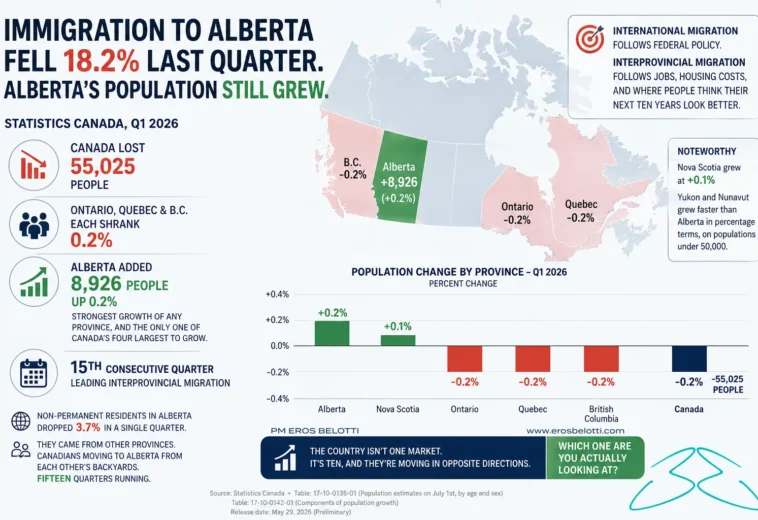
In the first quarter of 2026, Canada’s population shrank. Statistics Canada estimated a decline of 55,025 people, about 0.1%, to 41,417,056 on April 1, 2026. Ontario, Quebec and British Columbia each fell by about 0.2%. Alberta grew by about 0.2%, reaching 5,057,077 residents, and was the only one of Canada’s four largest provinces to grow at all.
For developers, investors and firms considering Alberta, the source of that growth matters as much as the number. This article explains what the Q1 2026 data show, why Alberta’s growth is different and how to use population data in project decisions.
The national picture
Canada’s population decline in Q1 2026 was driven mainly by lower immigration and a sharp fall in non-permanent residents. Statistics Canada reported that 83,149 permanent immigrants arrived in the quarter, 20.2% fewer than a year earlier, and that the number of non-permanent residents fell by 117,879, or 4.4%, as federal policy reduced temporary resident levels. Natural increase was slightly negative in the quarter.
The federal 2026-2028 Immigration Levels Plan set permanent resident admissions at 380,000 for 2026 and reduced targets for new temporary workers and students sharply, with the goal of bringing the temporary resident population below 5% of the total by the end of 2027.
Alberta’s different story
Alberta was not immune to these federal changes. Non-permanent residents in the province fell 3.7% in the quarter, to 261,031. Yet the population still grew. The difference comes from interprovincial migration: Canadians moving to Alberta from other provinces. Alberta has led Canada in net interprovincial migration for more than three years, and at the end of 2024 the provincial government reported that it had done so for ten consecutive quarters.
Policy-driven versus choice-driven growth
International migration largely follows federal policy. When Ottawa cuts targets, arrivals fall across the country. Interprovincial migration follows something else: jobs, housing costs and where people believe their next ten years will be better. One is a policy decision; the other is a bet made by households.
For anyone underwriting a project, that distinction matters. Population growth driven by a federal quota can reverse quickly with a policy change. Growth driven by years of people choosing to move with their families and belongings is harder to unwind.
A necessary caveat
Statistics Canada stresses that these are preliminary estimates, to be updated in September 2026, and that the national decrease could become smaller, larger or even turn into an increase, particularly because larger-than-usual revisions to non-permanent resident estimates are expected. Some smaller jurisdictions also grew in the quarter. None of that changes the overall pattern: the large provinces moved in different directions, and Alberta’s growth relied on domestic movers.
What it means for construction and real estate
Housing demand composition is changing
Interprovincial movers are often families and working-age adults relocating for jobs and affordability. They tend to seek ownership housing, family-sized rentals and suburban or regional locations. Temporary residents, whose numbers are falling, have historically been a major source of demand for smaller rental units. This shift helps explain why family-oriented product in Alberta has held up better than small apartments.
Rental markets will adjust
Fewer non-permanent residents and a wave of new rental completions are pushing vacancy up in Calgary and Edmonton. CMHC expects Calgary’s rental vacancy around 5.9% in 2026. Rental projects should be underwritten with that in mind.
Regional centres benefit
Interprovincial movers often choose communities around the big cities. Airdrie grew by more than 15,000 residents between 2021 and mid-2025, and Cochrane’s population rose 6.4% in 2025 alone.
Labour supply
Domestic migration also brings workers. With BuildForce Canada projecting that Alberta must add 48,800 construction workers by 2035, interprovincial arrivals are an important part of the workforce pipeline.
A note for European firms
For European companies reading a single headline about Canada before deciding whether to enter, the national average is the most misleading number available. Canada is not one market; it is ten provinces moving in different directions. A shrinking national population and a growing Alberta can both be true in the same quarter. Market entry, site selection and project feasibility should be based on provincial and city-level data.
How to use population data in feasibility
- Use provincial and municipal estimates, not national totals.
- Separate growth by component: natural increase, international migration, non-permanent residents and interprovincial migration.
- Match the product to the type of newcomer: families, workers, students or retirees.
- Watch revisions: preliminary estimates can change significantly.
- Combine population data with housing completions and vacancy to judge real absorption.
Regional differences inside Alberta
Provincial totals hide large differences between regions. Calgary and Edmonton absorb most newcomers, but the commuter towns around them often grow faster in percentage terms because families follow affordability into the collar communities. Smaller centres such as Red Deer, Lethbridge and Grande Prairie depend more on local industry, so their population trends track employment in energy, agriculture and logistics. For a developer, this means that a provincial growth figure is only a starting point. The relevant number is the growth in the specific catchment a project will serve, broken down by age and household type. A rental building near a university, a seniors residence and a starter-home subdivision each respond to very different demographic drivers, even when they sit in the same city.
The bottom line
Canada’s population shrank in early 2026, and Alberta’s grew. The growth came not from abroad but from other provinces, which makes it more durable than policy-driven growth. For developers and investors, the lesson is to look past the national headline and understand who is moving, where and why.
If you are evaluating a project in Alberta and want a feasibility review grounded in local demand data, see my feasibility services, read about Edmonton overtaking Calgary in interprovincial migration, or contact me. Which province are you actually looking at?
Frequently asked questions
Did Canada’s population decline in 2026?
Statistics Canada’s preliminary estimate shows a decline of 55,025 people in Q1 2026, to 41,417,056. The estimate will be revised in September 2026.
Did Alberta’s population grow in Q1 2026?
Yes, by about 0.2%, to 5,057,077, while Ontario, Quebec and British Columbia each declined by about 0.2%.
Why is Alberta still growing?
Mainly because of interprovincial migration from other provinces, driven by jobs and housing affordability.
Sources
- Statistics Canada: Canada’s population estimates, first quarter 2026
- Government of Alberta: Population statistics
- MLT Aikins: 2026-2028 Immigration Levels Plan
- CMHC: Summer update, 2026 Housing Market Outlook
- 181 views
- 0 Comment

Eros Belotti 01.

Eros belotti
Construction project manager with over 20 years of experience in Europe and the Canary Islands. Specialized in modular housing, container construction, real estate development and international project management. Founder of Reforma Vivienda Tenerife and Donkey Lab.