

//Alberta Wages vs House Prices: The Affordability Gap Developers Must Model
Alberta Wages vs House Prices: The Affordability Gap Developers Must Model
Tags : AlbertaAlberta ConstructionAlberta Real EstateBusiness DevelopmentCalgary Real EstateConstruction ManagementFeasibilityhousing affordabilityProject ManagementReal Estate Development
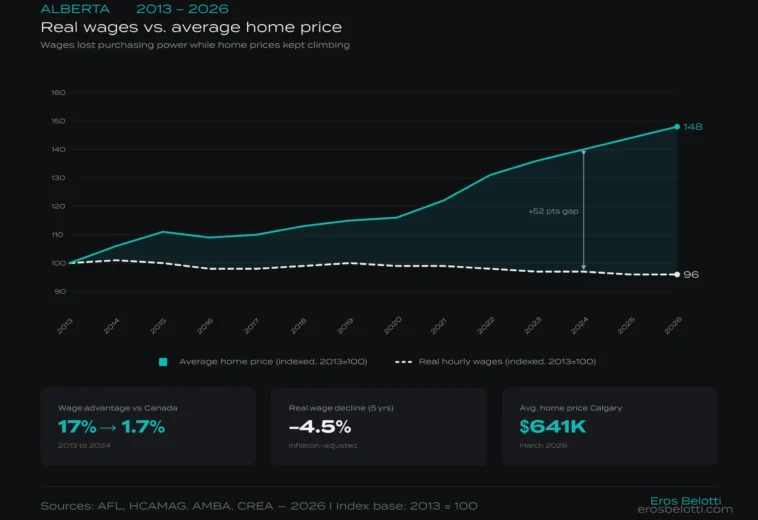
For a generation, Alberta’s economic story was simple: higher wages than the rest of Canada and more affordable homes. In 2013, average wages in the province were as much as 17% above the national average. By 2024 that premium had shrunk to about 2%. Meanwhile, home prices in Calgary have moved closer to national levels. For developers, that changes a basic assumption behind many pro formas: who can actually afford the product you are building?
This article looks at the data on wages, prices and affordability in Alberta, explains which buyers are most affected and shows how to build realistic income assumptions into a feasibility study.
The vanishing wage advantage
According to a report by the Centre for Future Work, summarised by HRD Canada, Alberta’s wage advantage has largely disappeared:
- Average wages were up to 17% above the national average in 2013, but only about 2% above by 2024.
- Real hourly wages in Alberta fell 4.5% over five years, while they rose 1.1% on average in the rest of Canada.
- In 2024, average hourly wages grew 2.2% in Alberta versus 3.8% nationally, while Alberta had the highest provincial inflation rate at 2.9%.
At the lower end of the income scale, Alberta’s general minimum wage remains $15 per hour in 2026, unchanged since October 1, 2018, and not indexed to inflation.
Prices kept moving
While incomes stalled in real terms, housing costs did not wait. CMHC’s mid-2026 outlook expects Calgary’s average MLS price around $650,000 in 2026 and Edmonton’s around $460,000. RBC Economics estimated in Q2 2026 that owning a home at market prices required 41.3% of median household income in Calgary and 36.8% in Edmonton, both above their long-term averages.
Alberta is still far more affordable than Toronto or Vancouver. But the gap between local incomes and local prices has widened, especially for entry-level buyers.
Who feels it most
Entry-level and mid-market buyers
First-time buyers and households on average or below-average incomes face the biggest squeeze. Their purchasing power depends on wages that have not kept up with inflation, while mortgage qualification depends on income multiples and stress tests.
Workforce housing
Workers in retail, hospitality, care and many trades need housing near their jobs at prices that match their wages. This segment is underserved and difficult to deliver profitably without careful design and cost control, or public support.
Premium detached homes
Detached homes in established and premium locations are holding up better. Their buyers often have higher incomes, equity from previous homes or capital from other provinces.
Why this matters for feasibility
Many feasibility studies assume that demand exists because population is growing. Population growth does create demand, but demand only becomes sales or rent at a price buyers and tenants can afford. When incomes and prices diverge, three things happen:
- Absorption slows at price points above what local incomes support.
- Unit sizes shrink as builders try to keep total prices affordable, which can reduce appeal for families.
- Incentives increase, eroding margins that looked healthy in the pro forma.
Building income assumptions into your model
Start from the buyer, not the product
Define the target buyer or tenant: household type, income range, savings and likely financing. Then calculate the price or rent they can sustain.
Use local income data
Median household incomes vary by city and neighbourhood. Use census and local data rather than provincial averages.
Apply realistic financing assumptions
Include current mortgage rates, stress test rules and down payment requirements. For rental projects, check rent-to-income ratios against the target tenant group.
Test the gap
Compare the price your project needs with what the target buyer can afford. If the gap is large, adjust product, size, finishes or location before buying land.
Run downside scenarios
Model slower absorption, lower prices and higher rates. A project that only works if incomes rise faster than they have in the past five years carries significant risk.
Opportunities in the affordability gap
The gap between incomes and prices is also an opportunity for developers who can deliver well-designed, efficient homes at attainable prices. Missing middle forms, secondary suites, smaller but well-planned family units, modular construction and partnerships with non-profits or public programs can reach buyers and tenants that conventional products miss. These projects require tight cost control and clear targeting, but demand for them is deep.
What to watch
Three trends will shape affordability in Alberta over the next two years. First, wage growth: if real wages start rising again, entry-level demand will strengthen. Second, rents: CMHC expects two-bedroom rents around $1,948 in Calgary and $1,624 in Edmonton in 2026, with vacancy rising, which may ease pressure on renters but also on rental project returns. Third, interest rates, which affect both buyers and developers. Monitoring all three helps time launches and price products realistically.
Rental demand and the income gap
When ownership becomes harder for households on average incomes, more of them rent for longer. That supports rental demand, but it also limits the rents that tenants can pay. Rental projects should therefore be tested against local income data as carefully as ownership projects. A common benchmark is that housing costs should not exceed about 30% of gross household income. If the rent a project needs is well above that level for its target tenants, lease-up will be slower and turnover higher, regardless of how strong overall demand appears.
The bottom line
Alberta still has demand. The question is for which buyer, at which price point and with which income assumption built into your model. Demand does not make every project viable. A feasibility study built on real income and price numbers does.
If you are running the numbers on a project in Alberta and want a second read on the affordability side, see my feasibility services, read my analysis of Alberta housing affordability, or contact me.
Frequently asked questions
Are wages in Alberta still higher than the Canadian average?
Only slightly. The Centre for Future Work found the premium fell from up to 17% in 2013 to about 2% in 2024, and real hourly wages fell 4.5% over five years.
What is Alberta’s minimum wage in 2026?
$15 per hour, unchanged since October 1, 2018.
What is the average home price in Calgary in 2026?
CMHC’s mid-2026 outlook forecasts an average MLS price of about $650,000 for Calgary in 2026, and about $460,000 for Edmonton.
Sources
- HRD Canada: Alberta wages falling behind national trends (Centre for Future Work report)
- Loans Canada: Alberta minimum wage 2026
- CMHC: Summer update, 2026 Housing Market Outlook
- RBC Economics: Housing affordability report, September 2026
- 174 views
- 1 Comment

Eros Belotti 01.

Eros belotti
Construction project manager with over 20 years of experience in Europe and the Canary Islands. Specialized in modular housing, container construction, real estate development and international project management. Founder of Reforma Vivienda Tenerife and Donkey Lab.
June 1, 2026 /
The numbers tell a clear story.
In 2013, Alberta’s wage premium made it the destination
for skilled workers across Canada.
That premium is now almost gone — but the housing
market never adjusted to reflect it.
For anyone running feasibility on a project in Alberta
right now: the end-buyer’s purchasing power is a
variable, not a constant.
Happy to share how I factor affordability data into
project evaluation. Just drop a comment or DM.