
Calgary Office Vacancy: Why It Won’t Fix Itself
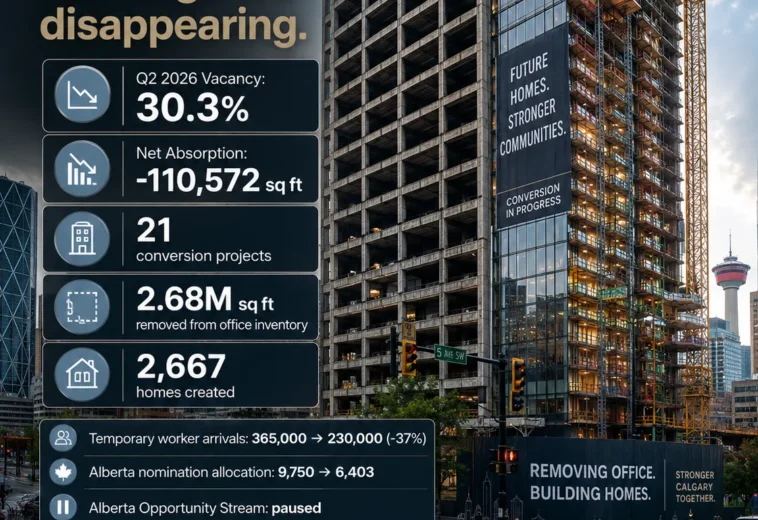
Calgary’s downtown office vacancy has been falling. But a large part of the improvement is not coming from tenants returning. It is coming from removing office buildings from the market. Through the city’s Downtown Office Conversion Program, 21 incentivised projects are converting about 2.68 million square feet of office space into roughly 2,667 homes, according to Money.ca. When the denominator shrinks, the vacancy rate can fall even when demand is weak.
This article looks at what is driving Calgary’s office vacancy, why waiting for demand to fix it misreads the problem and what that means for owners, investors and developers.
Where vacancy stands
Different brokerages measure Calgary’s downtown market in slightly different ways, but all describe a market with very high vacancy. Cresa reported downtown vacancy of 26.96% in Q2 2026, with positive net absorption of about 361,600 square feet, the first positive quarter since early 2025, while noting that energy-sector mergers continue to push sublease space onto the market. Vacancy is lowest in Class AA buildings, at about 17.5%, and highest in Class C, near 39%. The City of Calgary estimates more than 12 million square feet of downtown office space is vacant.
Conversions are shrinking the denominator
Calgary’s conversion program has removed nearly 2.7 million square feet from the office inventory and aims for 6 million by 2031. The City estimates conversions have reduced downtown vacancy by about 5%. That is real progress, but it is supply-side progress. It removes obsolete space rather than filling it.
Office demand is headcount demand
Office leasing ultimately depends on how many people companies plan to employ in the core. Several factors make that harder to forecast in 2026:
- Energy-sector consolidation: mergers often reduce combined head office space and add sublease supply.
- Hybrid work: companies need less space per employee than before 2020.
- Immigration changes: the federal 2026-2028 Immigration Levels Plan reduced new temporary worker arrivals to 230,000 in 2026, 37% fewer than the previous target, while keeping permanent resident admissions at 380,000. Companies that relied on temporary workers to scale quickly face more uncertainty.
When a company cannot plan its hiring pipeline with confidence, it avoids long leases. Instead of signing ten years for space it may not fill, it chooses coworking or short-term space. Multiply that by many decisions and long-term office demand stays weak even in a growing city.
Why the market will not fix itself
Calgary’s economy and population are growing. Yet downtown office demand is not tracking that growth, because much of the growth is in sectors and locations that do not require downtown towers. Suburban office markets have performed better, and new demand often favours top-quality buildings, leaving older Class B and C space behind.
Downtown Calgary will not be fixed mainly by tenants returning. It is being fixed on the supply side: conversions, repositioning and changing what the square footage is used for.
What this means for owners and investors
Owners of older buildings
For Class B and C buildings, the question is not when tenants will return but what the building should become. Conversion to residential, hotel, student or seniors housing, education or mixed use may offer better value than waiting. The City’s 2026 round of incentives, with $25 million available and a $75 per square foot incentive for residential and hotel conversions, supports that path.
Owners of top-quality buildings
Class AA and A buildings with strong amenities can compete for tenants consolidating into better space, but they also face competition from sublease supply.
Investors
Underwriting downtown office assets on a tenant-return assumption is risky. Models should test longer lease-up, lower rents and conversion scenarios.
Developers
Conversion projects require deep technical due diligence: floor plate depth, core position, structure, mechanical systems and code compliance. The gap between funded and completed conversions in Calgary shows how much those factors matter.
Which buildings are good conversion candidates
The City’s analysis indicates suitable candidates average about 224,000 square feet, with a median of about 151,000 square feet. Beyond size, good candidates usually have shallow floor plates that allow natural light in bedrooms, adequate floor-to-floor height for new services, structural capacity for residential loads and an envelope that can be upgraded economically. Buildings with deep floor plates may suit hotels, student housing or educational uses better than apartments.
A wider lesson
Calgary is not alone. Many North American downtowns face structural office oversupply. The cities making progress are those treating it as a land-use problem rather than a leasing problem, using incentives, zoning flexibility and technical support to convert obsolete space.
Questions to ask before buying downtown office space
For investors looking at discounted Calgary office assets, the price is rarely the hard part. The harder questions are about the building itself. How deep is the floor plate, and can it deliver natural light to residential units if converted? Where are the cores, risers and washrooms, and how expensive would it be to add plumbing to every unit? What is the remaining lease term of existing tenants, and can they be relocated? Does the building qualify for the City of Calgary downtown incentive program, and is there still funding available? What will the structural and envelope work cost, and how reliable is that estimate? Answering these questions in a structured feasibility study before an offer is made is far cheaper than discovering the answers after closing.
The bottom line
Calgary’s office vacancy is improving partly because buildings are being removed from the office market, not because demand has recovered. Office demand is headcount demand, and headcount planning has become more uncertain. If you are modelling downtown Calgary on a tenant-return assumption, the numbers deserve a second look.
If you are evaluating a conversion or repositioning, see my surveys, as-built and feasibility services, read about Calgary’s office conversion program, or contact me.
Frequently asked questions
What is Calgary’s downtown office vacancy rate?
Cresa reported 26.96% in Q2 2026; other brokerages report figures in a similar high range. The City estimates over 12 million square feet of vacant downtown office space.
How much office space has Calgary converted?
About 2.7 million square feet have been removed through the conversion program, toward a goal of 6 million square feet.
Will office demand recover in downtown Calgary?
Some recovery is possible in top-quality buildings, but structural factors such as hybrid work, consolidation and hiring uncertainty mean much older space will need new uses.
Sources
- Cresa: Q2 2026 Calgary office market report
- Money.ca: Calgary downtown office conversion program
- City of Calgary: Office conversion supporting analysis
- MLT Aikins: 2026-2028 Immigration Levels Plan
- 162 views
- 0 Comment

Eros Belotti 01.

Eros belotti
Construction project manager with over 20 years of experience in Europe and the Canary Islands. Specialized in modular housing, container construction, real estate development and international project management. Founder of Reforma Vivienda Tenerife and Donkey Lab.