

//Calgary or Edmonton in 2026? Choosing the Right City for Your Project
Calgary or Edmonton in 2026? Choosing the Right City for Your Project

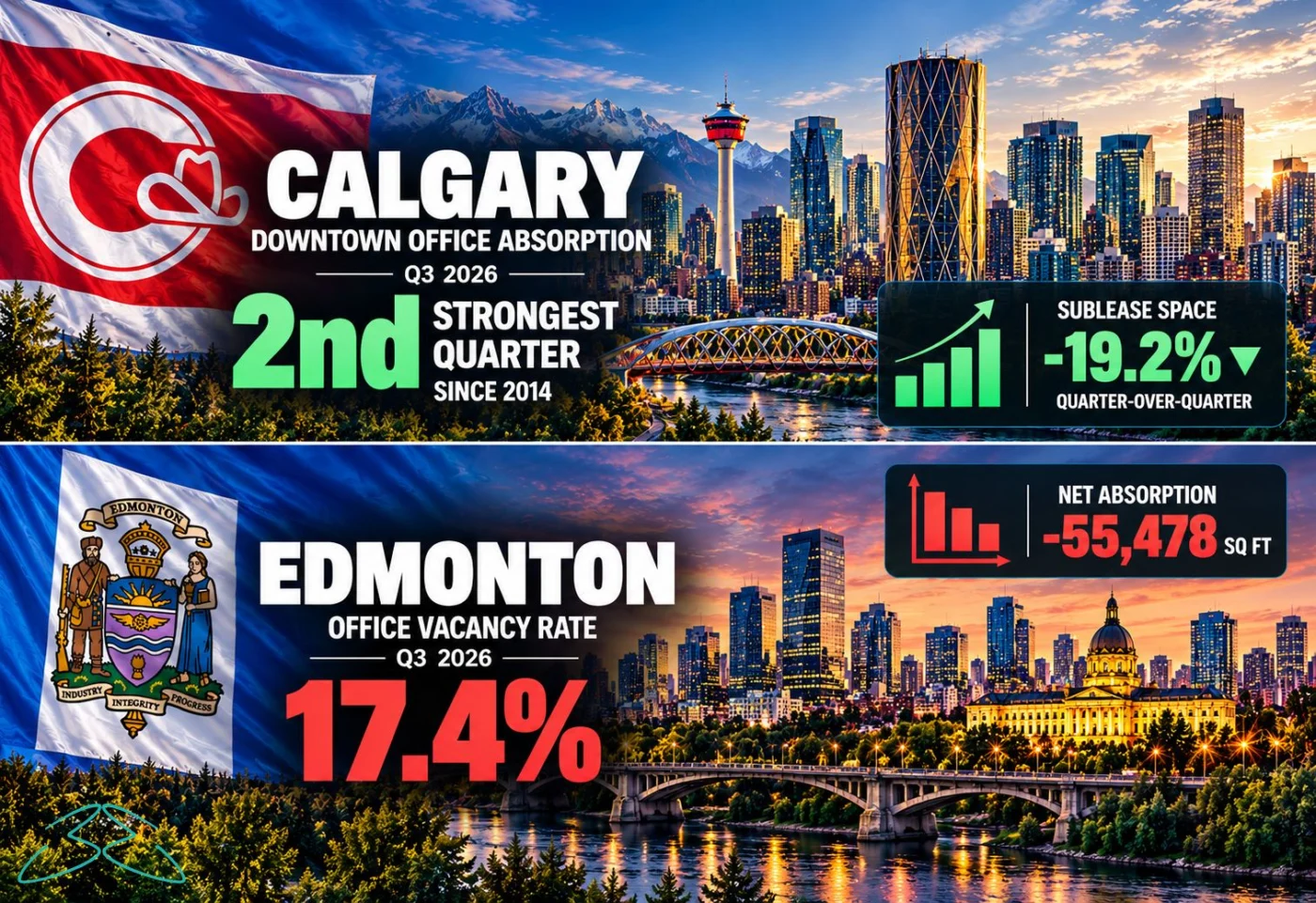
Calgary or Edmonton? For developers and investors looking at Alberta in 2026, it is one of the most common questions, and the honest answer is: it depends on what you are building and for whom. A year ago both cities were riding the same wave of record housing starts. Today they tell different stories, and the differences matter for every project decision.
This article compares the two markets using the latest available data on prices, affordability, rental vacancy, zoning and supply, and sets out which project types fit each city.
Same record, different paths
Alberta recorded 54,858 housing starts in 2025, a provincial record, and both Calgary and Edmonton set their own records. About 90% of the province’s starts were in the two metro areas, and 70% were multi-unit. For 2026, ATB Financial expects provincial starts to fall to about 45,000 as population growth slows.
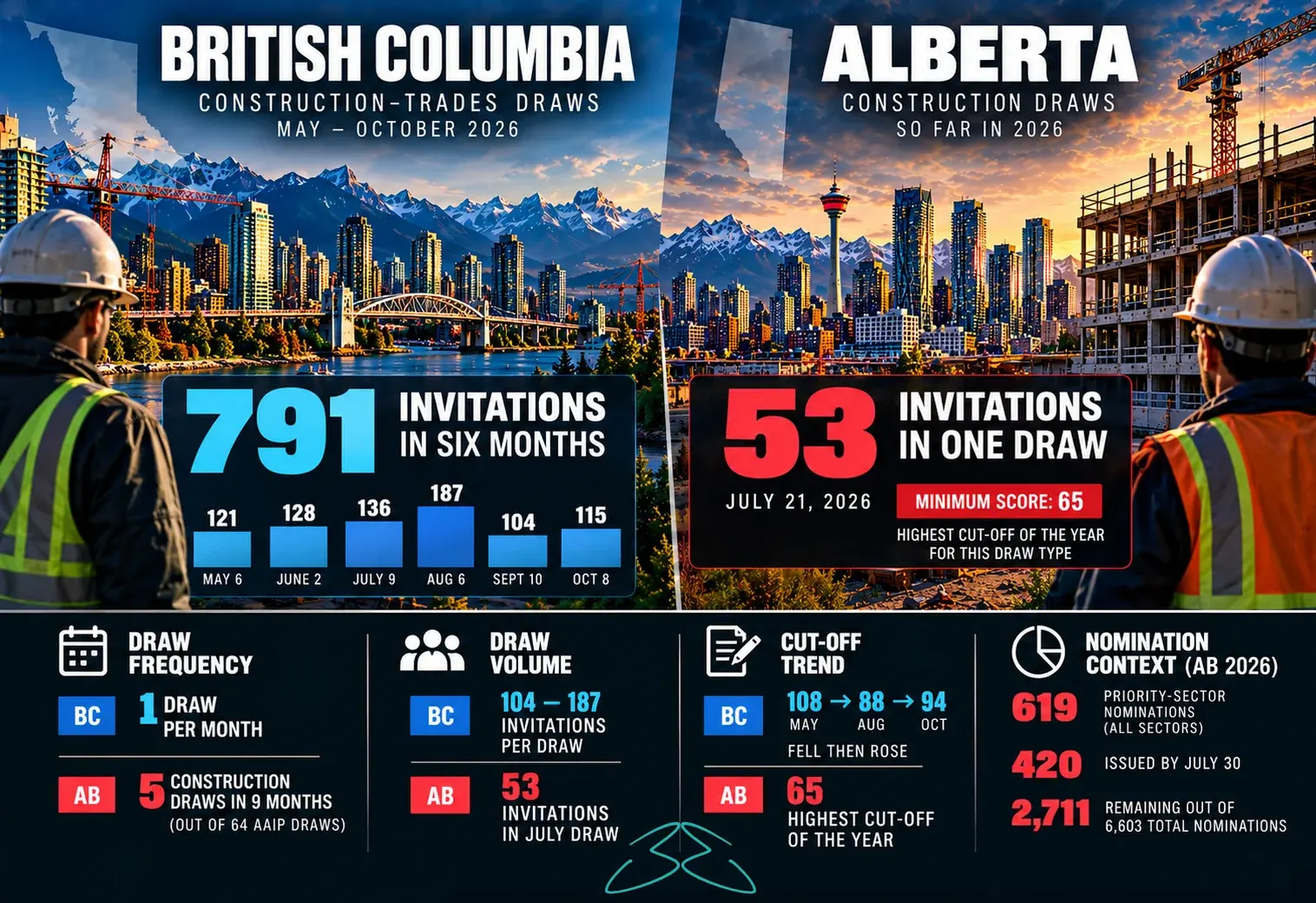
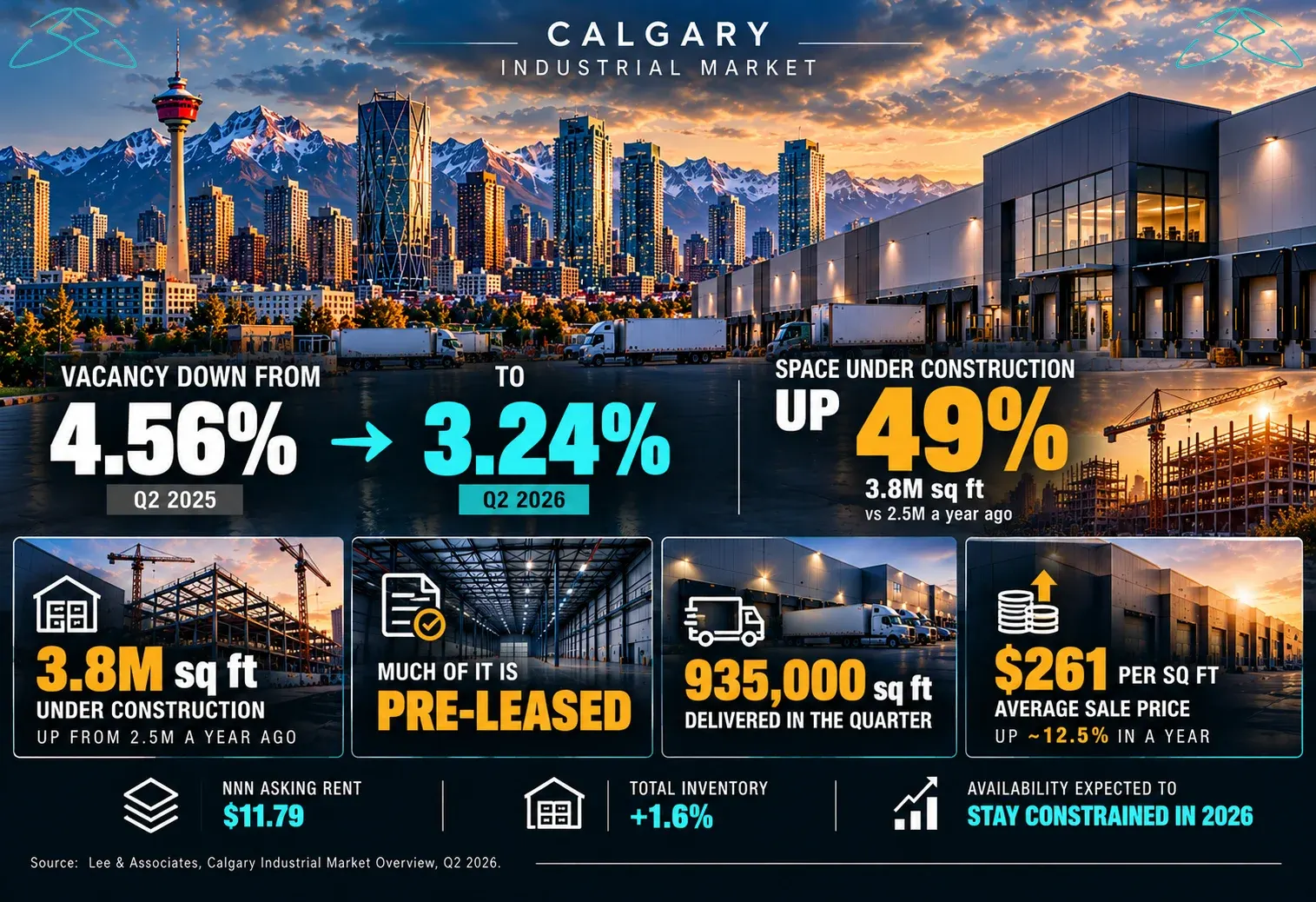
The slowdown will not affect both cities in the same way. Their price levels, rental markets and zoning regimes are different, and so is the type of buyer and tenant each attracts.
Prices and affordability
Edmonton remains the more affordable market. RBC Economics estimated in its Q2 2026 report that owning a home at market prices required 36.8% of median household income in Edmonton and 41.3% in Calgary. Calgary’s benchmark price in March 2026 was $565,600 according to CREB, with detached homes at $741,300 and apartments at $300,300.
Lower prices in Edmonton make entry easier for first-time buyers and investors, but they also cap revenue per unit. Higher prices in Calgary support more expensive construction, but buyers are more sensitive to further increases.
Rental market
CMHC’s 2025 rental market survey showed purpose-built rental vacancy at 5% in Calgary and 3.8% in Edmonton, while the national rate was 3.1%. Calgary’s higher vacancy reflects the large number of new rental units completed after record construction. For rental developers, it means more competition, more incentives and more careful underwriting of lease-up periods.
Supply pressure by segment
In Calgary, pressure is concentrated in apartments and row homes. In March 2026, apartment sales were down 28.8% year over year with 4.62 months of supply, and row home sales were down 19.3%. Detached homes, with 2.22 months of supply, remained tight.
Edmonton’s market has been more balanced for investors, with lower entry prices and steadier absorption in several segments, although RBC notes that affordability there has improved less than in other markets and remains above its long-term average.
Zoning: the biggest structural difference
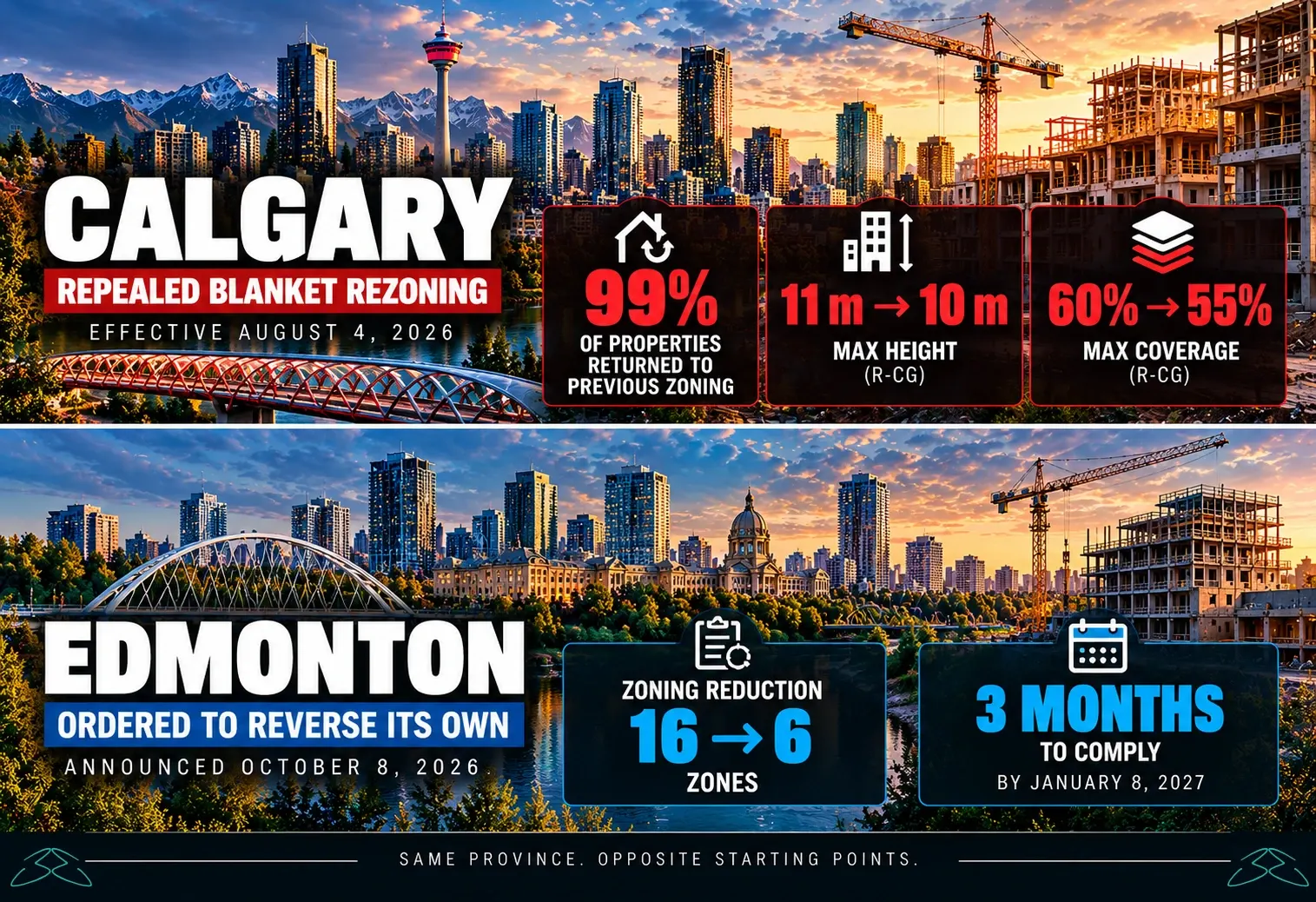
Edmonton’s Zoning Bylaw 20001, in force since January 2024, allows up to eight units on many residential lots by default. Missing middle units more than doubled from 2023 to 2024 according to Storeys. Calgary approved citywide rezoning in 2024 but repealed it in 2026, with changes effective August 4, 2026; about 99% of affected properties return to previous zoning, and most rowhouse projects again require a land use redesignation.
For small and mid-size builders, that difference is decisive. In Edmonton, a multiplex can often proceed with a development and building permit. In Calgary, the same project may first need a rezoning process, with its own timeline, cost and uncertainty.
Which projects fit which city
Edmonton tends to fit
- Small-scale infill: rowhouses, multiplexes and garden suites under RS zoning.
- Investors seeking lower entry prices and stable rental demand.
- Entry-level ownership product for first-time buyers.
Calgary tends to fit
- Ground-oriented family housing and detached product in established and suburban areas.
- Higher-end renovation and repositioning of existing homes.
- Rental projects with a clear differentiator: location, unit size, amenities or target tenant.
These are tendencies, not rules. A specific site, product and team can succeed in either city if the numbers work.
What changed for developers
Three things changed between 2025 and 2026. Construction costs stabilised but at a higher level, with national building construction prices up 4.1% year over year at the end of 2025. Capital became more selective, with lenders and investors asking for stronger presales and more conservative assumptions. And absorption stopped being automatic, as supply moved faster than buyers and tenants in some segments. Together these shifts make the choice of city and product much more important than in the boom years.
How to compare the two cities for a project
- Define the product: type, size, price point and target buyer or tenant.
- Compare land costs, development charges and zoning paths for comparable sites.
- Compare achievable prices or rents and current absorption for that product.
- Estimate construction costs and schedule, including approvals.
- Run the pro forma for both and test it against slower sales, lower prices and higher costs.
Don’t forget the secondary markets
The comparison is not only between the two big cities. Satellite communities around Calgary, such as Airdrie, Chestermere and Cochrane, and around Edmonton, such as St. Albert, Leduc and Sherwood Park, have their own land costs, development charges and buyer profiles. For some products, especially family housing, they can offer better land economics and faster approvals than the core cities. They also carry their own risks, including dependence on commuting patterns and infrastructure capacity, so they deserve the same feasibility discipline.
The bottom line
This is not a story of one city failing. It is a story of two markets that no longer move together. The question is not “is Alberta growing?” It is. The question is which city, which product type and which timing. Growth does not make every project financeable; feasibility does.
If you are comparing Calgary and Edmonton for a specific asset class and want a second read on the numbers, see my feasibility services, read about missing middle housing in Alberta, or contact me.
Frequently asked questions
Is Edmonton cheaper than Calgary in 2026?
Yes. RBC’s Q2 2026 affordability measure was 36.8% for Edmonton and 41.3% for Calgary, and benchmark prices are lower in Edmonton.
Which city has higher rental vacancy?
Calgary. CMHC reported purpose-built rental vacancy of 5% in Calgary and 3.8% in Edmonton in 2025.
Is it easier to build multiplexes in Edmonton?
Generally yes. Edmonton’s RS zone allows up to eight units on many lots by default, while Calgary repealed citywide rezoning in 2026.
Sources
- RBC Economics: Housing affordability report, September 2026
- Connect CRE: CMHC 2025 rental market results
- REW: Calgary market analysis, March 2026
- City of Calgary: Repeal of citywide rezoning
- Storeys: Edmonton small-scale residential results
- 225 views
- 1 Comment

Eros Belotti 01.

Eros belotti
Construction project manager with over 20 years of experience in Europe and the Canary Islands. Specialized in modular housing, container construction, real estate development and international project management. Founder of Reforma Vivienda Tenerife and Donkey Lab.
May 26, 2026 /
A quick note on why I’m focusing on this comparison right now.
Most of the Alberta market conversation still treats the province as one single opportunity. But on the ground, Calgary and Edmonton are operating on different fundamentals — vacancy rates, absorption pace, product type performance.
The developers and contractors I see navigating 2026 well are the ones asking granular questions before committing capital.
Not “is Alberta a good market?” But “is THIS product, in THIS city, at THIS cost basis — actually financeable?”
That’s the shift worth tracking.
If you’re working on a project in either market and want to think through the numbers — feel free to connect or send me a message.