

//Missing Middle Housing in Alberta: 70% of 2025 Starts Were Multi-Unit
Missing Middle Housing in Alberta: 70% of 2025 Starts Were Multi-Unit

Alberta recorded 54,858 housing starts in 2025, a provincial record. Many people read that number as a single-family housing boom. It was not. According to ATB Financial’s analysis of CMHC data, 70% of the province’s 2025 starts were multi-unit dwellings: apartments, rowhouses, multiplexes and other attached forms. That is the highest share on record and a structural change in what Alberta builds.
This article explains why the shift happened, how zoning in Calgary and Edmonton has shaped the so-called missing middle, and what developers and builders should consider when choosing a product type in 2026.
The numbers behind the shift
- 54,858 starts in 2025, 15% more than in 2024 and 33% more than in 2023.
- 70% multi-unit, up from 66% in 2024.
- About 90% of starts in the Calgary and Edmonton metro areas.
- Almost half a million new residents in Alberta between early 2023 and late 2025.
Rapid population growth, much of it from other provinces and from abroad, created demand for housing that is more affordable than a detached home on a large lot. Higher interest rates in 2023 and 2024 pushed buyers and investors towards smaller units, and rental demand encouraged purpose-built apartment projects.
What the missing middle means
The missing middle refers to housing forms between detached houses and large apartment towers: semi-detached homes, rowhouses, townhouses, fourplexes, small multiplexes and low-rise apartments. These forms can add density to existing neighbourhoods without dramatic change in scale, and they often offer family-sized units at lower prices than detached homes.
For decades, zoning in most Canadian cities made these forms difficult to build in established neighbourhoods. That changed in Alberta’s two largest cities, though in different ways.
Edmonton: zoning reform that stuck
Edmonton’s Zoning Bylaw 20001 took effect on January 1, 2024 and created a single Small Scale Residential (RS) zone that allows up to eight units on many lots by default. Results came quickly. According to Storeys, missing middle units in Edmonton more than doubled from just over 1,000 in 2023 to about 2,300 in 2024. Rowhouses alone added 1,216 units, compared with an average of 146 a year between 2019 and 2023, and the city approved 16,511 new housing units in 2024, 30% more than in 2023.
Calgary: rezoning, then repeal
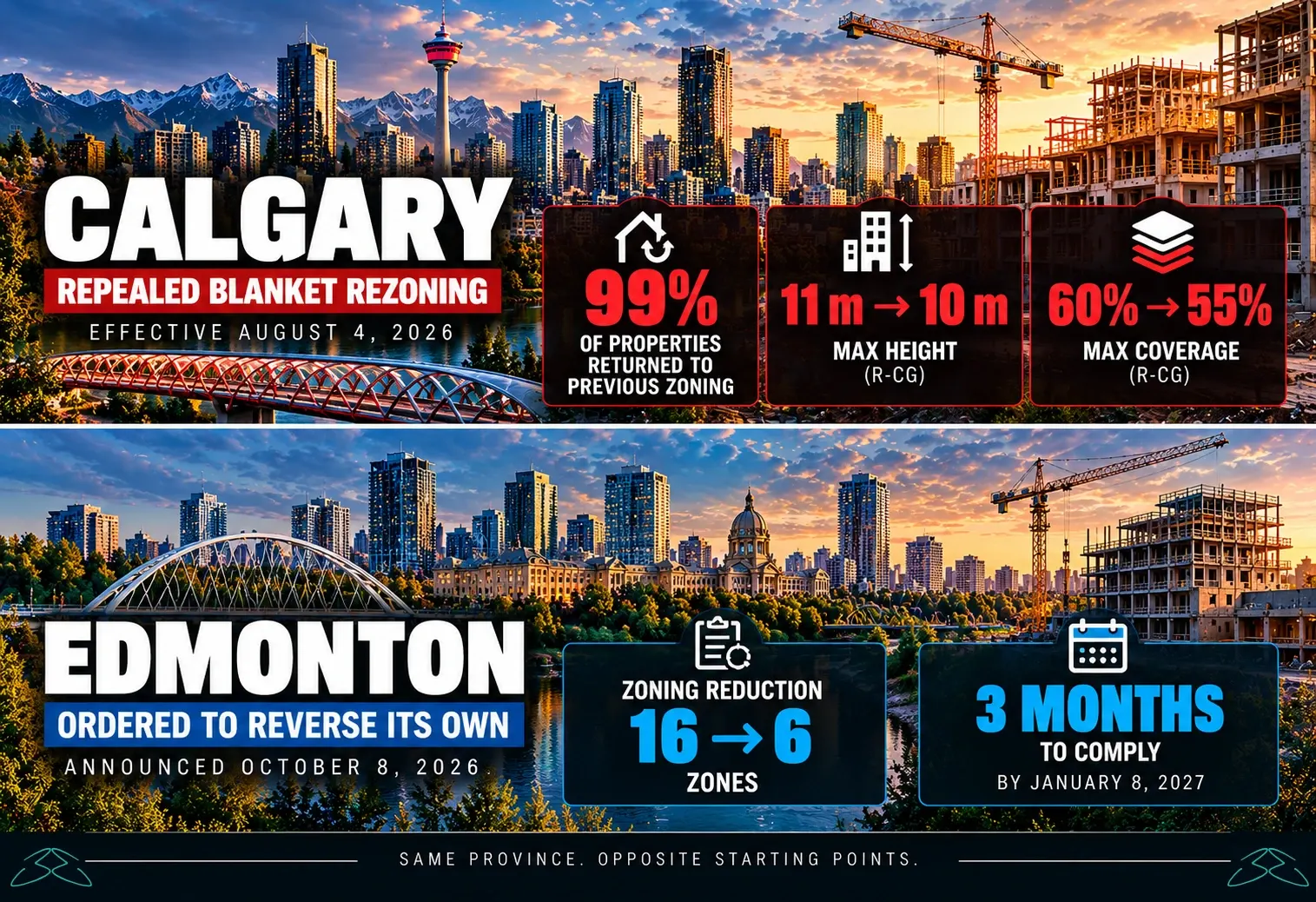
Calgary approved citywide rezoning for housing in May 2024, effective August 2024, allowing rowhouses and similar forms in most residential areas. The policy was controversial. In April 2026 City Council approved its repeal with amendments, and the changes took effect on August 4, 2026. According to the City, about 99% of affected properties return to their previous zoning, and owners who want to build rowhouses on many lots must again apply for a land use redesignation, plus development and building permits. The R-CG district remains but with a lower maximum height and lot coverage.
For developers, this means two different regulatory environments in the same province: Edmonton offers as-of-right small-scale density on many lots, while Calgary returns to a site-by-site rezoning process for most missing middle projects.
Is the multi-unit shift a risk?
The shift to multi-unit housing is not a red flag in itself; it reflects demographics and affordability. But concentration brings risk. In Calgary, apartment and row segments came under the most pressure in early 2026: in March, apartment sales fell 28.8% year over year with 4.62 months of supply, while row home sales fell 19.3%. Detached homes held up much better. When most new supply is one family of product types, competition within that segment intensifies.
How to choose the right product in 2026
1. Match the product to the location
Missing middle housing works best near transit, schools and services, where buyers and tenants value location over lot size. On the edge of a city, a rowhouse may compete directly with detached homes at similar prices.
2. Check the zoning path first
In Edmonton, confirm what the RS zone allows on your lot. In Calgary, confirm the current district after the 2026 repeal and the time and cost of a redesignation if needed. The zoning path should be part of feasibility, not an afterthought.
3. Design for families and long-term tenants
Units with three bedrooms, storage, private outdoor space and parking or bike storage are scarcer than small one-bedroom units. Differentiated product absorbs faster in a competitive market.
4. Test absorption against current data
Use current sales and rental data by segment, not 2024 conditions. Population growth is expected to slow to about 1.5% in 2026, and pro formas should reflect slower absorption.
5. Control construction cost and schedule
Small multi-unit projects often have thin margins. Complete drawings, a frozen design and a realistic schedule are as important as the land price.
Opportunities for builders and investors
The missing middle is attractive for smaller builders because projects are manageable in size, financing is accessible and construction methods are familiar from residential building. For investors, small multiplexes can combine rental income with long-term land value. The key is to treat each project as a development, with feasibility, zoning review and cost control, rather than as a bigger house.
What to watch next
Three indicators will show how the multi-unit shift evolves. First, the share of multi-unit starts in 2026: if it stays near 70% while population growth slows, competition in those segments will intensify. Second, rowhouse and multiplex permits in Calgary after the August 2026 repeal, which will show how much the policy change affects supply. Third, rents and vacancy rates in purpose-built rental, which determine whether investor-driven projects remain viable. Watching these monthly rather than annually gives developers a timing advantage.
The bottom line
Alberta is building at record levels, but the record was built with apartments and missing middle housing, not with detached homes. Record activity does not mean every format makes sense in every location. The right questions are which product type, which city and which location within it, and whether the zoning path and the numbers support it.
If you are evaluating a multi-residential or missing middle project in Alberta and want a second read on product-market fit and feasibility, see my feasibility and project management services, read my analysis of the Calgary market in 2026, or contact me.
Frequently asked questions
What percentage of Alberta housing starts were multi-unit in 2025?
70%, the highest share on record, according to ATB Financial’s analysis of CMHC data.
What is missing middle housing?
Housing forms between detached houses and large apartment towers, such as rowhouses, townhouses, fourplexes and small multiplexes.
Did Calgary repeal citywide rezoning?
Yes. Council approved the repeal in April 2026 and the changes took effect on August 4, 2026, returning about 99% of affected properties to their previous zoning.
Sources
- ATB Financial: Housing starts in Alberta, December 2025
- Storeys: Edmonton multiplex and small-scale residential results
- City of Calgary: Repeal of citywide rezoning
- REW: Calgary market analysis, March 2026 (CREB data)
- 158 views
- 1 Comment

Eros Belotti 01.

Eros belotti
Construction project manager with over 20 years of experience in Europe and the Canary Islands. Specialized in modular housing, container construction, real estate development and international project management. Founder of Reforma Vivienda Tenerife and Donkey Lab.
May 26, 2026 /
For context: I’ve been tracking Alberta’s construction pipeline from the outside — European background, with project management and real estate development experience across Italy, Switzerland, and Spain.
What struck me most when I started digging into Alberta’s numbers wasn’t the volume. It was the composition.
The missing middle shift isn’t just a supply story. It’s a signal about who Alberta is building for — and that changes everything about how you approach feasibility, product design, and market timing.
Curious what you’re seeing on the ground. Are developers in Calgary and Edmonton already repositioning their pipelines — or still chasing the old playbook?