

//Edmonton vs Calgary Real Estate: The $195K Gap in 2026
Edmonton vs Calgary Real Estate: The $195K Gap in 2026
Tags : 2026 housing pricesAlberta Housing MarketCalgaryconstruction AlbertaEdmontonInterprovincial Migrationreal estate feasibilitysite selection
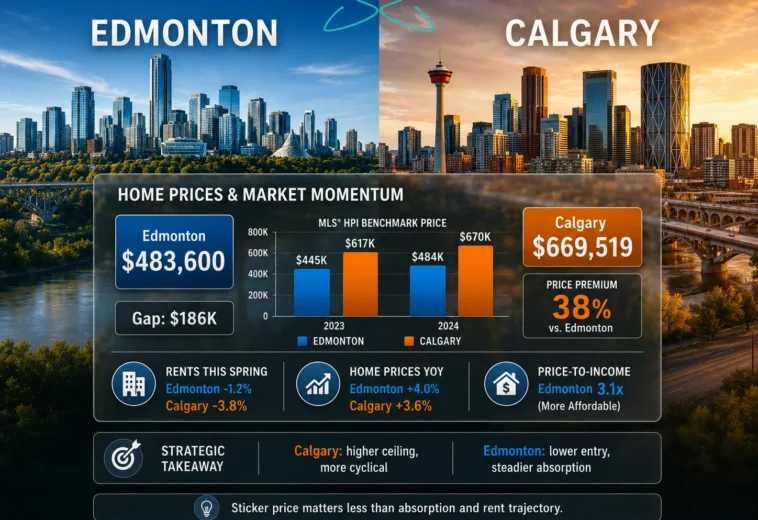
In June 2026 the average home price in Calgary was about $659,400; in Edmonton it was about $464,900, according to Sagen’s Alberta housing market update. That is a gap of nearly $195,000 inside the same province. With Edmonton now attracting more interprovincial migrants than Calgary, the obvious question is what these different price levels mean for the two housing markets, and for anyone deciding where to build or invest.
The answer is not what the price tags alone suggest. This article compares the two markets on prices, rents, affordability and supply, and sets out the trade-off between margin and resilience.
Prices: Calgary higher, Edmonton rising faster
Sagen’s June 2026 figures show:
- Calgary: average price about $659,400, up 2.5% year over year; sales 2,260, down 6.6%; new listings down 10.2%.
- Edmonton: average price about $464,900, up 4.9%; sales 2,236, down 7.6%; new listings up 5.0%.
Both markets were broadly balanced, with sales-to-new-listings ratios of 57 and 56. Edmonton’s prices rose faster from a lower base, while Calgary’s higher-priced market grew more slowly.
Affordability: a structural advantage for Edmonton
RBC Economics estimated in Q2 2026 that owning a home at market prices required 36.8% of median household income in Edmonton and 41.3% in Calgary, compared with 64.1% in Toronto. Edmonton’s affordability makes it accessible to first-time buyers and households moving from more expensive provinces, which helps explain why it led Canada in net interprovincial migration in 2024/25.
Rents: Calgary cooling faster
Rental data point in the same direction. According to liv.rent’s June 2026 report, average unfurnished one-bedroom rents were about $1,467 in Calgary, down 4.6% year over year, and about $1,253 in Edmonton, down 3.8%. Since January, Calgary’s one-bedroom rents had fallen slightly while Edmonton’s had edged up. CMHC’s mid-2026 outlook expects rental vacancy of about 5.9% in Calgary and 4.8% in Edmonton in 2026.
After two years of strong rent growth and record construction, Calgary’s rental market is adjusting more sharply.
Supply: both cities building less
CMHC reported that by May 2026 year-to-date starts were down 28% in Calgary and 14% in Edmonton. Its outlook expects Calgary starts of about 22,000 and Edmonton starts of about 16,000 in 2026. Edmonton is receiving more interprovincial movers while building less than in 2025, a combination that supports absorption.
What matters for feasibility
For a development project, the average sale price is one of the least useful numbers on the page. What decides a 24-month build is absorption and rent trajectory during construction and lease-up. On those measures, Edmonton’s steadier inflow and lower vacancy look less exposed than Calgary’s higher-priced but more cyclical market.
Calgary: higher ceiling, more cycle exposure
Calgary offers higher prices and rents per unit, a larger corporate base and strong amenities. But it is more exposed to energy-sector cycles, corporate consolidation and the current wave of rental completions. Margins per unit can be higher, but so can volatility.
Edmonton: lower ceiling, more resilience
Edmonton offers lower land and entry costs, more permissive small-scale zoning and steady demand from movers. Revenue per unit is lower, so projects need tight cost control, but absorption risk may be lower.
The trade-off for investors and developers
For firms underwriting an Alberta entry, including European developers, the real trade-off is between margin per unit in Calgary and absorption resilience in Edmonton. Neither city is weak; they have different risk profiles. The right choice depends on product, capital structure and risk appetite.
How to compare the two for a specific project
- Define the product and target buyer or tenant.
- Compare land cost, development charges and zoning for comparable sites.
- Compare achievable prices or rents for that product, not city averages.
- Compare competing supply under construction in each submarket.
- Model absorption and vacancy scenarios over the construction and lease-up period.
- Calculate returns and test them against downside scenarios in both cities.
Don’t ignore the surrounding regions
The comparison is not only between the two cores. Satellite communities such as Airdrie and Cochrane near Calgary, and St. Albert, Leduc and Sherwood Park near Edmonton, have grown quickly and offer different land costs and buyer profiles. For family-oriented product, they can sometimes outperform both cities. Including them in the analysis widens the set of viable options.
What could change the picture
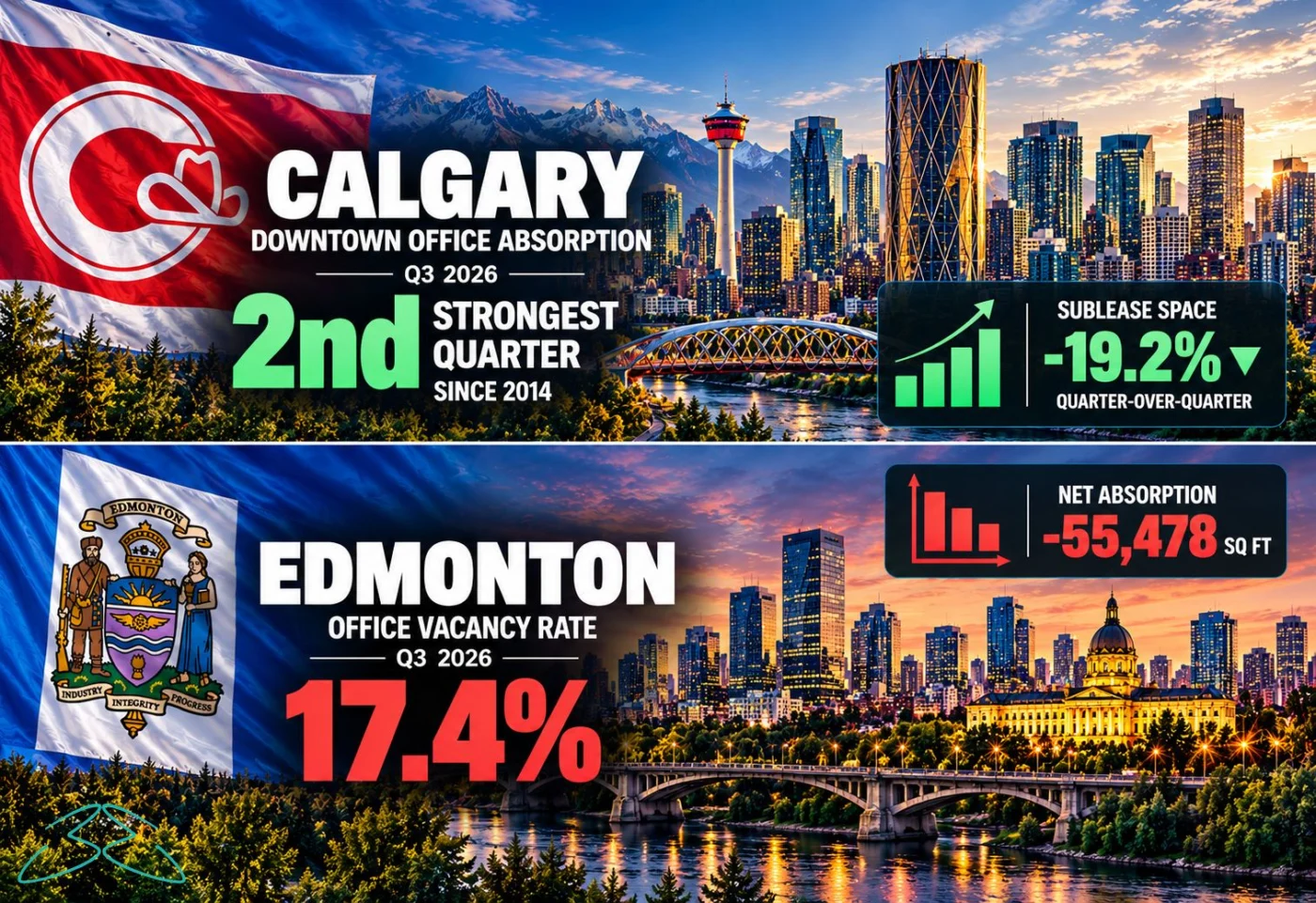
Several factors could shift the balance. Energy prices and corporate decisions affect Calgary’s office and housing demand more than Edmonton’s. Large projects in the capital region, such as the Meta data centre, could tighten Edmonton’s rental market further. Federal immigration changes reduce demand for small rental units in both cities. Watching these drivers helps investors adjust their allocation over time.
Financing and lender appetite
Lenders look at the two markets differently as well. Edmonton projects often show stronger debt-service coverage on rental buildings because land and construction costs are lower relative to achievable rents. Calgary projects can support higher absolute rents but need more equity to cover land costs. Programs such as CMHC MLI Select are available in both cities and reward affordability, energy efficiency and accessibility commitments, which can change the comparison significantly. Before choosing a city, it is worth running the same project through both cost structures with realistic financing terms.
The bottom line
A $195,000 average price gap tells you Calgary is the more expensive market. It does not tell you which market suits your project. Calgary offers a higher ceiling with more cyclical exposure; Edmonton offers steadier absorption at lower price points. Feasibility built on absorption and rent trajectory, not on headline prices, is what reveals the better choice.
If you are weighing Calgary against Edmonton for a project, see my feasibility services, read about Edmonton overtaking Calgary in interprovincial migration, or contact me. Which way are you weighting it?
Frequently asked questions
What is the average home price in Calgary and Edmonton?
In June 2026, about $659,400 in Calgary and about $464,900 in Edmonton, according to Sagen.
Are rents falling in Calgary?
Yes. Average unfurnished one-bedroom rents in Calgary were about 4.6% lower year over year in June 2026, compared with about 3.8% lower in Edmonton.
Is Edmonton a better place to invest than Calgary?
It depends on the project. Edmonton offers lower entry costs and steadier absorption; Calgary offers higher revenue per unit with more cyclical risk.
Sources
- Sagen: Alberta housing market update, June 2026
- liv.rent: June 2026 Calgary and Edmonton rent report
- RBC Economics: Housing affordability report, September 2026
- CMHC: Summer update, 2026 Housing Market Outlook
- 156 views
- 1 Comment

Eros Belotti 01.

Eros belotti
Construction project manager with over 20 years of experience in Europe and the Canary Islands. Specialized in modular housing, container construction, real estate development and international project management. Founder of Reforma Vivienda Tenerife and Donkey Lab.
July 22, 2026 /
Sources, for anyone who wants to check the numbers:
→ Average home prices, June 2026 — CREB (Calgary) & Realtors Association of Edmonton
→ Rents & vacancy trends — CMHC and Yardi Q2 2026
→ Price-to-income ratio & Imperial Oil layoffs — as covered in my previous post
One thing I left out of the post for length: the $186K price gap isn’t just a number — it’s roughly a 38% premium to build or buy in Calgary over Edmonton. On a multi-unit project, that premium has to be earned back through either higher rents or faster absorption. Right now Calgary is delivering neither. That’s the part worth watching over the next 12 months.