

//Removed the One-Year Barrier for Foreign-Trained Engineers Alberta
Removed the One-Year Barrier for Foreign-Trained Engineers Alberta
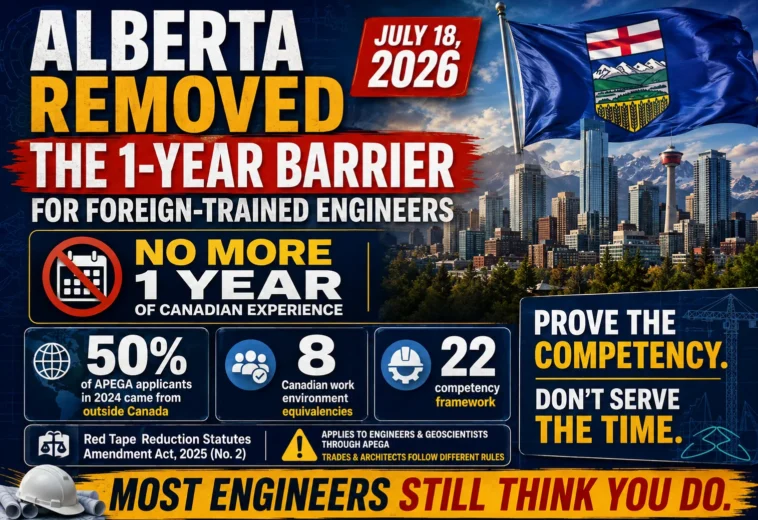
If you are one of the foreign-trained engineers Alberta has been trying to attract for the past decade, something changed on July 18, 2026 — and almost nobody noticed.
Until that date, an internationally trained engineer applying for a professional engineer licence in Alberta had to complete one full year of Canadian engineering experience before being allowed to practise independently. Not a year of learning the market. A year of waiting out a requirement.
That requirement is gone.
The change did not make the front page. It arrived through a regulatory update from APEGA, the Association of Professional Engineers and Geoscientists of Alberta, and six weeks later most of the people it was designed to help still have not heard about it.
Here is what actually changed, how the new process works, and — more importantly — where the real bottleneck moved.
What changed on July 18, 2026
The one-year Canadian experience requirement was not deleted. It was converted from a measure of time into a measure of competency.
APEGA already assessed engineering applicants against 22 competencies. As of July 18, eight of those competencies have been designated as mandatory Canadian work environment competencies, each carrying a minimum score the applicant must reach.
Those eight are competencies 1.1, 1.6, 1.9, 2.1, 2.2, 2.3, 5.1 and 6.2. They cover knowledge of Canadian regulations, codes and standards, quality control, safety awareness, professional accountability and communication.
The logic is straightforward once you see it. What the regulator actually wanted was never that you physically spent twelve months in Canada. It was that you understand how to operate inside the Canadian regulatory environment. If you can demonstrate that, the calendar stops being relevant.
The change follows amendments to Alberta’s Fair Registration Practices Act, announced by the provincial government on November 17, 2025, which removed Canadian work experience as a registration requirement for regulated professions unless it can be justified on public safety grounds. The legislative vehicle was the Red Tape Reduction Statutes Amendment Act, 2025 (No. 2).
APEGA had already applied the same model to geoscience applicants in April 2026, where seven of 29 competencies serve the same function. The stated goal is a nationally consistent method for evaluating Canadian and international professional experience against the same standard.
How the new assessment actually works
The process rests on two separate instruments, and it helps to keep them distinct, because they measure different things.
The WRVL measures duration
The Work Record Validator List is your career timeline. It exists to demonstrate at least 48 months of professional-level engineering experience — employers, positions, the country where the work was performed, start and end dates.
That 48-month floor was not touched by the reform, and it could not have been: it is set by Alberta’s Engineering and Geoscience Professions Act and the associated General Regulation. No regulator can remove a statutory requirement with a policy update.
The CBAT measures substance
The Competency-Based Assessment Tool is where you document the 22 competencies, grouped into six categories: technical competence, communication, project and financial management, team effectiveness, professional accountability, and social, economic, environmental and sustainability considerations.
For each competency you write in a Situation / Actions / Outcome format: one concrete situation, the specific actions you took, the result. APEGA is explicit that you should write in the first person — “I” rather than “we” — because a claim written in the plural does not demonstrate your decision.
Each competency is scored from 0 to 5, where 0 indicates no awareness of the competency and 5 indicates a mature level of practice.
Where the real bottleneck moved
You do not score yourself. Two distinct roles are involved, and the difference between them matters.
References simply confirm that you worked somewhere, in a given role, during a given period. A manager or an HR representative is sufficient — no technical knowledge required. You need at least one for each employer.
Validators carry the weight. You need at least three. They must have direct knowledge of your work, must have actually reviewed it, and they are the ones who assign the score to each competency. Each validator completes one response form per assigned competency — a minimum of one and a maximum of 20 — followed by an overall reference form covering your professional character, ethics and communication.
And this is where applicants trained in Europe hit friction.
For Category 1 technical competencies, the validator is expected to hold a professional engineer designation from a Canadian engineering regulator. Alternatively, they may be a “practitioner”: someone holding an engineering degree plus at least four years of professional engineering experience. But if that validator is not registered with a Canadian regulator and is validating Category 1 competencies, they must submit a detailed résumé to APEGA covering their education, work history and professional designations.
In practical terms: the barrier has not been removed, it has been relocated from your calendar to the availability of your former supervisors. You now need to persuade three people in Milan, Madrid or Munich to complete forms in English for a Canadian regulator, and at least one of them to submit their own CV.
For an engineer who has changed employers frequently, or whose former managers have retired, this is a real obstacle — arguably a harder one than simply waiting twelve months.
APEGA also conducts quality assurance audits and may independently verify reference responses by phone or email.
What has not changed
This part deserves to be stated plainly, because it is where misunderstandings start.
The 48 months of experience remain mandatory. So does the National Professional Practice Exam, the English language competency requirement, academic documentation, the good character and reputation requirement, and the citizenship or permanent residency question.
The deadlines are tight and unforgiving. You have 90 days to complete and pay for your application, and a further 90 days after payment to submit all questionnaires, response forms and academic records. Miss either window and the application is withdrawn.
One important detail: if your application was already in progress before July 18, 2026, you continue under the rules in effect when you applied. The change is not retroactive.
What this means if you are considering Alberta
Roughly 50 per cent of APEGA applicants in 2024 came from outside Canada. This is not a marginal adjustment affecting a handful of people — it applies to half the intake.
At the same time, Alberta is running one of the largest industrial, energy and data centre construction pipelines in its history, against a workforce it cannot fill from within the province.
If you are an experienced engineer who looked at Alberta two or three years ago and concluded the licensing path was too slow to justify the move, the arithmetic changed six weeks ago. The twelve months are gone.
What replaced them is a documentation exercise — and documentation, unlike time, is something you can start preparing today.
One caveat worth stating clearly: this reform applies to engineers and geoscientists registered through APEGA. Skilled trades and architects follow entirely separate paths, with different regulators and different rules. Do not assume it transfers.
Frequently asked questions
Do foreign-trained engineers still need Canadian experience to work in Alberta?
No. As of July 18, 2026, the one-year Canadian work experience requirement has been removed for professional engineer applicants. Applicants now demonstrate eight Canadian work environment equivalencies through APEGA’s competency-based assessment instead.
How many competencies does APEGA assess?
Twenty-two, grouped into six categories. Eight of those — 1.1, 1.6, 1.9, 2.1, 2.2, 2.3, 5.1 and 6.2 — are designated Canadian work environment competencies and carry a minimum required score.
How much experience do I need for a P.Eng. licence in Alberta?
At least 48 months of professional-level engineering experience. This requirement is set by statute and was not affected by the July 2026 change.
Does this change apply to architects or skilled trades?
No. The reform applies only to engineers and geoscientists registering through APEGA. Architects and trades are regulated separately.
What if I already applied before July 18, 2026?
Applications already in progress continue under the requirements that were in effect at the time of application. The change is not retroactive.
I write about the Alberta construction and real estate market, and about what European firms and professionals need to know before entering it. If licensing, feasibility or project delivery in Alberta is on your radar, connect with me on LinkedIn — I publish something worth reading most mornings.
- 179 views
- 1 Comment

Eros Belotti 01.

Eros belotti
Construction project manager with over 20 years of experience in Europe and the Canary Islands. Specialized in modular housing, container construction, real estate development and international project management. Founder of Reforma Vivienda Tenerife and Donkey Lab.




August 21, 2026 /
Source, for anyone who wants to read it directly: https://www.apega.ca/news/2026/06/29/streamlining-the-competency-based-assessment-process-for-engineering-applicants
Two details that didn’t fit in the post:
If your application was already in progress before July 18, you stay under the old rules. The change isn’t retroactive.
And the eight Canadian environment competencies are 1.1, 1.6, 1.9, 2.1, 2.2, 2.3, 5.1 and 6.2 — each carries a minimum score you have to hit. Worth knowing before you start writing.