
//Seattle Construction Restart After the World Cup Pause: Why Remobilisation Is the Risk
Seattle Construction Restart After the World Cup Pause: Why Remobilisation Is the Risk
Tags : Construction Risk ManagementConstruction SchedulingFIFA World Cup 2026King CountyProject CoordinationSDOTSeattle ConstructionWashington State Real Estate
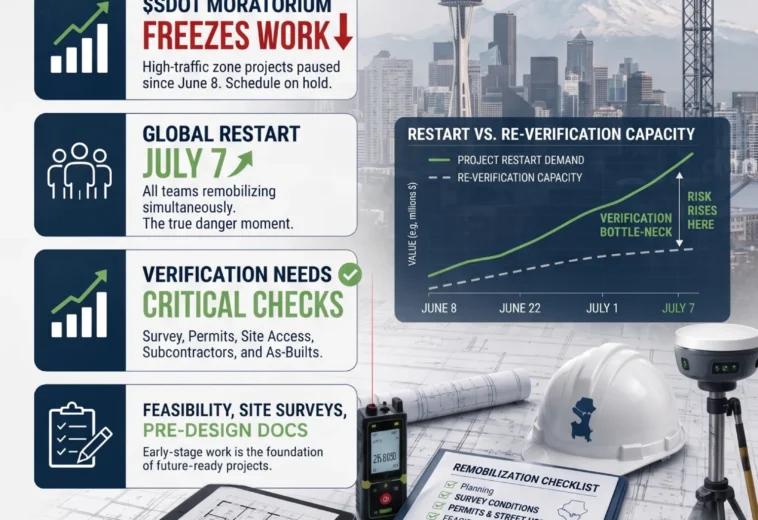
During the 2026 FIFA World Cup, the Seattle Department of Transportation (SDOT) paused most construction in the public right-of-way from June 8 to July 7, 2026. Projects with Street Use permits in the downtown core, near the stadiums and on transit routes citywide had to stop work that restricted mobility and clear the right-of-way by June 7. A pause of a month is manageable. The risky moment is not the pause itself. It is the restart, when dozens of projects try to remobilise in the same window.
This article explains why simultaneous restarts create schedule risk, what project managers and contractors should re-verify before returning to site, and what lessons apply to any planned shutdown, from major events to seasonal restrictions.
What the pause required
According to the City of Seattle, affected projects had to restore the street to defined standards before stopping: at least 2 inches of hot-mix asphalt over 4 inches of crushed rock on non-arterial streets, and at least 6 inches over 6 inches on arterials, and keep that restoration safe and functional until project completion. SDOT offered limited work windows in mid-June and an exception process for projects that could not pause. Work on streets outside the pause zone could continue, sometimes with an updated Street Use permit.
Why the restart is the dangerous moment
When the pause ends, every affected project wants to restart at once. That creates competition for the same limited resources and exposes assumptions that were reasonable before the pause but may no longer be valid.
1. Site conditions may have changed
Temporary restorations, utility work by others, weather and traffic can change site conditions. Survey control points may have been disturbed. As-built information from before the pause may not match the site after it.
2. Permits and approvals need checking
Street Use permits, traffic control plans and approvals may need re-verification, extension or updating before crews return, especially if work zones or schedules changed.
3. Subcontractor schedules assumed a normal restart
Subcontractors planned to return after the pause, but so did their other clients. Crews, equipment and specialist trades may be overbooked in the first weeks.
4. Deliveries and crane access compete
Concrete pours, material deliveries and crane lifts all need street access. When many sites restart together, delivery windows and traffic control resources become bottlenecks.
5. Inspections bunch up
Inspectors face a backlog of requests at the same time, which can delay sign-offs needed to continue work.
A remobilisation checklist
- Re-survey critical control points and verify site conditions against drawings.
- Inspect temporary restorations and protection measures.
- Confirm permit status, traffic control plans and any required updates.
- Reconfirm subcontractor start dates and crew sizes in writing.
- Re-sequence deliveries and crane use, coordinating with neighbouring projects where possible.
- Book inspections early.
- Update the schedule with realistic productivity for the first weeks.
- Brief all crews on any changes to site conditions, access or safety.
Lessons for any planned shutdown
Major events, seasonal restrictions, holiday shutdowns and regulatory pauses all share the same pattern. A well-planned pause includes a well-planned restart. The teams that stay on schedule are the ones that re-verify conditions before remobilising, not the ones that simply pick up where they left off.
Plan the restart before the pause
Before stopping, document site conditions with photos and survey data, list the first tasks after restart and secure key subcontractors for specific dates.
Use the pause productively
Office work continues during a site pause: resolve open design questions, process submittals, update drawings and procure materials so that the restart is not delayed by paperwork.
Coordinate with neighbours
In dense urban areas, coordinating delivery and crane schedules with adjacent projects reduces conflicts for everyone.
Communicate with the city
Early contact with permit and inspection staff helps identify issues before they delay remobilisation.
Documentation matters
A pause is a natural checkpoint for documentation. Updating as-built drawings and survey records before stopping, and verifying them after restarting, protects the project from disputes about pre-existing conditions and ensures that work continues from accurate information.
Beyond Seattle
Host cities for major events, including the other North American World Cup cities in 2026, increasingly use construction restrictions to manage traffic and safety. Similar measures apply around large festivals, sports events and political summits. For contractors working in multiple cities, building event calendars into project schedules from the start is becoming standard practice. In Canada, winter conditions create comparable seasonal pauses for some types of work, and the same restart discipline applies when crews return in spring.
The cost of a poor restart
A poorly managed restart rarely appears as one big problem. It shows up as many small delays: a crew sent home because access was blocked, a pour postponed because an inspection was not booked, a delivery that could not unload, a trade that found conditions different from the drawings. Each costs a day or two. Together, in the first weeks after a pause, they can add more delay than the pause itself.
The bottom line
A construction pause does not kill a schedule. A simultaneous, unprepared restart does. For project managers and contractors, the week before remobilisation is the time to re-check survey, permits and site access, not the week after crews arrive.
If you are planning around a shutdown or restart and want help structuring the remobilisation, see my construction project management services, read about trade coordination, or contact me. What is your plan for re-verifying conditions before remobilising?
Frequently asked questions
When was Seattle’s World Cup construction pause?
From June 8 to July 7, 2026, for projects with Street Use permits in the downtown core, near the stadiums and on transit routes citywide.
What should contractors check before restarting after a pause?
Site conditions and survey control, temporary restorations, permits and traffic control, subcontractor availability, delivery and crane schedules, and inspection bookings.
Why are simultaneous restarts risky?
Because many projects compete for the same crews, equipment, deliveries, street access and inspections at the same time.
Sources
- City of Seattle Building Connections: Public right-of-way construction pause during the 2026 FIFA World Cup
- SDOT Blog: World Cup roadside chat
- 122 views
- 1 Comment

Eros Belotti 01.

Eros belotti
Construction project manager with over 20 years of experience in Europe and the Canary Islands. Specialized in modular housing, container construction, real estate development and international project management. Founder of Reforma Vivienda Tenerife and Donkey Lab.



June 30, 2026 /
Source: Seattle Department of Transportation (SDOT), “Keeping Seattle Moving: Your Guide to the 2026 FIFA World Cup Construction Pause” — moratorium runs June 8 to July 7, 2026, covering most street-level work in high-traffic zones citywide.