

//Meta’s $13 Billion Data Centre in Alberta: What It Signals for Construction
Meta’s $13 Billion Data Centre in Alberta: What It Signals for Construction
Tags : AI infrastructureAlberta ConstructionAlberta data centredata centre investmentMeta data centreSturgeon County
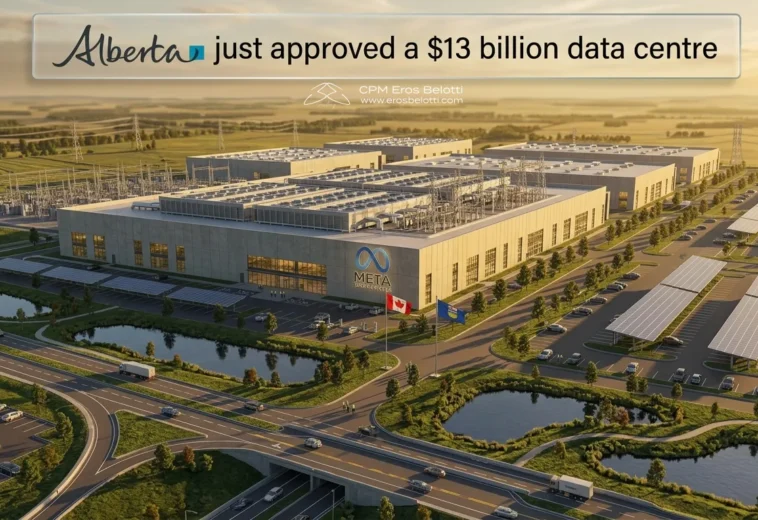
In July 2026 Meta confirmed its first Canadian data centre, in Sturgeon County north of Edmonton, with an investment of more than $13 billion, excluding computing equipment and the power plant. It is a major project by any standard: over 3,000 construction jobs at peak, about 300 permanent jobs and a campus that will draw up to 1,800 MW at full build-out. But the bigger signal for Alberta’s construction industry is not this single project. It is the pipeline forming behind it.
This article reviews what the Meta project includes, what the provincial data say about the wider data centre pipeline and what it means for contractors, consultants and developers.
The Meta project in numbers
According to the Government of Alberta’s data centre figures:
- Investment: more than $13 billion by Meta, excluding AI chips and the power plant.
- Power: 970 MW approved for Phase 1 by the Alberta Electric System Operator (AESO), and about 1,800 MW at full build-out.
- Dedicated generation: the Greenlight natural gas power plant, about 932 MW, estimated at $4.6 billion, built by Pembina, Morgan Stanley Infrastructure Partners and Kineticor.
- Site: about 1,750 acres and roughly 2.9 million square feet of facility space.
- Jobs: 3,000+ construction jobs at peak and 300 permanent operating jobs.
- Local infrastructure: about $60 million committed to roads and water in Sturgeon County.
The pipeline behind it
The province reports that about 19,565 MW of new data centre load was seeking connection on AESO’s large-load list as of July 30, 2026. For context, Alberta’s record peak internal load was 12,785 MW in December 2025, and AESO’s interim limit for new large-load connections in its first phase, 1,200 MW, is already fully allocated.
One caveat is essential: these are connection requests, not approvals or confirmed projects. Many will not proceed. But even a small share of that queue would represent years of construction activity in civil works, power generation and transmission, mechanical and electrical systems and building construction.
In December 2024 the province set a goal of attracting $100 billion in data centre investment within five years. Meta’s project is the largest single step toward that goal so far.
What data centres need from construction
Civil and site works
Large sites require grading, roads, drainage, water and wastewater infrastructure, often in rural or semi-rural areas.
Power infrastructure
Generation plants, substations, transmission connections and on-site electrical distribution are among the most complex and time-critical packages.
Building shells and fit-out
Data halls, support buildings and offices are built quickly and to precise specifications, often in phases.
Mechanical and cooling systems
Cooling is central to data centre performance and represents a large share of mechanical work.
Commissioning
Integrated systems testing is rigorous, and documentation must be precise.
Opportunities across the supply chain
Few firms will lead a data centre project of this size, but many can participate: civil contractors, electrical and mechanical subcontractors, steel and concrete suppliers, surveyors, CAD and BIM providers, commissioning agents, safety consultants and workforce accommodation providers. Firms that position themselves on this supply chain now, through prequalification, partnerships and specialised capability, are the ones likely to be busy in 2027 and 2028.
The constraints
Labour
A single project needing more than 3,000 workers at peak competes with housing, institutional and energy projects. BuildForce Canada projects Alberta must add 48,800 construction workers by 2035.
Power and water
Grid capacity, generation and water access shape where projects can locate. The province notes that some southern river basins have been closed to new surface water licences since 2006.
Approvals and community acceptance
Not every proposal succeeds. In September 2025 Rocky View County council voted against the land use change for a proposed 1,100-acre data centre campus, and the Alberta Utilities Commission has closed at least one power plant application for incomplete filing before it was resubmitted.
Equipment lead times
Transformers, switchgear and cooling equipment can have long lead times that drive schedules.
What it means for the wider market
Data centre construction pulls specialised trades, especially electricians, toward large projects. That can keep costs elevated for other sectors even as residential activity slows. It also creates demand for workforce housing and services in surrounding communities and supports local tax bases: the Sturgeon County mayor has estimated more than $40 million a year in property taxes.
How firms can prepare
- Identify which data centre packages match your capabilities.
- Prepare prequalification documents, safety records and references.
- Partner with firms experienced in mission-critical facilities.
- Invest in quality, documentation and commissioning capability.
- Plan workforce capacity realistically before bidding.
Lessons from other data centre markets
Regions in the United States and Europe that experienced rapid data centre growth show a common pattern: early projects create demand for specialised electrical and mechanical capacity, local labour becomes scarce, and power and water availability quickly become the deciding factors for new projects. Communities also become more selective about land use, noise and resource consumption. Alberta’s advantages in natural gas and land are significant, but the experience elsewhere suggests that grid capacity, community acceptance and skilled labour will shape how much of the queue becomes real construction.
The bottom line
Meta’s $13 billion project is a strong signal that capital is choosing Alberta. The data centre queue suggests a multi-year pipeline in civil, power, cooling and building construction, although much of it remains uncertain. The question for Alberta’s construction industry is who is ready to build it.
If you are preparing to pursue data centre or other large non-residential work and want help with project controls and documentation, see my construction project management services, read about where Alberta construction demand is moving, or contact me. Are you seeing this pipeline turn into real tenders yet?
Frequently asked questions
How much is Meta investing in Alberta?
More than $13 billion in its Sturgeon County data centre, excluding computing equipment and the dedicated power plant.
How many construction workers will the Meta data centre need?
More than 3,000 at peak construction, with about 300 permanent operating jobs.
How large is Alberta’s data centre queue?
About 19,565 MW of new data centre load was seeking connection on AESO’s large-load list in July 2026. These are requests, not approvals.
Sources
- Government of Alberta: AI data centres by the numbers
- HRD Canada: Meta breaks ground on first Canadian data centre
- BuildForce Canada: Alberta outlook 2026 to 2035
- 167 views
- 1 Comment

Eros Belotti 01.

Eros belotti
Construction project manager with over 20 years of experience in Europe and the Canary Islands. Specialized in modular housing, container construction, real estate development and international project management. Founder of Reforma Vivienda Tenerife and Donkey Lab.



July 9, 2026 /
Artificial intelligence is transforming the global economy, and Alberta is making sure we lead rather than follow.” — Premier Danielle Smith, on the Meta announcement.
Her framing says it all: this isn’t just one facility. It’s a bet that Alberta becomes the place where AI infrastructure gets built. For anyone in construction and development, that bet is the opportunity.
Full announcement → https://datacenters.atmeta.com/2026/07/hello-sturgeon-county/