
Texas Housing Market 2026: Austin vs Dallas, Decoded
Many people describe the 2026 Texas housing market as a slowdown. The data tell a more nuanced story. Sales are rising, but prices are soft, and the two biggest metros are sending different signals. According to the Texas A&M Real Estate Research Center, statewide home sales in June 2026 were up 8.6% year over year, while prices were slightly below year-ago levels, extending a decline that began in mid-2025. Demand did not leave. What changed is the buyer, and many builders have not yet changed the product.
This article compares Austin and Dallas-Fort Worth, explains why the narrowing gap between new and existing home prices matters, and sets out what developers should do differently in feasibility.
Austin: more sales, weaker prices
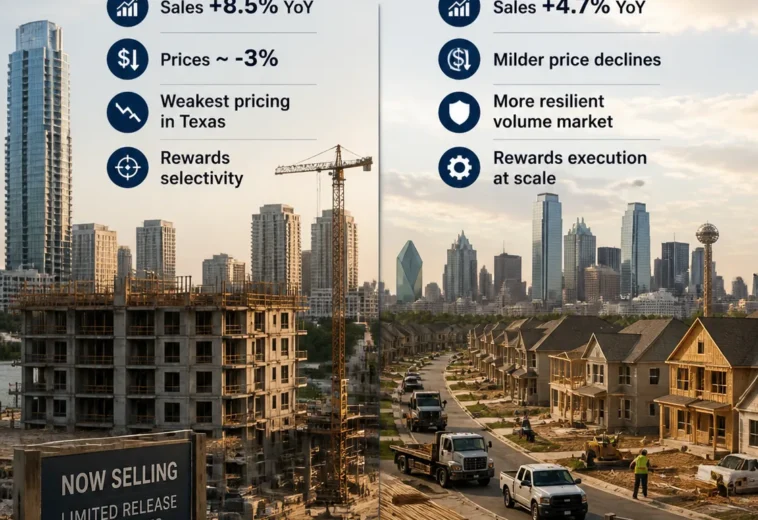
Austin is the state’s most price-sensitive major market. The Research Center reported Austin’s year-to-date sales running 8.7% above the previous year’s pace, yet home prices fell 2.2% year over year in June, the steepest decline among the metros it cited. Monthly data from Unlock MLS for August 2026 showed the Austin metro median price at $412,000, down 6.4% year over year, with sales down 7.3% in that month and homes selling at about 93% of list price in the city. Inventory had risen earlier in the year, with the Research Center reporting Austin listings up 7.3% in spring.
Austin punishes anything mispriced or poorly matched to buyers. It rewards selectivity: the right location, the right size and a price that reflects today’s market rather than the peak.
Dallas-Fort Worth: steadier
Dallas-Fort Worth has shown milder price declines and signs of stabilisation. The Research Center noted that Fort Worth-Arlington posted consecutive months of year-over-year price gains and that Dallas-Plano showed signs of stabilising, while new listings trailed the previous year. DFW’s larger and more diversified economy, together with continued corporate relocations and major projects such as the Texas A&M-Fort Worth campus, supports steadier demand.
Dallas rewards operators who can execute at volume on the right product: efficient construction, attainable price points and good locations along growth corridors.
One state, two markets
Reading Austin and DFW as one market leads to the wrong product in both. A strategy that works in DFW, building at scale in expanding suburbs, can struggle in Austin, where buyers are highly sensitive to price and competing resale inventory. A product designed to compete in Austin’s selective market may leave margin on the table in parts of DFW.
The vanishing new-home premium
One of the most important structural shifts is the gap between new and existing home prices. According to research economist Yanling Mayer of the Texas A&M Real Estate Research Center, quoted by Spectrum News in July 2026, the gap between new builds and resales in Texas has narrowed to just above $15,000, compared with about $100,000 before the pandemic.
When new homes cost almost the same as resales, builders lose the premium that used to cover higher construction costs. Buyers compare a new home directly with an existing one in a similar location, and builders compete on price, incentives and value rather than on newness alone.
Where the edge moves
When the new-home premium disappears, competitive advantage shifts from location or design alone to precision in feasibility:
- Cost per square foot: tight control of construction cost, often through simpler designs and standardised components.
- Square footage: right-sizing homes so total price fits buyer budgets.
- Product target: designing for the buyer who is actually in the market now, such as first-time buyers, move-down households or investors seeking rentals.
- Incentives: budgeting realistically for rate buy-downs and closing cost assistance.
These decisions are made at month zero, in the feasibility study, not during sales.
How to adapt feasibility for Texas in 2026
- Use metro- and submarket-specific data, never statewide averages.
- Compare your target price with resale homes of similar size and location.
- Test smaller home sizes and alternative layouts against buyer budgets.
- Include incentives and longer sales periods in the pro forma.
- Stress-test against further price softening, especially in Austin.
Lessons for other markets
The Texas experience offers a lesson for builders elsewhere, including Alberta. When a market adds a large volume of new homes in a short period, the premium for new construction erodes and resale inventory becomes the main competitor. Builders who design for current buyers, control costs tightly and price realistically keep selling; those who rely on the market of two years earlier accumulate inventory. Reading each metro separately and acting on the data early is the common thread.
What builders are doing differently
Builders that are selling steadily in 2026 share some common practices: smaller and more efficient floor plans, standardised specifications that reduce cost and construction time, transparent incentive programs that help buyers with financing, and land positions in corridors where employment is growing. They also adjust launch pace to absorption, releasing phases only when earlier homes are selling, rather than building speculative inventory that must later be discounted.
The bottom line
2026 is not testing who can wait out a slowdown. It is testing who built the right thing for the buyer who is actually here. Austin and Dallas-Fort Worth are two different markets, and the shrinking gap between new and resale prices means precision in cost, size and product now matters more than ever.
If you are evaluating a residential project in Texas and want a second read on the feasibility, see my feasibility services, read about Fort Worth and the Texas A&M campus, or contact me. Are you reading Austin and Dallas as one market, or two?
Frequently asked questions
Are home prices falling in Texas in 2026?
Slightly. Statewide prices in June 2026 were about 0.4% below a year earlier, while sales rose 8.6%, according to the Texas A&M Real Estate Research Center.
Is Austin or Dallas the stronger market?
Dallas-Fort Worth has shown steadier prices, while Austin has seen the steepest price declines among major Texas metros despite rising sales.
What is the new-home premium in Texas?
The gap between new and existing home prices has narrowed to just above $15,000, compared with about $100,000 before the pandemic.
Sources
- Texas Housing Insight, August 2026 (Texas A&M Real Estate Research Center data)
- Spectrum News: Texas housing outlook (July 2026)
- Hoodline: Austin home sales in August 2026 (Unlock MLS data)
- 105 views
- 0 Comment

Eros Belotti 01.

Eros belotti
Construction project manager with over 20 years of experience in Europe and the Canary Islands. Specialized in modular housing, container construction, real estate development and international project management. Founder of Reforma Vivienda Tenerife and Donkey Lab.